The Prescription Your Phone Can Write
AI, the Body After 60, and the Tools That Actually Exist
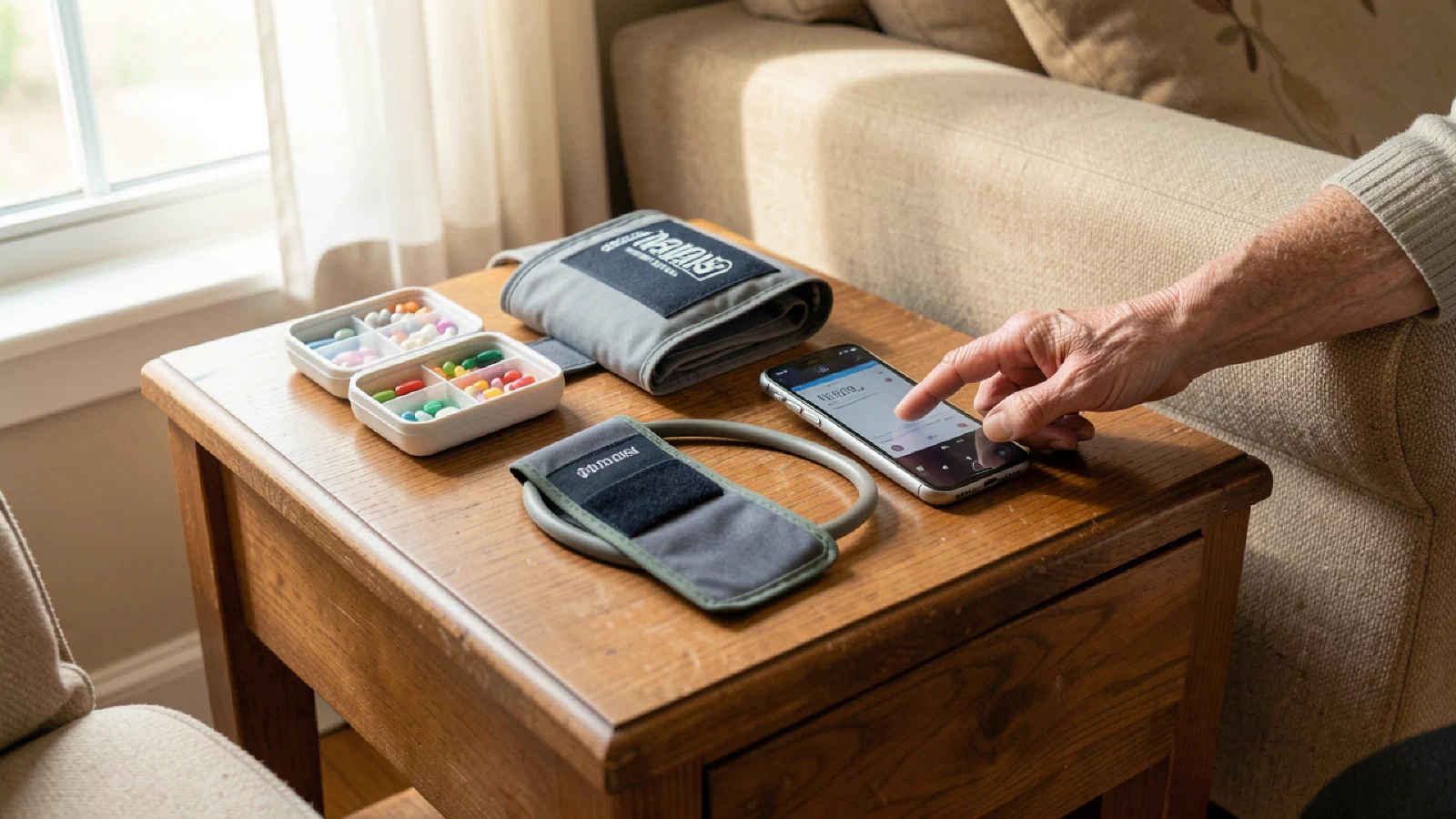
Linda’s kitchen table looks like a small pharmacy. Seven prescription bottles arranged in a rough arc, a blood pressure cuff folded beside them, a glucose monitor in its zip case, three paper bags from three different pharmacies, and a handwritten schedule she updates every time something changes. She is 71, sharp, and still working part-time as a bookkeeper. She manages her own medications the way she manages accounts: methodically, carefully, and with the full awareness that she is the only person who can see the whole picture.
Last month she ended up in the emergency room. A doubled dose of a blood pressure medication, easy to miss when her cardiologist adjusted the dose and her primary care physician hadn’t yet received the note. Her doctors are not negligent. None of them made a mistake inside their own domain. But no one owns the view from Linda’s kitchen table, where all seven medications exist in the same room at the same time, and where one small miscommunication becomes a 911 call.
This is the first installment of a series that asks what can actually be built. Not what will be possible in some brighter future, but what tools exist right now, what is genuinely close, and what requires a different kind of change than any app can provide. We start where the evidence is most concrete: the body, and the daily infrastructure of managing it.
The medication problem nobody owns
Blue Gray Matters covered polypharmacy in BGM-3G. The short version: nearly half of adults over 65 take five or more prescription medications, and the problems compound in ways no single prescriber is positioned to catch. A cardiologist prescribes within the heart. A rheumatologist prescribes within the joints. An endocrinologist prescribes within the blood sugar. The pharmacist catches the obvious interactions that software flags. The subtle cascading effects, the ones where a mild dizziness from one medication increases fall risk, which leads to a fracture, which leads to a hospitalization, which introduces an infection, which starts a different cascade entirely, those slip through.
The structural problem is simple and intractable: no one is paid to see the whole patient.
What exists now is more useful than most people realize. Smart pill dispensers, the kind that sort daily doses into compartments and send alerts to family members when a dose is missed or taken twice, have been on the market for years. They range from around $60 for simple single-compartment models to $800 or more for fully automated dispensers that lock medications and unlock only at scheduled times. They work as advertised. They are not exciting technology. They significantly reduce missed and doubled doses in people managing complex regimens.
Medication management apps like Medisafe and MyTherapy allow users to photograph their pill bottles, log doses, and receive interaction checks. They are not perfect; they rely on the user having an accurate and complete medication list, which is exactly the part that is hard to maintain across multiple prescribers. But they are free, available on most smartphones, and meaningfully better than a handwritten schedule as a safety net.
What most seniors don’t know: Medicare Part D includes a program called Medication Therapy Management, or MTM. If you take eight or more chronic medications and have three or more qualifying conditions, you are likely eligible for a free comprehensive medication review, conducted by a pharmacist, that looks at your full list for interactions, duplications, and dosing problems. You have to ask for it. Your plan may not tell you. According to the Centers for Medicare and Medicaid Services, roughly two-thirds of eligible beneficiaries never receive this review.
This is not a technology problem. It is an information problem, and it is solvable tomorrow morning with one phone call to your Part D plan.
What is genuinely close: AI-powered medication reconciliation that pulls from multiple pharmacy records and electronic health systems to build a complete medication list automatically, then runs interaction checks against that complete list in real time. Several health systems are piloting this. The technology works in controlled settings. The barrier is interoperability: your cardiologist’s EHR and your rheumatologist’s EHR often cannot speak to each other, so the AI has the same partial-picture problem the human prescribers have. That barrier is not technical. It is contractual and political.
What requires structural change: a single entity, human or automated, with both the data access and the clinical authority to review and reconcile a patient’s complete medication picture. Until someone owns this function and someone pays for it, Linda’s kitchen table remains the most sophisticated medication management system in her life. It should not be.
Remote monitoring: what Medicare is changing and why it matters
Remote Patient Monitoring, or RPM, covers devices that collect health data at home and transmit it to a clinical team for review. Blood pressure cuffs, glucose monitors, pulse oximeters, weight scales. Medicare has covered RPM for years, but coverage was inconsistent and billing was complicated enough that many small practices didn’t bother.
That is changing. The ACCESS model, scheduled for broader implementation in July 2026, is the most significant expansion of RPM reimbursement in Medicare’s history. Under it, primary care practices participating in the model will receive payment for setting up monitoring programs, reviewing data, and responding to alerts. The intent is to catch deterioration early, before it becomes an emergency department visit.
The outcome evidence is genuine. Multiple trials show that RPM programs reduce hospitalizations for heart failure, COPD, and hypertension. The effect sizes are meaningful, not transformative, but meaningful. A 2023 Cochrane review found RPM reduced heart failure hospitalizations by roughly 20 percent compared to usual care. That is significant if you are the one who would have been hospitalized.
The caveat worth naming: monitoring and managing are not the same thing. A device that transmits your blood pressure to a clinical team is only useful if that team has the capacity to review the data and act on it. Many practices setting up RPM programs are doing so with existing staff, which means the data often gets reviewed during office hours, which means the 2 AM reading that should have triggered a call sometimes doesn’t until Tuesday. The technology exists. The clinical workflow to use it well is still catching up.
If you have a chronic condition managed by a primary care physician, asking whether they offer RPM and whether you qualify is worth the conversation. If they don’t, it is reasonable to ask why, particularly after mid-2026 when the ACCESS model is in wider effect.
Fall detection: the honest assessment
The fall detection market is enormous and partially built on fear. Devices marketed to older adults often lead with the scenario of lying on the floor for hours, unable to reach a phone. This is a real risk: falls are the leading cause of injury death in adults over 65, and the time between a fall and discovery meaningfully affects outcomes. The fear is legitimate. What the marketing often does not address is how well detection actually works.
Wearable fall detection devices, including smartwatches from Apple and other manufacturers, use accelerometers to identify the pattern of a fall. Independent studies have found detection rates for genuine falls between 70 and 90 percent, with false positive rates that vary considerably by activity level. A person who gardens, plays tennis, or moves energetically through the day may find their device generating frequent false alarms, which causes people to stop wearing them. A device you take off because of false alarms does not detect your fall.
Ambient detection systems, which use radar or infrared sensors installed in the home rather than devices worn on the body, have higher detection rates in controlled settings and do not require the person to wear anything. Companies like Amazon and several smaller firms now offer these. The privacy trade-off is real: radar that detects falls also detects sleep patterns, breathing rates, and activity throughout the home. For someone who lives alone and wants the safety net, that trade-off may be straightforward. For others it is not.
The gap that detection does not close is prevention. Knowing that someone has fallen is not the same as reducing the risk that they will. BGM-3E covered the evidence on fall prevention: strength and balance training, medication review for medications that increase fall risk, home hazard assessment. These interventions are less marketable than a device, and they work. The most effective fall intervention is the one that prevents the fall from happening.
The two-to-three year horizon
Several technologies are close enough to matter for people who are planning, even if they are not available today.
Ambient radar-based monitoring, already in early commercial deployment, is moving toward full-home coverage that can detect not just falls but gait changes over time. A change in walking speed or stride pattern often precedes a fall or a cognitive decline event by months. Capturing that change early enough to intervene is the promise. Clinical validation studies are underway; the technology is not yet ready for broad recommendation, but it is not fantasy.
AI-powered gait analysis from smartphone cameras is in active development at several university medical centers. The idea is that a phone propped on a counter could analyze how someone walks and flag changes that warrant clinical attention, without specialized hardware, without subscriptions, without a wearable. If the clinical validation holds, this could become the most accessible version of a monitoring tool yet: the device most seniors already have, doing something genuinely useful.
Continuous glucose monitoring, long standard for people with insulin-dependent diabetes, is expanding toward broader use for people with prediabetes and metabolic concerns. Abbott’s Libre and Dexcom’s sensors are now available without a prescription for over-the-counter purchase in the United States. The cost remains significant, around $75 to $100 per month without insurance coverage, but coverage is expanding as evidence accumulates.
What you can do tomorrow
These are not abstract suggestions. They are specific, concrete, and require no new technology to start.
Call your Medicare Part D plan and ask whether you qualify for a Medication Therapy Management review. If you take eight or more chronic medications and have multiple conditions, the answer is likely yes. Ask for the comprehensive medication review, not just the targeted medication review.
Write down every medication you take, including over-the-counter drugs, supplements, and vitamins, and bring that complete list to your next appointment with every specialist you see. Ask each of them whether they have access to your full list. If the answer is no, that is a gap worth naming.
Ask your primary care physician whether their practice offers Remote Patient Monitoring and whether your conditions would qualify. If you already own a blood pressure cuff or glucose monitor, ask whether that device can be integrated into a clinical monitoring program.
If you are considering a fall detection device, look for one with independent accuracy data, not just manufacturer claims. Understand the false positive rate for someone with your level of physical activity. Consider whether you will actually wear it every day before committing to the subscription.
Linda’s kitchen table is still the most comprehensive view of her health. That shouldn’t be true. What she did this week: she called her Part D plan, found out she was eligible for MTM, and has an appointment with a pharmacist next Tuesday. Her doctors didn’t know she hadn’t had that review. They assumed someone else had handled it. No one had.
That is the technology gap that matters most right now. Not the radar sensors or the AI gait monitors, useful as those may become. It is the gap between what already exists, paid for, available, and underused, and the people who need it most and don’t know to ask.
The best medication management system for Linda is still the kitchen table. But the table, at least, now has a second opinion.
Related reading: BGM-3G (Polypharmacy and the Cascade), BGM-3A (The Heart of the Matter), BGM-1C (The Pharmacy Trap), BGM-5B (Smart Homes, Stubborn Homes), BGM-10E (Broadband as a Lifeline)
Blue Gray Matters is an independent publication. We have no financial relationship with any product, device, or service mentioned here.
How this article connects to others in Blue Gray Matters.
Sources cited in this article.
- Centers for Medicare & Medicaid Services. "Medication Therapy Management." CMS, 2024.
- U.S. Food and Drug Administration. "FDA Clears First Blood Test Used in Diagnosing Alzheimer's Disease." FDA News Release, 16 May 2025.
- Centers for Medicare & Medicaid Services. "ACCESS Model: Ambulatory Specialty Care Empowerment for Seniors." CMS Innovation Center, Dec. 2025.
- Inglis, Sally C., et al. "Structured Telephone Support or Non-Invasive Telemonitoring for Patients with Heart Failure." Cochrane Database of Systematic Reviews, vol. 10, 31 Oct. 2015, CD007228.
- Centers for Disease Control and Prevention. "Older Adult Fall Prevention." CDC, 2024.
- Chen, Mu-Chen, et al. "Accuracy of Smartwatch-Based Fall Detection in Real-World Settings: A Systematic Review." JMIR mHealth and uHealth, vol. 11, 2023, e44248.
- Maher, Robert L., et al. "Clinical Consequences of Polypharmacy in Elderly." Expert Opinion on Drug Safety, vol. 13, no. 1, Jan. 2014, pp. 57-65.
- U.S. Food and Drug Administration. "Over-the-Counter Continuous Glucose Monitors." FDA Press Announcement, Mar. 2024.
- Centers for Medicare & Medicaid Services. "Remote Patient Monitoring CPT Codes and Billing Guidance." Medicare Learning Network, 2024.