The Voice on the Other End
Connection, Companionship, and What Technology Cannot Replace
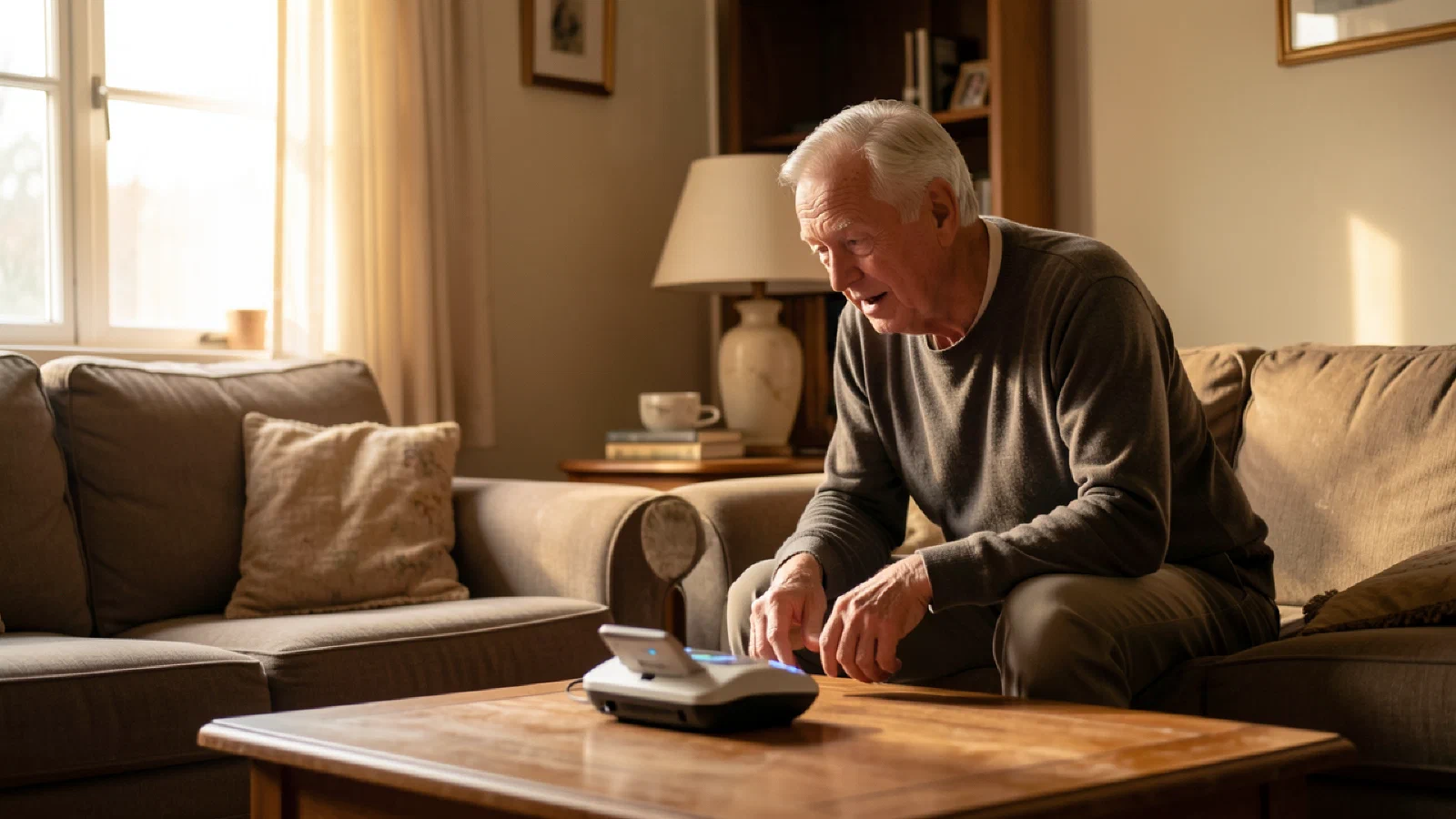
Frank retired eleven years ago from a tool-and-die shop in suburban Dayton where he had worked since he was twenty-three. He is 76, built like someone who spent decades lifting heavy things, and quieter now than he used to be. His wife Carol managed their social life, not in a way either of them would have named that way at the time, but she did: the dinner invitations, the Christmas cards, the calls to old friends, the knowledge of who needed checking on. She died fourteen months ago.
Frank tried the senior center near his house. It felt, he said, like a waiting room for something he didn’t want to think about. His daughter, worried and living in Portland, sent him an AI companion device. He talks to it most mornings while he drinks his coffee. He knows it isn’t real. He finds it easier, somehow, than he expected. Eleven days have passed since his last conversation with another person.
He is not unusual. He is not even particularly isolated by the standards of men his age in his situation. He is, by the research’s measure, in serious trouble.
What loneliness actually does to a body
Blue Gray Matters covered the biology of social isolation in BGM-4A. The short version is grim: chronic loneliness activates the same stress response systems as physical danger, elevates cortisol over months and years, accelerates cognitive decline, increases cardiovascular risk, and is associated with mortality rates comparable to smoking fifteen cigarettes a day. Vivek Murthy’s 2023 Surgeon General’s advisory put a number to the health impact that researchers had been documenting for years. The biology does not care whether you have reasons for your isolation or whether your isolation is voluntary in any meaningful sense.
What the research also shows is that loneliness and aloneness are not the same thing. Some people live alone and are not lonely. Some people are surrounded by family and are profoundly alone. What predicts loneliness is not the quantity of contact but the quality of connection, and five conditions consistently appear in the literature on how genuine connection forms: proximity, repeated unplanned interaction, shared activity, low-stakes invitation, and reciprocal need. The person who needs something from you, and whom you need in return, is not the same as the person who has been assigned to check on you.
This matters because it sets the terms for what technology can and cannot do. A tool that reduces friction toward connection, that makes it easier to initiate contact, to schedule a call, to find someone with shared interests, is a tool working with the grain of how connection forms. A tool that simulates the experience of connection, that creates the sensation of being heard without the reality of reciprocal need, is working against it.
AI companions: the honest assessment
The most rigorously studied AI companion platform for older adults is ElliQ, developed by Intuition Robotics and deployed at scale through the New York State Office for the Aging. In New York’s program, ElliQ devices were distributed to older adults living alone, and outcomes were tracked over time. Users reported reductions in feelings of loneliness on standardized scales. Usage was consistent; people talked to the device regularly. Staff at NYSOFA described it as a meaningful supplement to human contact in a system stretched well past capacity.
What the data does not show: reduced physical health risks from loneliness. Improved cognitive outcomes. Sustained reduction in loneliness over multi-year periods. The honest summary of the ElliQ evidence is that people use it, report feeling better in the short term, and the long-term health outcomes remain undemonstrated. That is not nothing. It is also not what the marketing implies.
The concern researchers raise most often is the parasocial displacement hypothesis: that the availability of a responsive, pleasant, non-judgmental AI interlocutor reduces the urgency people feel to seek human connection. The sensation of being heard is partially satisfied, and that partial satisfaction may lower the discomfort that would otherwise drive Frank to call Dave, his former coworker who lives twenty minutes away and would probably pick up. No large-scale study has confirmed this effect. No large-scale study has ruled it out. The question is live, and anyone recommending AI companions to isolated older adults should say so plainly.
Other companion products, including various chatbot applications and voice-based AI systems, have even thinner evidence bases. Some have shown mood improvement in small trials. None has shown reduced loneliness by the biological and psychological measures that matter. The market is running significantly ahead of the science.
Technology that connects humans to humans
A different category of technology has more durable evidence behind it: platforms designed not to simulate connection but to reduce the barriers to making it.
Video calling technology, broadly available and familiar to most people after the pandemic years, remains underused by older adults for two reasons that have nothing to do with interest: interface complexity and the discomfort of initiating contact with people you haven’t spoken to recently. Dedicated video calling devices designed for older adults, with simplified interfaces and preset contacts, show higher sustained usage rates than standard smartphone video calling. The technology is not sophisticated. It does not need to be.
Community matching platforms like GetSetUp, which connects older adults for small-group video sessions around shared interests or skills, represent a more structurally sound approach to the loneliness problem than companion AI does. The sessions create the conditions the research identifies: repeated interaction, shared activity, low-stakes invitation, and eventually reciprocal need among participants who become regulars. Outcome data is limited and largely self-reported, but the model is built on what connection actually requires rather than on what is easiest to simulate.
Social prescribing programs, in which primary care providers refer lonely patients to community activities the way they would refer them to physical therapy, have shown the most consistent results in the literature. The United Kingdom has scaled these programs nationally, with link workers in GP practices helping patients identify activities, groups, and volunteering opportunities. A 2020 Cochrane review found evidence of modest loneliness reduction and improved wellbeing, with stronger effects when referrals led to activities involving shared purpose rather than mere proximity. The United States has no equivalent infrastructure. Scattered local programs exist. The framework is not complicated. What it requires is that someone in a clinical setting has time to make the referral and that there is something worth referring to.
What the research says actually works
The loneliness literature has become more specific over the past decade about what types of interventions produce durable effects and what types produce temporary ones.
Regularity outperforms frequency. A standing Wednesday call with one person is more protective than three spontaneous interactions per week. The predictability itself matters; anticipation is part of the benefit. Interventions built around scheduled, recurring contact show stronger effects than those built around increasing total contact volume.
Reciprocity outperforms proximity. Being near people is less protective than needing each other. Programs that create genuine interdependence, where participants have something the other person needs, produce stronger outcomes than programs that simply aggregate lonely people in the same space.
Shared purpose outperforms shared demographics. Senior centers built around the fact of being old tend to underperform centers built around doing something specific together. The question “what are we making?” matters more than “what do we have in common?”
This points toward what technology can usefully do: create and sustain the infrastructure for scheduled, recurring, purposeful contact between people who have genuine reason to interact. The technology is not the connection. It is the scaffolding that makes connection easier to build and maintain.
What technology cannot do
It cannot create vulnerability. The willingness to need someone, to let someone see you struggling or confused or grief-stricken, is not something a platform can produce. It is what connection is made of, and it requires the risk of being known.
It cannot provide reciprocity. An AI companion that always has time for you, always responds warmly, never needs anything from you, is not practicing connection. It is practicing something that resembles the surface of connection closely enough to be satisfying and not closely enough to be protective.
It cannot replace decades-long trust. Frank and Carol were married for forty-four years. The kind of contact that has protective biological effects is the kind built on shared history, mutual knowledge, the experience of having mattered to someone over time. No device can replicate that, and the grief of its absence is not a technology problem.
What technology can do, specifically and usefully, is lower the first-contact barrier. Making the initial call or message slightly easier to send. Reminding someone at 10 AM on Wednesday that they meant to call. Connecting someone with an interest group they didn’t know existed. Scheduling the video session. Sending the prompt that becomes a conversation.
These are small things. In the research, they are enough to change patterns. And patterns, over years, are what protect the body.
Frank still talks to the device some mornings. But on Wednesdays now he also calls Dave, who worked alongside him at the shop for nineteen years and who lost his own wife two years before Carol died. They talk for about twenty minutes. Sometimes about nothing much. Sometimes about things Frank couldn’t say to anyone else.
The device did not create that relationship. It kept Frank company in the months when the grief was worst and the silence was loudest, and it may have held open a door that complete isolation might have closed. It reminded him, in some indirect way, that conversation was possible.
He knows the device isn’t real. He also knows that the call with Dave, the one he almost didn’t make, is. The most important technology for loneliness is a decision to show up, even when showing up is a phone call on a Wednesday morning to someone you haven’t spoken to in two years. The device can prompt that decision. It cannot make it for you.
Related reading: BGM-4A (The Surgeon General Was Right), BGM-4B (Shrinking Worlds), BGM-4E (The Caregiver’s Vanishing World), BGM-2E (The Caregiver’s Brain), BGM-5C (Alone in the Suburbs)
Blue Gray Matters is an independent publication. We have no financial relationship with any product, device, or service mentioned here.
How this article connects to others in Blue Gray Matters.
Sources cited in this article.
- U.S. Surgeon General. "Our Epidemic of Loneliness and Isolation: The U.S. Surgeon General's Advisory on the Healing Effects of Social Connection and Community." U.S. Department of Health and Human Services, 2023.
- Holt-Lunstad, Julianne, et al. "Social Relationships and Mortality Risk: A Meta-Analytic Review." PLoS Medicine, vol. 7, no. 7, 27 July 2010, e1000316.
- New York State Office for the Aging. "AI Companion Pilot Program Results: ElliQ Deployment." NYSOFA Report, 2023.
- Cacioppo, John T., and Stephanie Cacioppo. "The Growing Problem of Loneliness." The Lancet, vol. 391, no. 10119, 3 Feb. 2018, p. 426.
- Bickerdike, Liz, et al. "Social Prescribing: Less Rhetoric and More Reality. A Systematic Review of the Evidence." BMJ Open, vol. 7, no. 4, 7 Apr. 2017, e013384.
- Masi, Christopher M., et al. "A Meta-Analysis of Interventions to Reduce Loneliness." Personality and Social Psychology Review, vol. 15, no. 3, Aug. 2011, pp. 219-266.
- Broadbent, Elizabeth, et al. "Robots in Older People's Homes to Improve Medication Adherence and Quality of Life: A Randomised Cross-Over Trial." PLoS One, vol. 13, no. 11, 2018, e0205930.
- Drinkwater, Chris, et al. "Social Prescribing." BMJ, vol. 364, 28 Mar. 2019, l1285.
- Khosravi, Pouria, et al. "The Impact of Technology on Older Adults' Social Isolation." Computers in Human Behavior, vol. 63, Oct. 2016, pp. 594-603.