The Hidden Economy of Caregiving
The Unpaid Labor Crisis Behind Growing Old in America
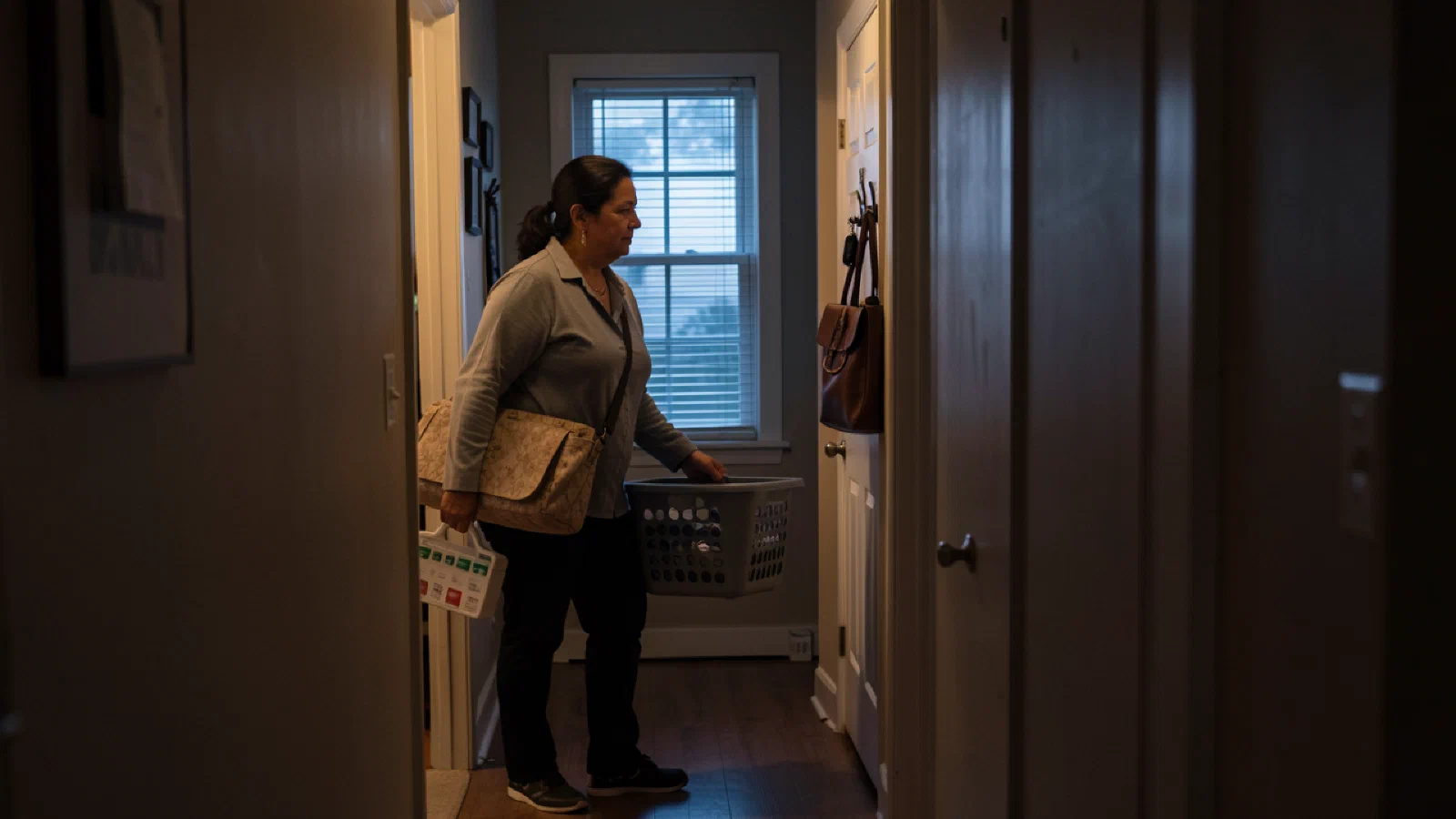
She is up at 5:40 because her mother needs to use the bathroom and cannot get there alone. The transfer from bed to wheelchair takes practice and patience and a lower back that has been complaining for months. Then the morning medications: the blood pressure pill, the thyroid pill, the Aricept, the vitamin D, the stool softener that the gastroenterologist added last month, all sorted into the plastic organizer she fills every Sunday night. Breakfast is oatmeal because her mother can still manage a spoon most days. While her mother eats, she answers two emails from work, apologizes for missing yesterday’s 4:00 meeting, and starts a load of laundry that includes sheets she changed at 2 AM.
By 8:15 she has dressed her mother, called the pharmacy about a prior authorization denial, left a message for the neurologist’s office, and packed a lunch for the home aide who arrives at 9:00 and costs $28 an hour out of pocket. She drives to work. At noon she will call to check in. At 5:30 she will drive home, relieve the aide, cook dinner, manage the evening medications, help her mother to bed, and sit down at the kitchen table for the first time all day. She will not mention that she skipped her own doctor’s appointment again, the third time this year.
This is not the version of caregiving that appears in public service announcements or political speeches. There is no soft lighting. There is no music. There is a woman in her mid-fifties whose own retirement savings have stopped growing, whose career has stalled, whose marriage is strained, and whose blood pressure has been climbing for a year. She does this work because she loves her mother and because no one else is going to do it. She is not unusual. She is one of 63 million.
The Scale of an Invisible Economy#
The AARP and National Alliance for Caregiving published their most recent national caregiving survey in July 2025. The headline number was 63 million: one in four American adults now provides unpaid care to someone with a chronic, disabling, or serious health condition. That figure represents a nearly 50% increase from 2015, when the count was 43.5 million. The growth reflects an aging population, longer lifespans, rising rates of chronic disease, and a formal care system that cannot meet demand.
The economic value of this unpaid labor is staggering. AARP’s Valuing the Invaluable report estimated that in 2021, family caregivers contributed approximately $600 billion worth of unpaid care, based on 36 billion hours at an average imputed value of $16.59 per hour. That figure exceeds total Medicaid spending. It exceeds all out-of-pocket healthcare spending in the country. And it is conservative: it does not account for the complexity of the care provided, the out-of-pocket expenses caregivers absorb, or the wages they forfeit.
The demographics tell a familiar story about who carries this weight. The majority of caregivers are women. They are disproportionately people of color. Nearly a third are sandwich generation caregivers, supporting both children and aging parents simultaneously. Seven in ten are also employed, though “employed” often means working reduced hours, turning down promotions, or leaving jobs entirely when the care demands become unmanageable.
Over 40% of caregivers now provide what the AARP report classifies as high-intensity care. Many perform medical tasks that would require licensing in a clinical setting: administering injections, managing catheters, operating medical equipment, handling wound care. Only 22% report receiving any training for this work. The system hands families clinical responsibilities and walks away.
What Caregiving Costs the Caregiver#
The financial damage is the most measurable and the least surprising. Half of all caregivers report at least one negative financial impact from caregiving. A quarter are taking on debt. One in five cannot afford basic necessities, including food. On average, family caregivers spend more than $7,200 per year on out-of-pocket caregiving costs, absorbing expenses the formal system does not cover: home modifications, medical supplies, transportation, supplemental aides, adult day programs.
The less visible costs accumulate over years. A woman who reduces her hours at 52 to care for a parent and does not return to full-time work until 60 has lost eight years of peak earning potential, eight years of 401(k) contributions, eight years of employer matching, and eight years of Social Security credits. The retirement security she spent decades building erodes while she is busy keeping someone else alive. The Rand Corporation has estimated that family caregivers collectively forfeit $522 billion in wages annually. That number dwarfs what most policy proposals contemplate in caregiver support.
The health consequences are equally severe. A landmark 1999 study by Richard Schulz and Scott Beach, published in JAMA, found that elderly spousal caregivers experiencing emotional strain had mortality risks 63% higher than non-caregiving controls. Subsequent research has reinforced the pattern: depression, anxiety, cardiovascular disease, immune dysfunction, and chronic pain are all elevated among caregivers, particularly those providing high-intensity care over extended periods. One in five caregivers in the 2025 AARP survey reported their own health as fair or poor. Nearly 40% reported high emotional stress.
Then there is the social cost, the one that rarely appears in economic models. Caregiving is isolating. Friendships recede. Social activities disappear. The caregiver’s world contracts to the orbit of the person they are caring for, and the loneliness compounds the depression, which compounds the health effects, which compounds the financial strain. For dementia caregivers, the isolation is especially acute. A spouse caring for a partner with Alzheimer’s disease loses the relationship long before they lose the person. The grief is ongoing and unresolvable, and there is no formal structure of support for it.
What the System Provides#
The federal government’s primary response to the caregiving crisis is the Family and Medical Leave Act, signed in 1993. FMLA provides up to 12 weeks of unpaid, job-protected leave per year for employees at companies with 50 or more workers. The leave is unpaid. It covers only about 56% of workers. And 12 weeks is a fraction of the time most caregiving situations require. FMLA was a meaningful step when it passed. As a caregiving support structure, it is wildly inadequate.
State-level progress has been more substantial but remains uneven. As of early 2026, thirteen states and the District of Columbia have enacted mandatory paid family leave programs: California, Connecticut, Colorado, Delaware, Maine, Maryland, Massachusetts, Minnesota, New Jersey, New York, Oregon, Rhode Island, and Washington. Several more states have voluntary programs. The coverage, duration, and wage replacement rates vary widely (from 50% to 90% of wages, with caps that differ by state), and many programs are still being phased in. Delaware began paying benefits in January 2026. Maine’s program starts in May 2026. Maryland’s will not begin until January 2028.
These programs matter. A caregiver in Washington state can access 12 weeks of paid leave with up to 90% wage replacement. But a caregiver in Texas, or Georgia, or Ohio has nothing beyond the unpaid federal FMLA floor. Geography determines whether you can afford to care for your parent without going broke.
Medicaid offers another narrow pathway. Through home and community-based services (HCBS) waiver programs, some states allow Medicaid to pay family members as caregivers. The rates are low, typically $10 to $18 per hour, and waitlists are long. In many states, the HCBS waitlist stretches years. The VA’s Program of Comprehensive Assistance for Family Caregivers (PCAFC) is more generous, providing stipends, healthcare, and respite care, but it is limited to veterans who meet specific eligibility criteria.
Respite care, the temporary relief that allows a caregiver to rest, see a doctor, or simply sleep, is grossly underfunded relative to need. The National Family Caregiver Support Program, authorized under the Older Americans Act, received approximately $242 million in federal funding in fiscal year 2025. Spread across 63 million caregivers, the math does not require elaboration.
Technology and the Caregiver#
The 2025-2026 wave of CMS innovation models touches caregivers at the margins, indirectly and incompletely.
The ACCESS model, launching July 2026, creates the first dedicated Medicare payment pathway for technology-enabled chronic disease management. Remote monitoring, AI-supported symptom tracking, and digital health devices (accelerated through the FDA’s companion TEMPO pathway) could reduce the crisis-management burden that falls on family caregivers. A mother whose diabetes, hypertension, and chronic pain are better managed through continuous monitoring may have fewer emergency episodes, fewer hospitalizations, fewer middle-of-the-night calls to her daughter. That is real. It matters.
The LEAD model, launching January 2027, targets homebound and dually eligible patients, the population requiring the most intensive family caregiving. Its CARA episode-based specialist arrangements could improve coordination among providers, reducing the role family members currently play as de facto care coordinators, the ones calling between doctors, reconciling conflicting instructions, tracking referrals. The Medicaid integration pilot in two states could eventually bridge some of the gaps caregivers spend hours navigating between programs.
Beyond CMS models, the assistive technology landscape continues to develop. Automated medication dispensers reduce the daily sorting and monitoring burden. Fall detection systems and wearable monitors provide an early warning layer that does not require someone to be physically present around the clock. GPS tracking devices offer a measure of safety for people with dementia who wander. Smart home systems can monitor activity patterns and flag changes that might indicate a decline.
These tools extend a caregiver’s reach. They do not replace her presence. ACCESS covers the patient, not the caregiver. LEAD is a provider-facing model; it does not pay, protect, or fund the family member holding the system together at home. A daughter managing her mother’s care still has no Medicare coverage for her own stress-related health problems, no federal paid leave, no compensation for the work she provides. Technology can make the hours more efficient. It cannot make there be fewer of them, and it cannot address the fundamental fact that the American healthcare financing system depends on unpaid labor to fill gaps it refuses to fund.
What Structural Support Would Actually Require#
The policy proposals exist. They are not obscure. The Credit for Caring Act, championed by AARP and introduced with bipartisan support in multiple Congressional sessions, would provide a federal tax credit of up to $5,000 per year for working family caregivers to offset out-of-pocket costs: home care aides, adult day services, home modifications, assistive technology, respite care, transportation. It has not passed.
Federal paid family and medical leave legislation has been introduced repeatedly. Every version has stalled. The United States remains the only wealthy nation without a national paid leave guarantee. The thirteen states that have enacted their own programs are proof of concept, not a national solution. A caregiver’s access to financial support should not depend on which side of a state border she lives on.
Social Security credits for caregiving years would address the retirement penalty directly. A person who leaves the workforce for five years to care for a parent currently accumulates zero Social Security credits for those years, reducing their eventual benefit. Several proposals would allow caregivers to receive credits during caregiving periods, partially compensating for the income and retirement savings they sacrifice. None has been enacted.
Expanding HCBS with real payment for family caregivers, at rates that reflect the complexity and intensity of the work, would acknowledge what the system already depends on. Germany’s long-term care insurance system, funded by mandatory payroll contributions from all workers over 23, provides direct cash payments to family caregivers and covers respite care. Japan’s mandatory long-term care insurance for adults over 40 funds professional home care services that reduce family caregiving intensity. Scandinavian models treat elder care as a public service, funded through taxation, with family caregiving supplemented rather than substituted by professional care.
The MAHA ELEVATE model, which tests evidence-based lifestyle interventions in traditional Medicare, could theoretically reduce chronic disease severity upstream, lessening the caregiving burden downstream. It is voluntary, untested at scale, and the populations most in need of preventive care often have the least access to it. If it works, the benefits would be measured in decades, not years.
The fundamental argument is simple and has been made for years without result: until caregiving is recognized as economically productive labor, no amount of innovation will solve this. The 2025-2026 CMS models improve how care is delivered. They do not value or fund the labor that holds the system together between clinical encounters.
At the Kitchen Table#
Here is what 63 million Americans already know: the system runs on them. It runs on skipped appointments and shortened careers and depleted savings accounts and quietly accumulated debt. It runs on love and obligation and the absence of any real alternative. It runs on people who do not have time to read policy briefs or track legislative proposals because they are too busy managing medications at 5:40 in the morning.
The previous installments in this series traced the financial architecture of aging: the total cost picture, Medicare’s gaps, pharmaceutical pricing, the Medicaid spend-down trap, and the collapse of the retirement safety net. Each described a failure of structure. This installment describes what absorbs those failures when they reach the household level. The answer is people. Mostly women. Mostly unpaid. Mostly uncounted in the economic models that determine where public resources go.
The next piece in this series, the synthesis, will pull these threads together and ask a harder question: given everything we have seen, does the 2025-2026 reform wave add up to structural repair, or does it remain a set of patches applied to a system whose architecture was never designed to hold? The answer matters for every person sitting at every kitchen table in America trying to figure out how to take care of someone they love without losing themselves in the process.
How this article connects to others in Blue Gray Matters.
Sources cited in this article.
- AARP and National Alliance for Caregiving. "Caregiving in the US 2025." Washington, DC: AARP. July 2025.
- AARP and National Alliance for Caregiving. "Caring Across States: Caregiving in the US 2025 State Analysis." Washington, DC: AARP. November 2025.
- Bipartisan Policy Center. "State Paid Family Leave Laws Across the U.S." BPC.org, 2024.
- Centers for Medicare and Medicaid Services. "ACCESS Model: Accelerating Care and Connecting Everyone to Sustainable Services." CMS.gov, December 2025.
- Centers for Medicare and Medicaid Services. "LEAD Model: Leveraging Existing ACOs to Drive." CMS.gov, December 2025.
- Centers for Medicare and Medicaid Services. "MAHA ELEVATE Model." CMS.gov, 2025.
- Reinhard, Susan C., Selena Caldera, Ari Houser, and Rita B. Choula. "Valuing the Invaluable 2023 Update: Strengthening Supports for Family Caregivers." Washington, DC: AARP Public Policy Institute. March 2023.
- Schulz, Richard, and Scott R. Beach. "Caregiving as a Risk Factor for Mortality: The Caregiver Health Effects Study." JAMA 282, no. 23 (1999): 2215-2219.
- Schulz, Richard, and Paula R. Sherwood. "Physical and Mental Health Effects of Family Caregiving." American Journal of Nursing 108, no. 9 Supplement (2008): 23-27.
- Vitaliano, Peter P., Jianping Zhang, and James M. Scanlan. "Is Caregiving Hazardous to One's Physical Health? A Meta-Analysis." Psychological Bulletin 129, no. 6 (2003): 946-972.