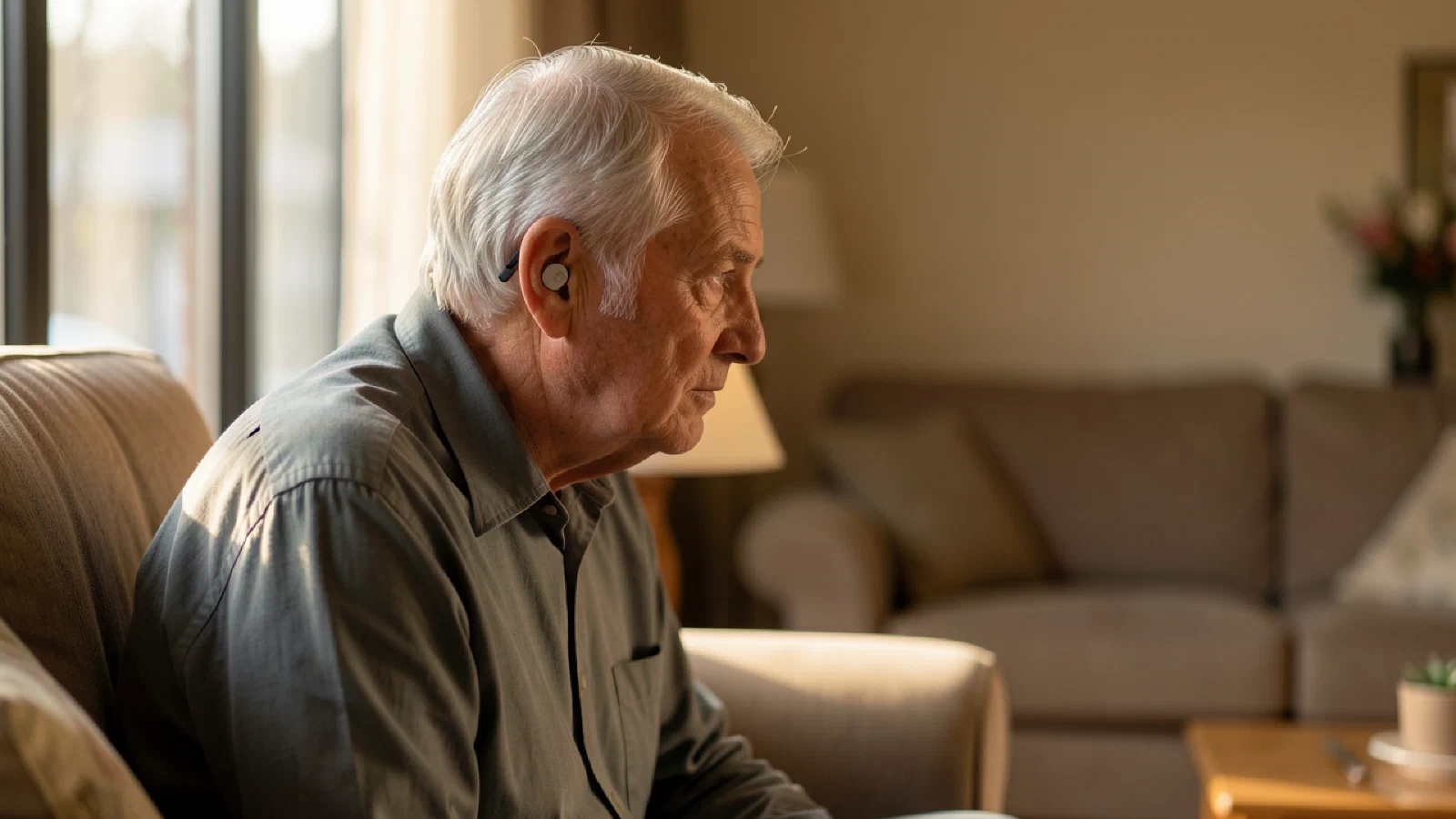
The Senses After 60
When the World Gets Quieter and Less Clear
Two out of three adults over 60 have hearing loss. Nearly 20 million Americans over 40 are living with some form of age-related macular degeneration. Glaucoma, which destroys vision so gradually that most people do not realize it is happening, affects 4.2 million American adults. These numbers are large enough to feel abstract, so here is what they look like in practice: a dinner conversation that becomes exhausting to follow, a newspaper column that blurs at the edges, a staircase that feels less certain underfoot at dusk.
Sensory loss in aging is so common that it barely registers as a medical event. Doctors note it, patients shrug, families adjust. The television gets louder. The font size goes up. The evening drive stops. Each accommodation is small. The cumulative effect is not.
What makes sensory loss particularly consequential is what it sets in motion. The person who can no longer follow group conversation begins declining invitations. The person whose vision dims stops reading, then stops driving, then stops going out. These look like personality changes or mood shifts. They are often recorded in medical charts as depression or “cognitive concerns.” But they are frequently sensory losses masquerading as something else, reshaping behavior long before anyone names them.
What the Ear Takes With It#
The Lancet Commission on Dementia, in its 2020 report and 2024 update, identified hearing loss as the single largest modifiable risk factor for dementia, accounting for roughly 8 percent of all cases worldwide. That finding surprised many clinicians. It should not have. The mechanisms are straightforward, even if the precise causal pathway is still being refined.
When the cochlea sends degraded signals to the brain, the auditory cortex must work harder to decode them. That extra processing effort draws cognitive resources away from memory, attention, and executive function. Over years, this reallocation is not free. A 2024 meta-analysis of 50 cohort studies involving more than 1.5 million participants found that hearing loss increased incident dementia risk by 35 percent, with each 10-decibel worsening of hearing associated with a 16 percent increase in risk.
The landmark ACHIEVE trial, published in The Lancet in 2023, tested whether treating hearing loss could slow cognitive decline. The results were both promising and complicated. Among the full study population of 977 older adults aged 70 to 84, hearing aids did not significantly slow cognitive decline over three years. But among a pre-specified subgroup of 238 participants who were at higher risk for cognitive decline, the hearing intervention reduced the rate of cognitive decline by 48 percent. A 2025 secondary analysis of the same trial found something equally striking: participants who received hearing aids experienced 27 percent fewer falls over three years.
These numbers do not prove that hearing aids prevent dementia. What they strongly suggest is that treating hearing loss preserves cognitive resources and physical safety in people who are already vulnerable. For anyone managing multiple risk factors for cognitive decline, untreated hearing loss is not a minor inconvenience. It is an accelerant.
The Hearing Aid Problem#
If hearing aids help this much, why are so few people wearing them? Only about 30 percent of Americans over 70 who could benefit from hearing aids have ever used one. Among all adults with hearing loss, the figure is closer to 17 percent.
The FDA’s 2022 rule creating over-the-counter hearing aids was designed to change this. OTC devices, available without a prescription at $200 to $800, brought the cost down dramatically from the $2,000 to $7,000 range of traditional prescription devices. By 2025, the MarkeTrak survey reported that overall hearing aid adoption had risen to 39 percent of those with perceived hearing difficulty, with OTC devices accounting for about 5.7 percent of that total. That is progress, but it is modest progress. OTC hearing aids work best for mild to moderate loss in first-time users. They do not replace audiological evaluation for severe loss, complex hearing profiles, or the kind of personalized fitting that makes the difference between a device you wear and a device you leave in a drawer.
The deeper problem is cultural. Hearing loss carries a stigma that vision loss largely does not. People will wear reading glasses at a restaurant without hesitation but resist hearing aids for years. That resistance has measurable consequences: not just in diminished quality of life, but in cognitive reserve spent compensating for degraded auditory input rather than consolidating memory and managing daily decisions.
For severe hearing loss, cochlear implants remain dramatically underused in older adults despite strong evidence of benefit. Many people over 65 who are candidates have never been told that the option exists.
Harold#
Harold is 74. He has moderate hearing loss in both ears and early dry macular degeneration. His wife noticed he was turning up the television. His ophthalmologist noticed drusen on his retinal exam. His primary care doctor knows about neither finding.
Harold has stopped calling his grandchildren because he cannot hear them clearly on the phone. He has stopped reading the newspaper because the print looks blurred even with his glasses. He thinks he is slowing down. What is actually happening is that two treatable conditions are converging to shrink his world, and nobody has connected them.
Harold’s primary care doctor sees a patient who seems less engaged. His family sees a grandfather who is pulling away. Everyone has an explanation. None of them are correct.
What the Eye Takes With It#
Age-related macular degeneration is the leading cause of vision loss in Americans over 60. In 2019, an estimated 19.8 million Americans over 40 were living with some form of AMD, including 1.49 million with the late-stage, vision-threatening form. The condition comes in two varieties. Dry AMD, which accounts for roughly 80 percent of cases, involves gradual thinning of the macula and, until recently, had no approved treatment. Wet AMD involves abnormal blood vessel growth beneath the retina and is treated with anti-VEGF injections, typically administered into the eye every four to eight weeks, for years.
Glaucoma, the other major thief, affects 4.22 million American adults as of 2022, according to CDC estimates. Its damage to the optic nerve is irreversible and progresses silently. And it does not affect everyone equally. Black Americans have a glaucoma prevalence of 3.15 percent, compared to 1.42 percent among white Americans. They are diagnosed on average six years earlier, experience faster disease progression, and are six times more likely to go blind from the disease. These disparities involve both biological factors and systematic differences in access to eye care.
Diabetic retinopathy, which connects directly to the metabolic story told in the previous installment on diabetes, remains one of the most preventable causes of vision loss, yet it is still caught late in many patients simply because screening intervals slip.
The common thread across all three conditions: early detection changes outcomes. Late detection limits options. And the current system, which separates eye care from primary care from brain care, ensures that too many people arrive late.
When Both Go#
When vision and hearing decline together, the effects multiply rather than add. Balance depends on integrating visual, vestibular, and proprioceptive signals. Degrade two of those three inputs and fall risk escalates sharply. Cognitive load increases when both sensory channels are impaired, leaving fewer resources for memory, attention, and executive function. The research on dual sensory impairment consistently shows accelerated cognitive decline and earlier dementia onset compared to impairment in either sense alone.
This is the connection that Harold’s doctors are missing. His hearing loss and his vision loss are not two separate problems on two separate specialists’ lists. They are a single, compounding threat to his independence, his safety, and his cognitive future.
What Is Coming#
The treatment landscape for both conditions is shifting, though at different speeds.
For hearing, the most important advance is not a new device but a new understanding: that treating hearing loss is brain care, not just ear care. The ACHIEVE trial’s fall reduction data, published in 2025, added physical safety to the argument. The combination of cognitive protection and fall prevention makes hearing intervention one of the highest-value, lowest-risk medical interventions available to older adults. AI-powered hearing aids that filter background noise in real time and enhance speech recognition are now commercially available, though separating genuine capability from marketing claims requires careful evaluation.
For vision, the pipeline is more dramatic. Gene therapy for wet AMD (ABBV-RGX-314, currently in Phase 3 trials) offers the possibility of a single treatment that allows the eye to produce its own anti-VEGF protein, potentially replacing years of injections. Results are expected in 2026, with clinical availability, if the data hold, possibly by 2028. For dry AMD, elamipretide targets mitochondrial dysfunction in retinal cells and is in Phase 3 trials. An oral medication (iptacopan, Novartis) that could prevent early AMD progression is in Phase 2. These are real programs with real data behind them, but none are available today. For today’s patients, the practical reality remains injections for wet AMD, monitoring for dry AMD, and pressure management for glaucoma.
What You Can Do Now#
Get your hearing tested. Not as a concession to aging, but as a cognitive health measure with evidence behind it. If you are over 50, the American Academy of Otolaryngology recommends screening. If hearing aids are appropriate, use them consistently; the benefit comes from daily wear, not from the device sitting in a nightstand.
Get a comprehensive eye exam, including dilation, on the schedule your ophthalmologist recommends. If you have diabetes, do not let retinopathy screening lapse. If you have a family history of glaucoma, particularly if you are Black or Hispanic, start screening earlier and insist on regular follow-up.
If you are managing both hearing and vision changes, understand that the combination matters more than either one alone. Bring this up with your primary care doctor, who may not know what your audiologist found or what your ophthalmologist saw. The medical system will not connect these dots for you. You may need to connect them yourself.
And know this: the person who stops going to dinner, who stops reading, who seems to be withdrawing from the world, may not be depressed, and may not be developing dementia. They may simply be unable to hear or see well enough to stay engaged. That is a problem with a solution. The first step is recognizing it for what it is.
How this article connects to others in Blue Gray Matters.
Sources cited in this article.
- Livingston, Gill, et al. "Dementia Prevention, Intervention, and Care: 2024 Report of the Lancet Standing Commission." The Lancet, vol. 404, no. 10452, 31 July 2024, pp. 572-628.
- Lin, Frank R., et al. "Hearing Intervention Versus Health Education Control to Reduce Cognitive Decline in Older Adults With Hearing Loss in the USA (ACHIEVE): A Multicentre, Randomised Controlled Trial." The Lancet, vol. 402, no. 10404, 2 Sept. 2023, pp. 786-797.
- Huang, Alison R., et al. "Hearing Intervention and Falls in Older Adults: A Secondary Analysis of the ACHIEVE Randomized Clinical Trial." JAMA Otolaryngology — Head & Neck Surgery, 2025.
- Powell, Danielle S., et al. "Hearing Loss and Cognition: What We Know and Where We Need to Go." Frontiers in Aging Neuroscience, vol. 13, 27 Jan. 2022, 769405.
- U.S. Food and Drug Administration. "FDA Finalizes Historic Rule Enabling Access to Over-the-Counter Hearing Aids for Millions of Americans." FDA News Release, 16 Aug. 2022.
- Rein, David B., et al. "Prevalence of Age-Related Macular Degeneration in the US in 2019." JAMA Ophthalmology, vol. 140, no. 12, Dec. 2022, pp. 1202-1208.
- Ehrlich, Joshua R., et al. "Vision Impairment and Receipt of Cognitive Test Results." JAMA Ophthalmology, vol. 142, no. 7, July 2024, pp. 654-661.
- Centers for Disease Control and Prevention. "Common Eye Disorders and Diseases." Vision Health Initiative, 2024.