Alone in the Suburbs
How the Places We Built for Families Fail Aging Bodies
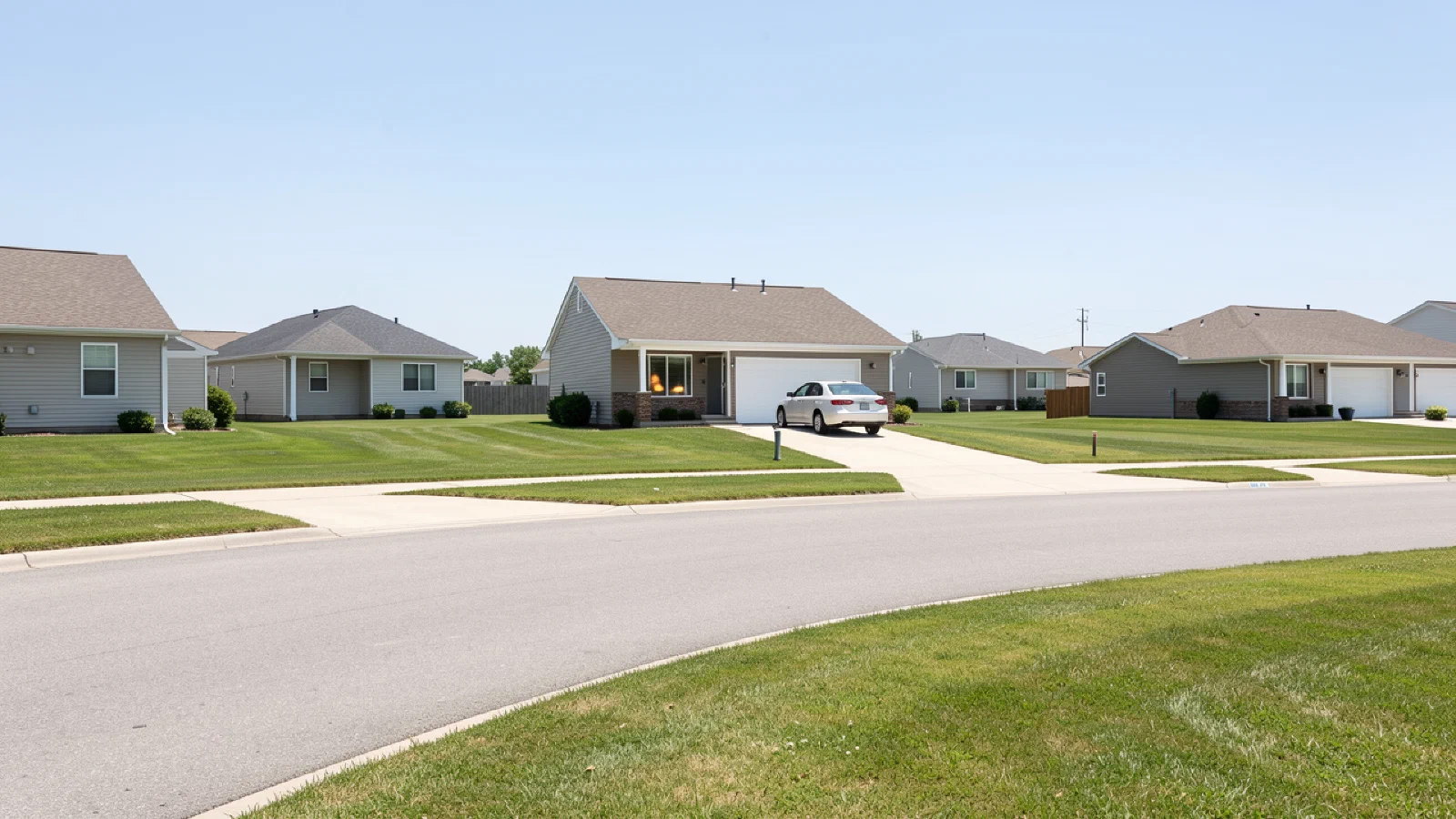
She moved here in 1978. Her husband’s company transferred him, and they found this house on a cul-de-sac with good schools and a backyard for the dog. Three bedrooms for three children. A two-car garage. The grocery was eight minutes away. The church was twelve.
Now she is eighty-two. The children left decades ago. Her husband died in 2019. She stopped driving last year after she clipped a mailbox and scared herself badly enough to hand over the keys.
She has not been to the grocery store in six weeks. A neighbor’s grown daughter shops for her when she can. The church sends someone, sometimes. The doctor’s office is four miles away, which might as well be forty. The sidewalk ends two houses down. There is no bus.
The house that was perfect for raising a family has become something else entirely. Not a home so much as a container. She is not aging in place. She is aging in isolation, in a neighborhood designed for people who drive.
The Design That Made Sense Then#
The American suburb was not an accident. It was a policy choice, backed by federal mortgage guarantees, interstate highways, and zoning codes that locked in a particular vision of how families should live.
After World War II, the FHA and VA loan programs made homeownership possible for millions of families, overwhelmingly white, who could not have afforded it otherwise. The loans came with conditions. Properties had to meet certain standards. Neighborhoods had to be “stable,” a word that often meant racially homogeneous. The suburbs that grew from this financing were designed for young families with children and cars.
Zoning codes reinforced the pattern. Single-family residential zones prohibited apartments, duplexes, and granny flats. Minimum lot sizes prevented smaller, more affordable homes. Commercial uses were banned from residential areas, ensuring that no corner store or café could exist within walking distance. Setback requirements pushed houses back from the street and away from each other. Sidewalks were optional, and many developers skipped them.
The assumptions embedded in this design were invisible because they were universal. Every adult drives. Every household is a nuclear family. Services are accessed by car. Neighbors are privacy buffers, not sources of support. The elderly, if they appeared in the planning documents at all, were expected to leave when they could no longer keep up.
For the families these suburbs were built for, the design worked. For everyone else, it fails.
What Happens When You Stop Driving#
Most Americans over eighty-five will eventually stop driving. Many over seventy-five already have. The reasons accumulate: declining vision, slower reaction time, reduced cognitive processing speed, the honest self-assessment that follows a close call or a fender-bender. Driving cessation is not a single event but a gradual narrowing, from night driving to highway driving to unfamiliar routes to, finally, not driving at all.
In a transit-rich city, losing the ability to drive is an inconvenience. In a suburb built around the car, it is a catastrophe.
Every trip becomes a favor to ask. Medical appointments, grocery runs, pharmacy pickups, church services, visits to friends: all require someone else’s time and vehicle. Many older adults stop asking rather than impose. The requests feel like burdens. The dependence feels like failure. Pride and practicality conspire to keep people home.
The research on what follows is consistent and grim. People who stop driving show dramatic reductions in out-of-home activity. Social engagement declines. Depression increases. Physical health deteriorates, in part because isolation breeds inactivity, in part because medical appointments get skipped when transportation is uncertain. Falls become more likely as bodies weaken. Hospitalizations follow. And hospitalizations, for older adults, often end with the conversation no one wanted: she cannot go home anymore.
The cascade that begins with handing over the car keys can end in a nursing home. The suburb that promised freedom delivers, in the end, a kind of house arrest.
Zoning as a Health Crisis#
The same codes that created these neighborhoods now prevent adaptation.
An aging widow might benefit enormously from a small accessory dwelling unit in her backyard: rental income to supplement Social Security, a caregiver living on-site, a grandchild nearby. In most American suburbs, building that unit is illegal. Single-family zoning prohibits accessory dwelling units. Minimum lot sizes prevent subdivision. Setback requirements make construction impossible even where zoning might allow it.
A walkable corner store, the kind that exists in older urban neighborhoods and European villages, would let an older adult buy milk and bread without arranging a car trip. Zoning prohibits commercial uses in residential areas. The nearest grocery is three miles away, accessible only by car or by asking someone for a ride.
Public transit might help, but transit needs density to function. Buses cannot run efficiently through cul-de-sacs with houses spaced an acre apart. Paratransit, the door-to-door service required by the Americans with Disabilities Act, exists but barely. It costs far more per trip than fixed-route transit, serves fewer people, and often requires scheduling days in advance. For someone who needs to get to a doctor appointment tomorrow, paratransit is not a solution.
The result is a built environment that works against the bodies living in it. The same neighborhood that felt safe and spacious at forty feels isolating and inaccessible at eighty. This is not a personal failing. It is a design failure, hardened into law.
What Is Beginning to Change#
Reform is happening, slowly, unevenly, and against fierce resistance.
California legalized accessory dwelling units statewide in 2020, removing local barriers that had blocked them for decades. Oregon passed similar legislation. Vermont, Minneapolis, and dozens of other cities and states have loosened single-family zoning to allow additional units on residential lots. AARP has made ADU advocacy a priority, publishing model legislation and lobbying for state-level reforms.
The YIMBY movement, originally focused on housing affordability in expensive coastal cities, has increasingly touched senior housing. The argument is the same: restrictive zoning limits supply, drives up costs, and prevents the kinds of housing configurations that would let people age in their communities. Whether the movement’s largely younger constituency will sustain attention to senior housing needs remains an open question.
Some developers are siting senior housing at transit nodes, building apartments and assisted living facilities where buses and trains stop. This is still rare. Most senior housing developments are built on cheap land at the suburban fringe, repeating the isolation problem in a different form.
Village-to-Village networks offer a grassroots alternative. These are member-driven organizations, typically serving a defined geographic area, where neighbors help each other with rides, errands, home repairs, and social connection. More than three hundred villages now operate across the United States. They depend on volunteers, often retirees themselves, and their reach is limited by the resources their members can contribute. They are necessary and insufficient.
What is not changing fast is the political reality. Most American suburbs remain zoned exactly as they were in 1970. Homeowners resist density. Local politicians defer to homeowners. Progress is measured in decades, not years. The woman on the cul-de-sac will not live to see her neighborhood become walkable.
In the Meantime#
The suburb is not inherently unkind. It was built with certain assumptions about who would live there and for how long. When those assumptions stop holding, the kindness disappears.
Fixing this requires more than home modifications. It requires neighborhood reform: zoning changes, transit investment, the slow construction of walkable places where services and community exist within reach. That is a generational project, a fight that will outlive most people currently living in these neighborhoods.
In the meantime, people find workarounds. Neighbors who check in. Churches that organize rides. Adult children who drive two hours each way for a doctor’s appointment. Village networks that fill gaps the market and government leave open. These are acts of love and solidarity. They are also patches on a system that should not require patching.
The woman on the cul-de-sac did not make a mistake when she moved here in 1978. She responded to the options available, the financing offered, the vision of the good life that her country was selling. The mistake was made before she arrived, by planners and policymakers who did not imagine she would ever grow old here, or who imagined she would leave when she did.
She has not left. She is still here, in the house that no longer fits her, in the neighborhood that no longer serves her, waiting for someone to answer the phone.
How this article connects to others in Blue Gray Matters.
Sources cited in this article.
- AARP. "The ABCs of ADUs: A Guide to Accessory Dwelling Units." AARP Livable Communities, 2024. aarp.org/livable-communities/housing/info-2019/accessory-dwelling-units-702.html.
- AARP. "AARP Livability Index." AARP, 2025. livabilityindex.aarp.org.
- Choi, Namkee G., and Diana M. DiNitto. "Depressive Symptoms Among Older Adults Who Do Not Drive." *The Gerontologist*, vol. 56, no. 3, 2016, pp. 432-443.
- Congress for the New Urbanism. "Sprawl Retrofit Initiative." CNU, 2024. cnu.org/sprawl-retrofit.
- Frey, William H. "The Nation's Older Population Is Still Growing, Census Bureau Reports." Brookings Institution, 2023. brookings.edu.
- Joint Center for Housing Studies of Harvard University. *Housing America's Older Adults 2023.* Harvard University, 2023.
- Lynott, Jana, and Carlos Figueiredo. "How the Travel Patterns of Older Adults Are Changing: Highlights from the 2022 National Household Travel Survey." AARP Public Policy Institute, 2024.
- Marottoli, Richard A., et al. "Driving Cessation and Increased Depressive Symptoms." *Journal of the American Geriatrics Society*, vol. 45, no. 2, 1997, pp. 202-206.
- Strong Towns. "The Growth Ponzi Scheme." Strong Towns, 2020. strongtowns.org.
- Village to Village Network. "About the Village Model." VtVNetwork, 2025. vtvnetwork.org.
- Webber, Sandra C., et al. "Mobility in Older Adults: A Comprehensive Framework." *The Gerontologist*, vol. 50, no. 4, 2010, pp. 443-450.