The Accessory Dwelling Revolution
Alternatives Between Your House and a Facility
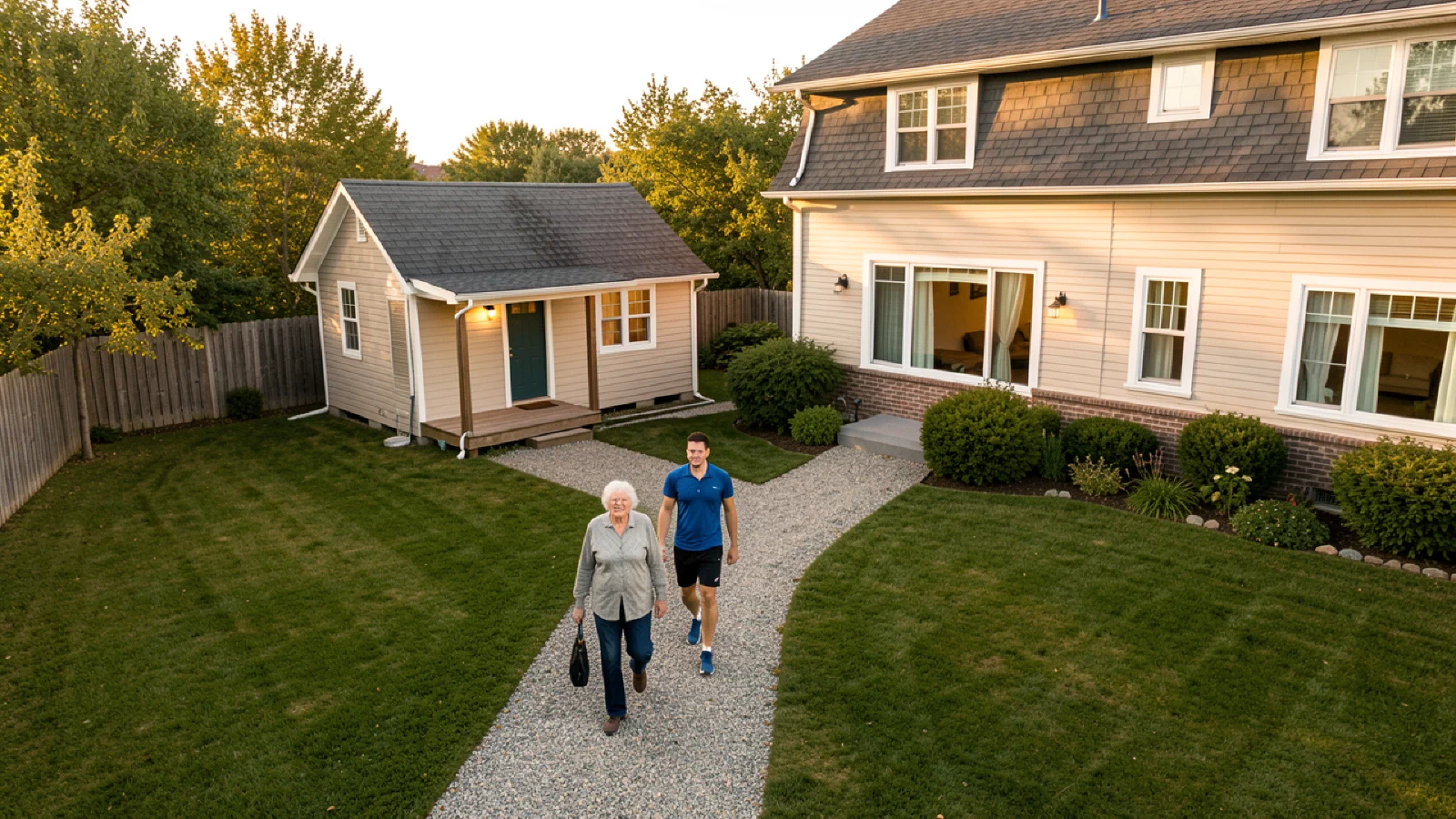
She built a cottage in her mother’s backyard. Six hundred square feet, one bedroom, a small kitchen, windows that look out on the garden they planted together thirty years ago. The same property, separate space. Close enough to check in every morning, far enough that both of them have privacy.
Her mother sleeps better knowing someone is fifty feet away. She sleeps better not listening for falls. When her mother needs more help, she is right there. When her mother wants to be alone, the door between them stays closed.
The city where they live made this legal three years ago. The city where her sister lives still prohibits it.
Between the house you own and the nursing home you fear lies a growing landscape of options. Accessory dwelling units. Multigenerational floor plans. Cohousing communities designed for aging. Shared living arrangements that split costs and provide companionship. Village networks that bring mutual aid to suburban neighborhoods. None of these solves the fundamental need for care when care is truly required. But they expand the possibilities between impossible independence and institutional placement.
The binary that trapped previous generations is beginning to crack.
ADUs and the Zoning Fight#
An accessory dwelling unit goes by many names. Granny flat. In-law suite. Backyard cottage. Carriage house. The concept is simple: a second, smaller residence on a single-family lot, allowing someone to live close to family without living inside the same walls.
For decades, ADUs were illegal in most American jurisdictions. Single-family zoning prohibited additional units. Parking requirements made construction impractical. Neighbors worried about density, traffic, and property values. Cities wrote rules that made backyard cottages impossible even where they were technically allowed.
California changed the equation in 2020 with statewide legislation that overrode local barriers. Setback requirements were relaxed. Parking mandates were eliminated near transit. Permitting was streamlined. The state told local governments to stop blocking what residents wanted to build.
The impact was immediate. California permitted over 23,000 ADUs in 2022, up from fewer than 5,000 in 2016. Oregon passed similar legislation. Vermont, Minneapolis, and dozens of other cities and states followed. AARP made ADU advocacy a priority, publishing model legislation and lobbying across the country.
The uses vary. Adult children building cottages for aging parents. Aging parents downsizing into the ADU while adult children take over the main house. Rental units that generate income to cover property taxes. Housing for live-in caregivers. The flexibility is the point.
Barriers remain. Construction costs range from $100,000 to $300,000, depending on size, location, and site conditions. Financing is complicated; home equity loans and construction loans have different requirements. Permitting, even where streamlined, still takes months. And the reform is not universal. Most American suburbs retain zoning codes that make ADUs illegal or impractical.
But the direction is clear. The legal structure that prohibited multigenerational living for decades is weakening, and each state that acts makes the next one easier.
Living With Family Again#
For most of human history, elders lived with their families. The American suburban model made this unusual: separate households, nuclear families, children who moved away and established independent lives. Multigenerational living became an anomaly rather than a norm.
That is changing, partly by necessity and partly by choice.
What multigenerational housing looks like now varies enormously. In-law suites within main homes, with separate entrances and private bathrooms but shared kitchens. Attached ADUs with full separation. True multigenerational floor plans designed from the start with two master suites, distinct living areas, and shared common space.
The benefits are real. Shared expenses reduce financial pressure on both generations. Built-in care, or at least proximity, reduces the logistics of checking in. Social connection counters isolation. Economic efficiency lets families pool resources that none of them could afford alone.
The challenges are equally real. Privacy is harder when everyone is under the same roof. Boundaries require constant negotiation. The emotional weight of watching a parent decline, of being watched while declining, of managing relationships that were complicated long before anyone got old, does not disappear because the address is shared. When it does not work, unwinding the arrangement is far harder than moving out of an apartment.
Policy has not caught up. There is no federal support for multigenerational housing. Some states have proposed tax credits for multigenerational construction or renovation, but nothing significant has passed. The families making this work are doing it without help.
Cohousing and Shared Living#
Cohousing originated in Denmark in the 1960s and spread to the United States in the 1980s. The model creates intentional communities: private residences clustered around shared common space. Residents own their own homes but share kitchens, gardens, workshops, and social areas. The community eats together several times a week. Neighbors know each other. Mutual aid is embedded in the design.
Approximately 170 cohousing communities now operate in the United States, with more in development. A subset focuses specifically on aging: ElderSpirit in Abingdon, Virginia, designed explicitly for older adults. Glacier Circle in Davis, California, with accessibility built in and a shared commitment to aging in community. These are not assisted living facilities. They are neighborhoods where people who want to grow old together have chosen to do so.
Shared living takes a different form. Multiple seniors share a single house, splitting costs and providing mutual support. Formal platforms like Silvernest and Nesterly match housemates, sometimes across generations. A graduate student needing affordable rent moves in with an older adult who needs occasional help and companionship. The exchanges are explicit: reduced rent in return for specific tasks, or simply lower costs for everyone who participates.
These arrangements require something not everyone wants to provide: willingness to live in community. Cohousing involves meetings, shared decisions, negotiated norms. Shared living means sharing a kitchen with someone you did not grow up with. For people who want connection and can tolerate friction, these options work. For people who value solitude or who struggle with compromise, they do not.
What Other Countries Build#
International models suggest what becomes possible when policy aligns with demographics.
Denmark, the birthplace of cohousing, also integrates senior housing within mixed-age developments. Universal accessibility standards mean homes are designed from the start for bodies that may decline. Home care is treated as a right, available to anyone who needs it regardless of income. Elders remain part of communities rather than separated into age-segregated facilities.
Japan, facing the most advanced demographic aging on Earth, has developed multiple models. Multigenerational living remains common, supported by cultural expectation and housing design. “Satellite senior housing” places older adults near, but not in, their adult children’s homes: close enough for regular contact, separate enough for independence. Service-attached housing combines residences with on-site care access, blurring the line between independent living and assisted living.
The Netherlands created Hogewey, the dementia village covered earlier in this series, but also maintains extensive home-based care infrastructure. The assumption is that people should stay in their communities as long as possible, and public investment follows that assumption.
What these countries share is a cultural premise America lacks: that society, not just family, is responsible for how elders live. When that premise is accepted, policy follows. When it is not, families are left to figure it out alone.
The Village Model#
Villages are a distinctly American response to distinctly American problems.
A Village is a member-based, volunteer-supported network for aging in place. Members pay annual dues (typically $400 to $600) and gain access to services that would otherwise require either money or luck: rides to medical appointments, help with grocery shopping, minor home repairs, social events, someone to call when the loneliness gets heavy.
Staff coordinate volunteers and connect members to vetted service providers. The volunteers are often retirees themselves, trading help now for help later, building the community they will need when they can no longer drive.
Over 300 Villages now operate across the United States, with 150 more in development. The model works in suburban and urban settings where there are enough older adults with the resources to join and the capacity to volunteer. It works less well in rural areas, in poor communities, and anywhere the density of organized retirees is low.
What Villages can do is substantial: extend independence, reduce isolation, create the informal networks of mutual aid that used to exist before car-dependent suburbs scattered everyone into private boxes. What they cannot do is provide medical care, replace paid help when care needs grow heavy, or function without a critical mass of volunteers.
They are necessary and insufficient. Like everything else in this space.
The Cracks Where Light Gets In#
The options between your house and a facility are multiplying. Some require money. An ADU costs six figures. Cohousing requires buying into a community with housing prices to match. Some require luck: the right city with the right zoning, the right family configuration, the right neighbors.
Some require a willingness to live differently than the suburban ideal promised. To share space. To negotiate with others. To accept help and offer it.
None of these is a universal solution. The person with advanced dementia needs care no ADU can provide. The person with complex medical needs requires skilled nursing no Village can offer. The person without resources has access to none of this.
But the binary is weakening. The assumption that you stay in your house alone until you cannot, then go to a nursing home, is no longer the only story. The alternatives are real, growing, and becoming legal in more places each year.
The cracks are where the light gets in. For some people, in some places, there is now room to imagine something different.
How this article connects to others in Blue Gray Matters.
Sources cited in this article.
- AARP. "The ABCs of ADUs: A Guide to Accessory Dwelling Units." AARP Livable Communities, 2024.
- California Department of Housing and Community Development. "Accessory Dwelling Unit Handbook." HCD.ca.gov, 2024.
- Cohousing Association of the United States. "What Is Cohousing?" Cohousing.org, 2025.
- Durrett, Charles. *Senior Cohousing: A Community Approach to Independent Living.* New Society Publishers, 2009.
- Glass, Anne P. "Elder Cohousing in the United States: Three Case Studies." *Built Environment*, vol. 38, no. 3, 2012, pp. 345-363.
- Graham, Carol L., et al. "The Village Model: A Consumer-Driven Approach for Aging in Place." *The Gerontologist*, vol. 57, no. 1, 2017, pp. 21-29.
- Howe, Deborah. "Aging in Place in the United States." *Planning Advisory Service Report*, American Planning Association, 2022.
- MetLife Mature Market Institute. "The MetLife Report on Multigenerational Living." MetLife, 2019.
- Nesterly. "How It Works." Nesterly.com, 2025.
- Silvernest. "About Silvernest." Silvernest.com, 2025.
- Village to Village Network. "About the Village Model." VtVNetwork.org, 2025.