The House That Holds You
Why Home Is More Than Where You Live
She stands in the kitchen at six in the morning, making coffee the way she has for forty-one years. The counter is worn where her hand rests. The cabinet door sticks if you don’t lift it slightly before pulling. She knows these things without thinking, the same way she knows how many steps from the bed to the bathroom in the dark.
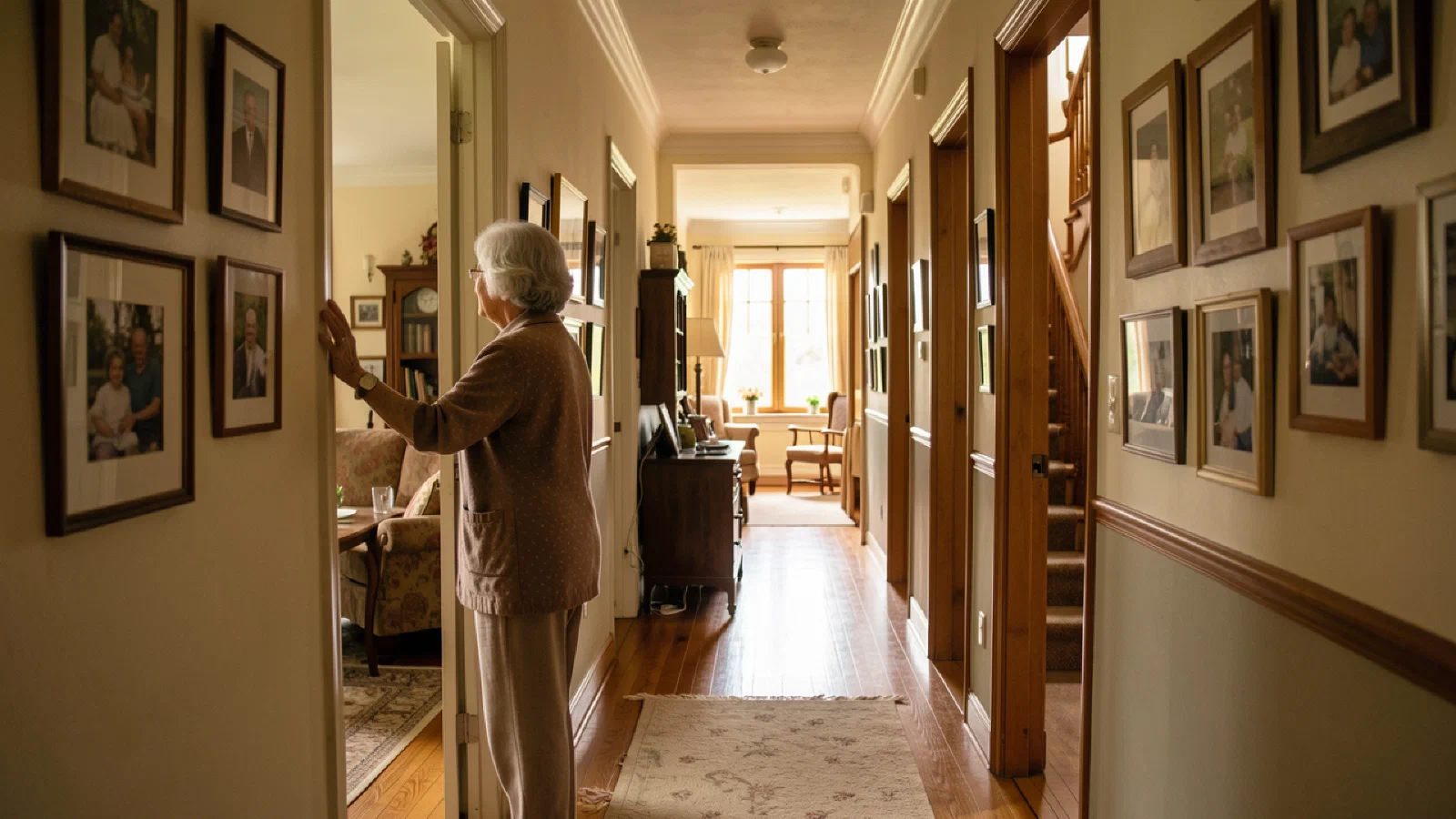
Her husband died in the bedroom upstairs. Her children took their first steps in the living room. The wallpaper in the hallway still has pencil marks showing how tall they grew each year. She never painted over them.
Last month, her son suggested she consider “something smaller, maybe with one floor.” He said it gently. He meant well. She heard something else: give up who you are.
This is where every conversation about aging in place begins, whether anyone names it or not. Not with square footage or grab bars or stair lifts, but with something far older. The house holds her. And she cannot imagine leaving it without leaving a part of herself behind.
The Shape of Belonging#
Environmental gerontologists, the researchers who study how place affects older adults, have a term for what she feels: place attachment. It sounds clinical, but the phenomenon it names is anything but.
Graham Rowles, who spent decades studying how older people relate to their homes, described what he called “place autobiography.” The house becomes a container for life history. Every room holds sediment: the corner where a daughter practiced violin, the window that looks out on a garden planted with a husband who is gone, the kitchen table where a thousand arguments and reconciliations unfolded. Moving is not just relocating. It is leaving the physical architecture of memory.
Robert Rubinstein, another researcher in this field, documented how home serves as a stage for the rituals that preserve identity. The morning coffee. The evening news in the same chair. The route from room to room that the body knows without consulting the mind. These routines might look like simple habit from the outside. From the inside, they are the structure that tells a person they are still themselves.
Then there is autonomy. Home is where you make the decisions. You decide when to eat, whether to answer the door, how hot to keep the thermostat, whether to stay up late watching old movies. You answer to no one. Every form of assisted or institutional living surrenders some of that control. Sometimes the surrender is necessary. But the loss is real, and older adults feel it acutely even when they cannot always articulate it.
The distinction between “house” and “home” is not sentimentality. It is psychology. You can move houses. Rebuilding home is far harder.
The Gap Between Wanting and Being Able#
Roughly 90 percent of adults over sixty-five want to remain in their current home as they age. AARP has been tracking this preference for decades. The term “aging in place” entered policy discussions in the 1980s, when it became clear that both preference and demographics were pointing in the same direction: more older people wanted to stay put, and there would be many more older people.
The housing stock did not get the memo.
Eighty-five percent of American homes lack basic accessibility features. No zero-step entry. No single-floor living option. No bathroom a wheelchair can enter. The houses were built when homeowners expected to leave or die before frailty arrived. The assumption was invisible because it was universal.
Zoning compounds the problem. Single-family zoning dominates American residential land, and in many jurisdictions it remains illegal to build an accessory dwelling unit in the backyard, to convert a garage into a mother-in-law suite, or to allow a caregiver to live on the property. The rules were written to preserve property values and neighborhood character. They now function as a barrier to precisely the arrangements that would allow people to age in their communities.
Then there is the infrastructure that makes aging in place possible: meal delivery, transportation, home health aides, emergency response systems. These supports exist unevenly. In urban areas with robust nonprofit networks, they are often available. In rural areas, they may not exist at all. The person who wants to stay home but can no longer drive, who lives three miles from the nearest grocery store, who needs someone to check in but has no one nearby to do it, discovers that the desire to stay is not the same as the ability to stay safely.
The gap between wanting to age in place and being able to do so is the subject of this entire series. Understanding why the desire runs so deep is where we have to start.
When the Body Changes Around the Home#
The house that worked at sixty-five may not work at eighty. Stairs become barriers. Bathtubs become hazards. The yard that was a joy to tend becomes a burden no fixed income can pay someone else to manage.
Deferred maintenance cascades. A roof not replaced becomes a ceiling not secure. A furnace not serviced becomes a January crisis. Homes require upkeep, and upkeep requires either physical capacity or money. When both are limited, small problems compound into large ones. The house begins to fail the person living in it.
Isolation follows its own logic. When driving becomes unsafe, and there is no transit, the house becomes a container for loneliness as much as memory. The neighborhood may still look the same. The experience of living in it has transformed.
Care needs are the sharpest edge. When someone requires help with bathing, medications, or meals, and no one is there to provide it, independence becomes a form of risk. The fall that happens when no one is home to hear it. The medication missed because no one noticed. The infection that progresses because no one saw the signs. What felt like autonomy becomes, at a certain point, something closer to danger.
None of this means that staying home is wrong. It means that staying home safely often requires resources, modifications, and support that do not materialize on their own.
The Conversation That Keeps Getting Postponed#
Families avoid talking about housing until crisis forces it. The pattern is grimly predictable: a hospitalization leads to a rehab stay, which leads to a hallway conversation in which someone says, “She can’t go home like this.” The decision gets made under pressure, without preparation, when everyone is exhausted and frightened.
Proactive planning looks different. It begins with a home assessment: Which rooms are accessible? What would modification cost? Which changes are possible with the current structure, and which would require something the house cannot become?
It continues with questions that feel uncomfortable: If you could no longer drive, how would you get to the doctor? If you needed help bathing, who would provide it? What would trigger a move, and where would you go?
These conversations are difficult precisely because they force a confrontation with futures no one wants to imagine. But just as end-of-life planning benefits from happening before the emergency, housing planning works better when it is not conducted in a hospital hallway at two in the morning.
The resistance runs deep. The house holds decades of meaning. The alternatives feel like admissions of decline. The cultural script says that needing help is failing. None of that makes the conversation less necessary.
The Work Ahead#
This series will examine what makes aging in place so difficult and what might make it more possible. We will look at technology: the smart home devices and monitoring systems that promise to extend independence, and the privacy trade-offs they require. We will look at the built environment: the suburban design that isolated older adults long before they became old, and the zoning reforms beginning to chip away at it. We will look at institutional care: what nursing homes were supposed to be, what many became, and what is emerging to replace them.
We will also look at the hardest question: when does home become unsafe? And who gets to decide?
Home is not a fixed address. It is a relationship. The relationship changes as you change and as the house changes. The work of aging well is learning how to maintain that relationship as both you and the house evolve, or how to build it somewhere new before the choice is made for you.
The woman in the kitchen knows every inch of that house. It knows her too. The question is whether knowing will be enough.
How this article connects to others in Blue Gray Matters.
Sources cited in this article.
- AARP. "2021 Home and Community Preferences Survey." AARP Research, 2021. aarp.org/research/topics/community/info-2021/2021-home-community-preferences.html.
- Joint Center for Housing Studies of Harvard University. *Housing America's Older Adults 2023.* Harvard University, 2023. jchs.harvard.edu/housing-americas-older-adults-2023.
- Oswald, Frank, and Hans-Werner Wahl. "Dimensions of the Meaning of Home in Later Life." *Home and Identity in Late Life: International Perspectives*, edited by Graham D. Rowles and Habib Chaudhury, Springer, 2005, pp. 21-45.
- Rowles, Graham D. "Place and Personal Identity in Old Age: Observations from Appalachia." *Journal of Environmental Psychology*, vol. 3, no. 4, 1983, pp. 299-313.
- Rowles, Graham D., and Habib Chaudhury, editors. *Home and Identity in Late Life: International Perspectives.* Springer, 2005.
- Rubinstein, Robert L. "The Home Environments of Older People: A Description of the Psychosocial Processes Linking Person to Place." *Journal of Gerontology: Social Sciences*, vol. 44, no. 2, 1989, pp. S45-S53.
- U.S. Department of Housing and Urban Development. *American Housing Survey.* U.S. Census Bureau, 2023. census.gov/programs-surveys/ahs.html.
- Wiles, Janine L., et al. "The Meaning of 'Aging in Place' to Older People." *The Gerontologist*, vol. 52, no. 3, 2012, pp. 357-366. doi.org/10.1093/geront/gnr098.