The Nursing Home Reckoning
What COVID Revealed and What Comes Next
They gathered outside the window in April 2020. The daughter held a sign that said “We love you, Mom.” The grandchildren waved. The woman inside could not hear them through the glass and did not seem to recognize them.
She died three weeks later. The death certificate said COVID-19. The daughter will spend years wondering whether the virus killed her mother or whether the isolation did. Whether she would have lived longer if someone had held her hand. Whether the last months of her life, locked in a room she could not leave, surrounded by staff in masks and gowns who did not have time to talk, constituted living at all.
The nursing home sent a bill.
This scene repeated itself hundreds of thousands of times across America during the pandemic. Over 200,000 nursing home residents died of COVID, approximately 15 percent of all US deaths from the virus. In some facilities, a quarter of the residents were gone within weeks. Families watched through windows. Staff burned out and quit. Infection control protocols that barely existed before March 2020 proved impossible to implement in buildings designed for efficiency, not isolation.
COVID destroyed whatever trust remained in nursing homes. But the nursing homes were already failing. The pandemic did not create the crisis. It exposed one that had been building for decades.
What Nursing Homes Were Supposed to Be#
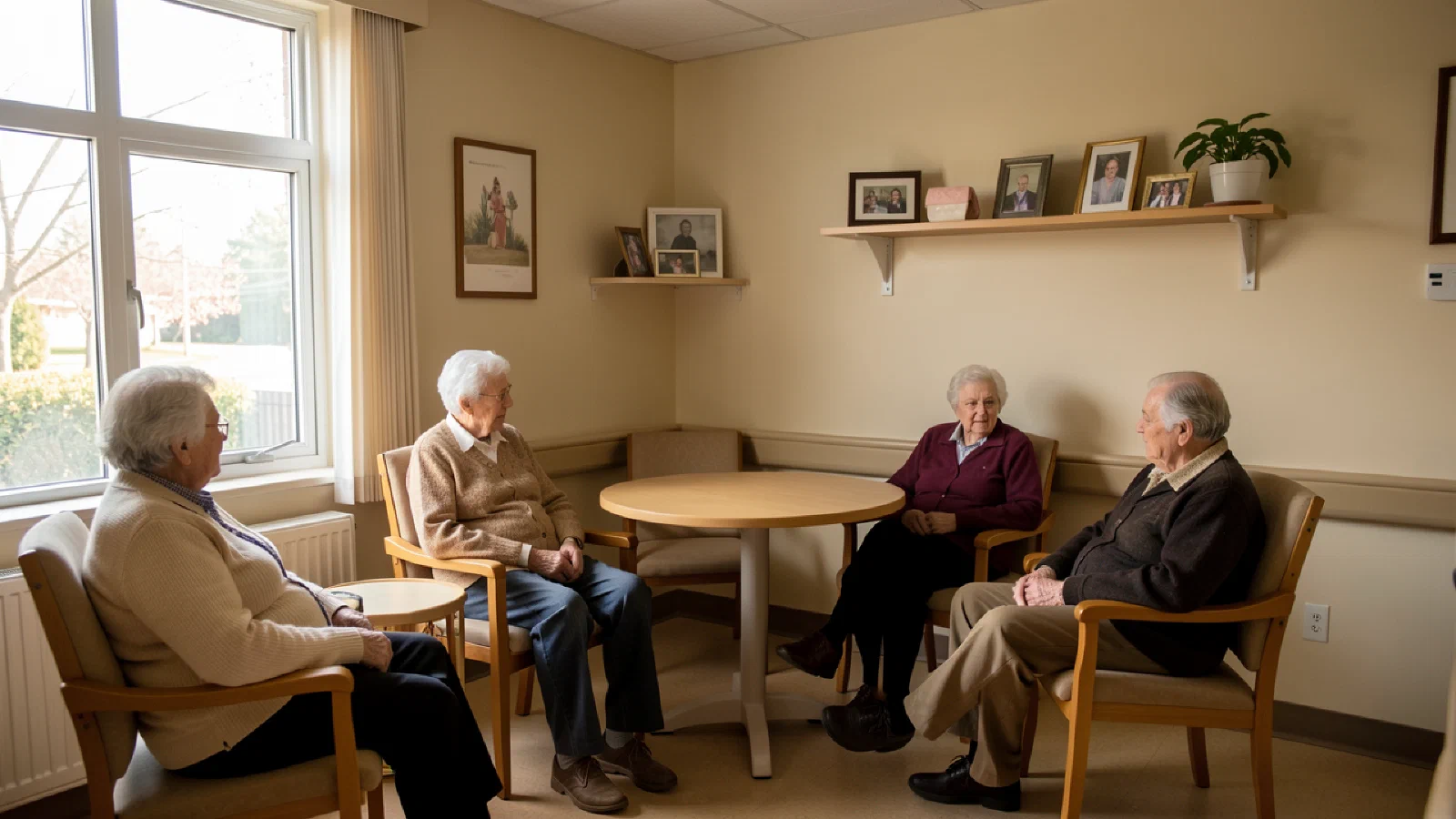
The nursing home was meant to be a safety net. A place for people who needed more support than could be provided at home. Skilled nursing for those recovering from surgery or stroke. Long-term care for those whose bodies or minds required constant attention. A dignified place to live when living alone was no longer possible.
The financial bargain that created the modern nursing home industry was straightforward. Medicaid would pay for care for the poor and for anyone who had spent down their assets to poverty. In exchange, nursing homes would accept reimbursement rates lower than what private-pay residents or Medicare contributed. The guaranteed stream of Medicaid dollars would provide a floor, and private pay would provide a ceiling, and the facilities would care for everyone in between.
When the model worked, it looked like this: smaller homes, often run by nonprofit organizations or religious communities, with stable staff who knew residents by name. The aide who helped someone to the bathroom at midnight had helped them to the bathroom at midnight for years. The activities director knew which residents would enjoy the music program and which preferred the garden. Care was not just medical. It was relational.
Some nursing homes still operate this way. They are not the norm.
What Many Nursing Homes Became#
The transformation happened gradually, then all at once.
Private equity discovered nursing homes in the 2010s. The dynamics were attractive: guaranteed government payments, high barriers to entry, a captive population with few alternatives. Acquisition accelerated. By 2020, roughly 11 percent of nursing homes were owned by private equity firms, and the number continues to grow.
Researchers have documented what followed. Atul Gupta at the Wharton School and colleagues found that PE-owned nursing homes had higher mortality rates and lower staffing levels than comparable facilities. A study in Health Affairs found that Medicare patients in PE-owned homes were more likely to be sent to the emergency room and more likely to die within 90 days of admission. The pattern held after controlling for patient characteristics and local market conditions.
The mechanisms were not complicated. To generate returns for investors, costs had to be cut. Staffing is the largest cost in any nursing home. Staff got cut.
Certified nursing assistant turnover now exceeds 100 percent annually in many facilities. This means the entire front-line care workforce replaces itself every year. Residents wait hours for help to the bathroom. Pressure ulcers develop because no one repositions bedridden patients often enough. Falls go undetected because no one is watching. The aide who shows up on Tuesday may never have met the resident before.
Financial engineering compounded the staffing problem. Sale-leaseback arrangements transferred real estate from nursing home operators to affiliated companies, generating cash for investors while saddling operators with rent payments that squeezed care budgets. Management fee structures directed money to parent companies. Related-party transactions created layers of extraction that regulators struggled to trace.
The regulatory system that was supposed to prevent all this failed. State inspection agencies are underfunded. Penalties for violations are minimal. A nursing home can be cited repeatedly for the same deficiency without consequence. Federal enforcement is inconsistent. The entities with the most incentive to extract profit have the resources to navigate the rules; the entities charged with enforcing the rules do not have the resources to stop them.
Before COVID, approximately 1.3 million Americans lived in nursing homes. Many had no alternative. Many were there against their will.
COVID as Revelation#
The pandemic did not break nursing homes. It showed how broken they already were.
Facilities designed around shared rooms and common dining could not isolate residents. Ventilation systems spread the virus. Personal protective equipment was unavailable because there were no stockpiles and no plans to acquire them. Staff who worked at multiple facilities to make ends meet carried infection from building to building. Underpaid workers had no sick leave, so they came to work when they were ill.
Then came the lockdowns. To slow transmission, nursing homes prohibited visitors. Families could not enter. For residents with dementia, who could not understand video calls, family simply vanished. Months passed. Cognitive decline accelerated. Depression deepened. Some residents stopped eating. Some stopped speaking. The isolation intended to save lives may have shortened them.
AARP surveys taken after the pandemic show the collapse in trust. The percentage of Americans who would consider nursing home care for themselves or a family member has dropped precipitously. The question families ask now is not “which nursing home” but “how do we avoid nursing homes entirely.”
The anger is justified. The question of what replaces them has no easy answer.
What Is Emerging#
CMS finalized new staffing requirements in April 2024. By 2027, every nursing home that accepts Medicare or Medicaid must have a registered nurse on-site 24 hours a day and must provide a minimum of 3.48 hours of direct nursing care per resident per day. The industry claims these requirements will force closures, particularly in rural areas where staffing is already impossible. Advocates say the standards barely meet minimum safety and are phased in too slowly.
The Green House Project offers an alternative model. Green Houses are small homes, typically 10 to 12 residents, with consistent staffing teams, private rooms, shared kitchens, and a design that resembles a house rather than a hospital. Evidence from the pandemic showed dramatically lower COVID infection and death rates in Green House settings. Research over years has documented lower hospitalization rates, fewer falls, and higher satisfaction among residents and families.
There are now approximately 350 Green Houses in 34 states. They work. The challenge is scale. Each home requires more square footage per resident than traditional nursing homes. Construction costs are higher. Reimbursement is the same. The model survives on mission-driven operators and markets where private-pay rates can subsidize Medicaid residents.
Dementia villages, modeled on the Hogewey community in the Netherlands, create self-contained neighborhoods where residents can walk streets, visit shops, and interact with staff embedded throughout the environment rather than confined to care stations. The cognitive benefits of environmental engagement and mobility appear substantial. American pilots are emerging, including Glenner Town Square in California and state-funded experiments in Ohio and Minnesota. They remain rare and expensive.
Technology offers incremental help. Telehealth reduces unnecessary hospital transfers. Monitoring systems can detect falls and wandering earlier. Robotic assistance may eventually help with physical support tasks. None of this replaces staffing. None of it fixes the fundamental economics.
The Medicaid Problem#
Medicaid pays for approximately 60 percent of nursing home residents. Reimbursement rates are set by states and vary wildly. In some states, Medicaid pays less than the cost of care. Facilities respond by understaffing Medicaid beds and hoping private-pay residents make up the difference.
Any alternative model must work within Medicaid economics or become an option only for those with private resources. Green Houses, dementia villages, and other innovations remain available mostly to people who can pay, or to communities served by nonprofit operators willing to absorb losses.
Federal programs try to shift the balance. Money Follows the Person helps Medicaid beneficiaries transition from institutions to community settings. Home and Community-Based Services waivers allow Medicaid funds to flow to home care, assisted living, and other non-institutional settings. Where these programs are fully implemented, they work. They are not universal. Waitlists in some states exceed 10 years.
The structural tension is this: Medicaid treats nursing home beds as an entitlement. Anyone who qualifies gets a bed. Medicaid treats home and community care as a limited benefit, capped by state budgets and available slots. The system is biased toward exactly the model that has failed.
What Remains#
The nursing home is not inherently evil. Some provide genuine care. The nonprofit home run by a religious community that has served its neighborhood for fifty years, the facility with low turnover and staff who treat residents like family, the skilled nursing unit that rehabilitates patients after surgery and sends them home stronger: these exist. They should not be forgotten in the reckoning.
But the incentive structure, the staffing crisis, the regulatory failure, and the Medicaid economics make failure the default. The pandemic made it visible. The question is whether visibility leads to change or whether we forget again when the emergency passes.
The alternatives exist. They are not yet at scale. They may never reach scale if funding does not follow values. The family that gathered at the window cannot wait for policy reform. They need answers now, and the answers available to them depend on their resources, their geography, and their luck.
The woman who died behind the glass was someone’s mother. She deserved better. So did the 200,000 others. So do the people in nursing homes tonight, waiting for help that may not come.
How this article connects to others in Blue Gray Matters.
Sources cited in this article.
- Centers for Disease Control and Prevention. "COVID-19 Nursing Home Data." CDC.gov, 2023. data.cms.gov/covid-19/covid-19-nursing-home-data.
- Centers for Medicare and Medicaid Services. "Medicare and Medicaid Programs; Minimum Staffing Standards for Long-Term Care Facilities." Federal Register, April 2024.
- Grabowski, David C., and Vincent Mor. "Nursing Home Care in Crisis in the Wake of COVID-19." *JAMA*, vol. 324, no. 1, 2020, pp. 23-24.
- Green House Project. "Research and Outcomes." TheGreenHouseProject.org, 2025.
- Gupta, Atul, et al. "Does Private Equity Investment in Healthcare Benefit Patients? Evidence from Nursing Homes." *NBER Working Paper 28474*, 2021.
- Harrington, Charlene, et al. "Nursing Home Staffing Standards and Staffing Levels in Six Countries." *International Journal of Nursing Studies*, vol. 49, no. 4, 2012, pp. 457-466.
- Kaiser Family Foundation. "Nursing Facilities, Staffing, Residents and Facility Deficiencies, 2009 Through 2019." KFF.org, 2021.
- Konetzka, R. Tamara, et al. "Association Between Nursing Home Characteristics and COVID-19 Outbreak Rates." *JAMA Network Open*, vol. 4, no. 5, 2021.
- Office of Inspector General. "Trends in Deficiencies at Nursing Homes Show Continued Need for CMS Oversight." HHS OIG, 2024.
- Zimmerman, Sheryl, et al. "The Green House Model of Nursing Home Care in COVID-19." *Journal of the American Geriatrics Society*, vol. 69, no. 12, 2021, pp. 3375-3382.