Retiring Abroad to Survive
When Social Security Stretches Further Somewhere Else
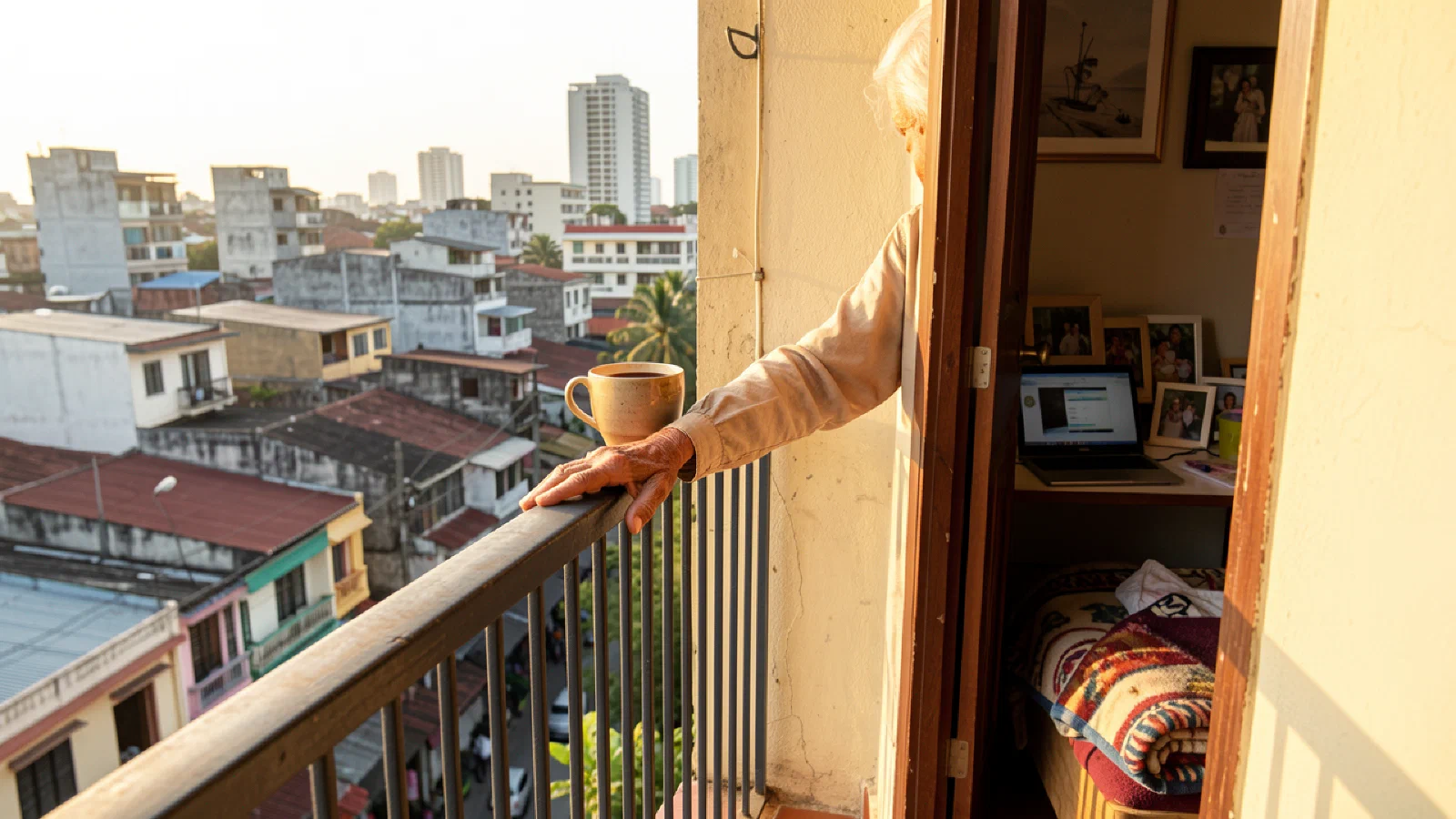
Patricia Reyes is sixty-nine years old, and she is sitting on her balcony in Cuenca, Ecuador.
Her Social Security check is $1,850 per month. Her rent for a two-bedroom apartment with mountain views is $500. Her monthly healthcare costs are minimal; she joined Ecuador’s public health system for $89 per month. She eats well, takes yoga classes, meets friends for lunch twice a week, and worries less about money than she has in decades. She also has not seen her grandchildren in two years. She chose this life. She also did not choose the circumstances that made it necessary.
Patricia represents a growing wave of American retirees who are leaving the country not for adventure but for survival. When Social Security and modest savings cannot cover housing, healthcare, and daily expenses in the United States, some discover they can live with dignity in places where the American dollar stretches further. This is not vacation. It is economic exile.
The Financial Math#
The arithmetic drives everything. The average Social Security retirement benefit in 2026 is approximately $1,900 per month. In most American cities, that covers rent and little else. In many desirable American locations, it does not cover rent at all. A retiree with $1,900 monthly and no significant savings faces poverty at home, poverty with stress and scarcity and the constant grind of choosing between medications and groceries.
That same $1,900 functions differently elsewhere. In Mexico, comfortable retirement living in cities like Mérida, Querétaro, or Lake Chapala costs $1,500 to $2,500 monthly, including housing, food, transportation, healthcare, and entertainment. In Ecuador, retirees report living well on $1,200 to $2,000 per month. Portugal, despite being in Western Europe, supports comfortable retirement at $1,800 to $2,500 monthly, less in smaller cities and inland regions. Panama, Costa Rica, Thailand, and the Philippines all offer similar mathematics: what barely sustains existence in America enables genuine life elsewhere.
The Social Security Administration sends benefit payments to most countries in the world. (Exceptions exist for Cuba, North Korea, and a handful of others with restricted financial relationships.) Your check arrives the same whether you live in Phoenix or Porto, deposited electronically to your American bank account, accessible via ATM virtually anywhere. No reduction applies for living abroad. The benefit you earned is the benefit you receive.
The calculation Patricia made is one that hundreds of thousands of Americans have made or are considering. In the United States, her $1,850 would cover rent in a modest apartment in a low-cost area, with perhaps $200 remaining for everything else. In Cuenca, it covers comfortable housing, comprehensive healthcare, food, utilities, social activities, and savings. The difference is not marginal. It is transformative.
The Healthcare Question#
Medicare does not follow you abroad. This is the fundamental trade-off that every retiring expatriate must confront. Leave the country, and you leave the healthcare system you paid into for forty years.
The options that replace it vary by destination but share common features. Many countries offer affordable public healthcare systems that legal residents can join. Ecuador’s IESS system costs roughly $89 monthly and covers most medical needs. Costa Rica’s Caja provides similar coverage. Portugal allows legal residents to access its public health system. The quality of public healthcare varies; major urban hospitals often provide excellent care while rural facilities may be more limited.
International health insurance fills gaps that public systems do not cover. Policies designed for expatriates cost between $200 and $600 monthly at retirement age, depending on coverage level and health status. These plans typically include hospital coverage, specialist care, prescription drugs, and medical evacuation back to the United States for serious conditions that require specialized treatment.
Self-pay works better abroad than in America. A doctor visit in Ecuador might cost $30. An emergency room visit runs $200. A dental crown costs $200 rather than $1,200. The lower cost of healthcare delivery means that paying out of pocket for routine care and minor emergencies is feasible in ways that American pricing prohibits.
Some retirees maintain dual strategies. They keep a legal U.S. address, continue Medicare enrollment, and return to the States for major procedures or complex care. This requires logistical planning, the ability to travel for medical reasons, and maintenance of American ties that enable the arrangement. It is complicated, but it is done.
The honest assessment: healthcare abroad can be excellent and affordable, but it requires navigation, insurance planning, and acceptance that you are operating outside the familiar American system. For many retirees, this trade-off is acceptable. For some, particularly those with complex chronic conditions requiring specialized coordination, it may not be.
Visas, Taxes, and Legal Complexity#
Moving abroad means navigating immigration systems, tax obligations, and legal requirements that most Americans have never encountered.
Many popular retirement destinations offer specific visa categories for retirees with passive income. Mexico’s Temporary Resident visa requires approximately $2,500 monthly income or roughly $42,000 in savings, with a pathway to permanent residency. Panama’s Pensionado visa, one of the most generous in the world, requires only $1,000 monthly pension income and provides discounts on entertainment, transportation, and utilities. Ecuador’s retirement visa requires $1,275 monthly income. Portugal’s D7 visa serves passive-income earners seeking European Union residency.
American citizens remain subject to U.S. taxation regardless of where they live. You will file federal tax returns from abroad, reporting worldwide income. The Foreign Earned Income Exclusion applies to earned income, not Social Security or investment income. Tax treaties between the United States and various countries prevent double taxation but require understanding of complex rules. Consulting a tax professional familiar with expatriate issues is not optional; it is necessary.
Banking requires forethought. Maintaining American bank accounts is essential for receiving Social Security, managing investments, and handling U.S. financial obligations. International wire transfers and currency conversion have costs that accumulate. Some American banks have become less willing to serve customers living abroad, requiring research to identify institutions that accommodate expatriate clients.
Estate planning grows more complex when you die abroad. Different inheritance laws, different processes for asset transfer, different tax implications. Legal documents prepared for American circumstances may not function as intended in foreign jurisdictions. Planning for this complexity while healthy costs less, emotionally and financially, than sorting it out during crisis.
The Emotional Cost#
The financial math works. The emotional math is harder.
Distance from family accumulates differently than distance from home. Grandchildren grow up on video calls. Birthdays arrive on screens rather than in living rooms. When your daughter has a crisis, you cannot drive over. When your son’s child is born, you book a flight that takes twenty-four hours rather than walking into the hospital. Holiday traditions that shaped decades of family life become memories or awkward reconstructions across time zones.
Cultural adjustment is real, even in places with established expatriate communities. You are a foreigner. The language is not yours, even if you study. The bureaucracy operates by rules you did not grow up absorbing. Loneliness exists abroad just as it exists at home, sometimes more intensely when the familiar patterns of your former life no longer structure your days.
Impermanence shadows every expatriate. Visa rules change. Political situations shift. Your health will eventually decline in ways that complicate living far from family and familiar medical systems. Some retirees abroad return to the United States by choice when circumstances change. Some return by necessity when their bodies no longer permit the life they built.
Identity carries weight. Leaving the country where you built your career, raised your children, buried your parents, and accumulated the relationships that define who you are: this carries psychological cost that financial spreadsheets do not capture. You are not escaping to paradise. You are making a trade-off, exchanging certain American difficulties for different foreign ones.
Community helps. Expatriate communities exist in every popular retirement destination. They can provide support, information, shared experience, and genuine friendship. They can also be insular, complaint-focused, and disconnected from the local culture that surrounds them. Finding community that enriches rather than diminishes retirement abroad requires effort and discernment.
Who Succeeds#
Retirees who thrive abroad tend to share certain characteristics.
They possess adaptable personalities: comfort with uncertainty, willingness to learn, acceptance that American conveniences will not follow them. They hold realistic expectations, understanding that they are relocating to a different set of trade-offs rather than escaping to perfection.
Their health status permits the life they are choosing. They are healthy enough to manage daily life abroad, to navigate unfamiliar systems, to tolerate the stress of building new routines. They have thought seriously about what happens when their health declines, and they have plans rather than hopes.
They maintain financial margin beyond bare survival. Emergencies happen. Flights home happen. Unexpected costs happen. Retirees who move abroad with no cushion face amplified stress when anything goes wrong.
They invest in connection, actively maintaining relationships with family and friends in the United States while building new relationships in their adopted homes. They do not assume that moving will solve loneliness; they work at community wherever they are.
They have exit strategies. They understand what happens if this does not work, how to return, what that would cost, where they would live. The option to leave reduces the pressure of having to make the choice succeed at any cost.
What This Reveals#
Retiring abroad is not a vacation. It is a life decision made under economic pressure, shaped by a system that has priced dignified retirement beyond the reach of millions of Americans who worked their entire lives.
For some, it provides years of comfortable, engaged living that would have been impossible at home. For others, it leads to isolation, regret, and complicated returns. The decision deserves serious assessment of finances, healthcare, legal requirements, and emotional readiness.
What it does not deserve is judgment. Patricia Reyes did not fail at saving for retirement. She worked, she raised children, she paid taxes and Social Security contributions, and she arrived at sixty-five with modest resources that the American economy had provided. The system that made her retirement arithmetic impossible in her own country is the failure. Her response to that failure, finding a place where her work and savings buy dignified life rather than anxious poverty, is adaptation, not surrender.
The people making this choice are responding to a structure that abandoned them. Some will find what they seek. Some will not. All of them deserve better options at home.
How this article connects to others in Blue Gray Matters.
Sources cited in this article.
- "American 'Economic Refugees' Are Increasingly Retiring Abroad." CBS News, 23 Sept. 2019, www.cbsnews.com/news/retirement-crisis-economic-refugees-why-more-americans-are-retiring-abroad/.
- "Best Countries and Cities Abroad for American Retirees in 2025." A4UInfo, www.a4uinfo.com/best-countries-retire-2025/. Accessed 3 Mar. 2026.
- "Increasing Numbers of Americans Are Retiring Abroad." Expat Network, 21 Oct. 2025, expatnetwork.com/increasing-numbers-of-americans-are-retiring-abroad/.
- "Retire Abroad Alert: The Countries Where a $2,000 Social Security Check Stretches the Furthest in 2026." YourNews, 23 Feb. 2026, yournews.com/2026/02/23/6527221/retire-abroad-alert-the-countries-where-a-2000-social-security/.
- "Retiring Abroad? Here's Why More Americans Are Moving to Portugal and Mexico in 2025." Obsev, 11 July 2025, www.obsev.com/life/retiring-abroad-why-more-americans-are-moving-to-portugal-and-mexico.
- "SSA Payments Outside US." Social Security Administration, www.ssa.gov/international/payments.html. Accessed 3 Mar. 2026.
- "10 Best Countries for Americans to Retire in 2026." Global Citizen Solutions, www.globalcitizensolutions.com/top-10-countries-to-retire-abroad-for-americans/. Accessed 3 Mar. 2026.
- "The 7 Cheapest Countries to Retire on Social Security in 2025." Your Finance World, 25 Oct. 2025, www.yourfinanceworld.com/the-7-cheapest-countries-to-retire-on-social-security-in-2025/.