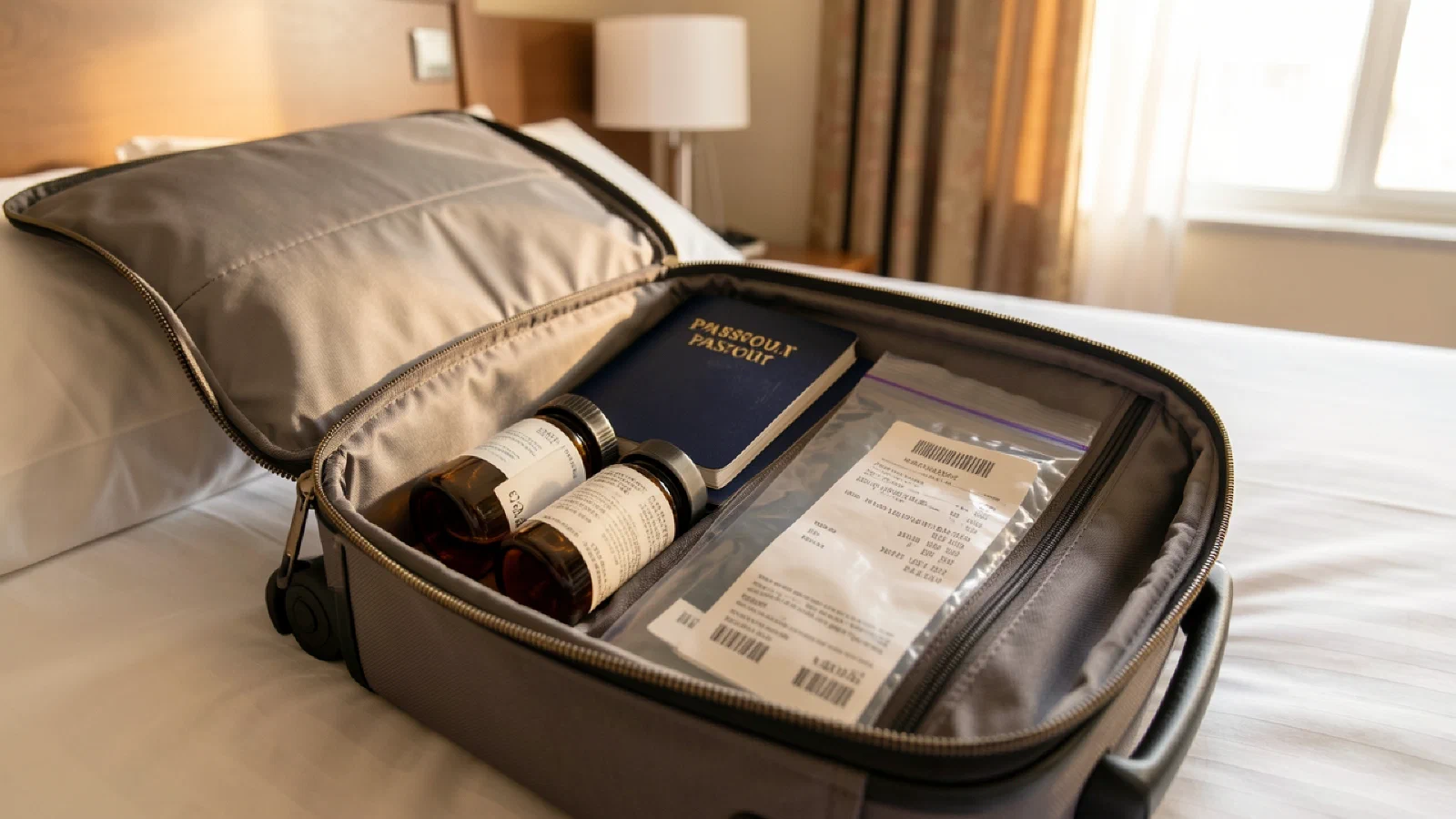
The Prescription Flight
Crossing Borders for Affordable Medications
Four times a year, Robert Chen drives to Windsor, Ontario.
He is seventy-one years old, a retired machinist living in Detroit. The drive takes thirty minutes. At a pharmacy near the Ambassador Bridge, he fills ninety-day supplies of three medications: one for blood pressure, one for cholesterol, one for type 2 diabetes. Total cost in Canada: $340. Total cost at his American pharmacy: $1,400. He has been making this trip for six years. He knows it is not quite legal. He does not care.
Robert represents millions of Americans who have done similar math and reached similar conclusions. The price gap between American and Canadian prescription drugs is so vast, and the enforcement of importation laws so minimal, that crossing a border for medications has become a routine workaround for people who cannot afford their prescriptions at home.
The Price Gap#
Americans pay two to three times more than Canadians, British, or Germans for the same brand-name drugs. Some medications show even larger differentials. Insulin, the medication that keeps 8.4 million Americans alive, reveals the absurdity most starkly: a vial that costs approximately $300 in the United States costs roughly $30 in Canada. The same manufacturer, the same medication, the same life-sustaining compound, priced tenfold higher on one side of the border.
The examples multiply across therapeutic categories. Advair, an asthma medication, costs approximately $400 per month in the United States and $100 in Canada. Eliquis, a blood thinner that prevents strokes, runs about $500 monthly in America and $120 in Canada. Humira, used for autoimmune conditions, costs thousands per month in the United States and a fraction of that across the border.
Why does this gap exist? The United States, alone among wealthy nations, lacks comprehensive government price negotiation for prescription drugs. Patent protections extend longer and face fewer challenges. Pharmacy benefit managers add layers of cost. Reference pricing, which ties domestic prices to international benchmarks, does not exist. The pharmaceutical industry sets American prices based on what the market will bear, and the market will bear a great deal when the alternative is illness or death.
The Inflation Reduction Act brought some relief. Medicare can now negotiate prices for certain drugs. A $2,000 annual cap on Part D out-of-pocket costs reduces catastrophic exposure. Insulin costs are capped at $35 per month for Medicare beneficiaries. These changes help, but they do not eliminate the gap, and they do not help the millions of Americans who are uninsured or whose employer plans offer weak prescription coverage.
The Legal Landscape#
Here is the uncomfortable truth: importing prescription drugs for personal use is technically illegal under federal law. The Federal Food, Drug, and Cosmetic Act prohibits it, with narrow exceptions. Americans who order medications from Canadian pharmacies or carry them across the border are, in a strict legal sense, breaking the law.
Here is the practical truth: the FDA has exercised enforcement discretion for decades. The agency generally does not pursue individuals who import ninety-day supplies for personal use, as long as the drug treats a serious condition, is not commercially available domestically at an affordable price, poses no unreasonable safety risk, and is clearly for the patient’s own consumption. This is not legal permission. It is enforcement discretion, a deliberate choice not to prosecute conduct that remains technically prohibited.
Several states have attempted to formalize drug importation through official programs. Florida received conditional FDA approval for a state importation program in 2024, seeking to import specific medications from Canada for certain state programs. Colorado, Vermont, Maine, New Mexico, New Hampshire, and North Dakota have pursued similar initiatives. As of early 2026, no state program is fully operational. The federal pathway remains bureaucratically complex, and pharmaceutical manufacturers in Canada have shown limited enthusiasm for participating in programs that might reduce their American revenue.
The gray zone persists. Policy could change. A new administration, a new FDA commissioner, a shift in enforcement priorities could transform millions of quiet lawbreakers into prosecution targets. The legal foundation beneath prescription tourism is sand, not bedrock.
Safety Considerations#
The FDA’s official concern about drug importation focuses on safety: counterfeit medications, contaminated products, improper storage, incorrect dosages. These concerns are not fabricated. Counterfeit drugs exist in global supply chains. Online pharmacies range from legitimate operations to criminal enterprises selling dangerous substances.
But the safety calculus requires context. Canada has robust pharmaceutical regulation. Health Canada oversees drug safety with standards comparable to the FDA. Medications dispensed by licensed Canadian pharmacies are generally equivalent to American medications, often manufactured by the same companies in the same facilities. The safety risk of obtaining Lipitor from a verified Canadian pharmacy is not meaningfully different from obtaining it in Detroit.
Mexican pharmacies present more variability. Brand-name medications from established pharmacies in border towns are generally safe. Generics and smaller operations carry more uncertainty. Quality varies in ways that require patient vigilance.
Verification services exist to help patients identify legitimate sources. The Canadian International Pharmacy Association (CIPA) and PharmacyChecker evaluate online pharmacies and certify those meeting safety standards. Using verified sources reduces risk substantially. Red flags include pharmacies that require no prescription, prices dramatically below market rates, unclear source countries, and no verifiable physical address.
How People Do It#
In-person importation from Canada follows a predictable pattern. Patients drive across the border, present their American prescriptions (or work with Canadian physicians who can issue equivalent prescriptions), and fill ninety-day supplies at Canadian pharmacies. Border towns have developed infrastructure to serve this demand. The process is straightforward for those who live within driving distance of the Canadian border.
Mexican border towns serve a similar function for different medications. Some drugs requiring prescriptions in the United States are available over the counter in Mexico. Pharmacies in border towns from Tijuana to Los Algodones serve American customers as a primary market. The process is less formalized than Canadian importation, and the quality spectrum is wider.
Online ordering extends these options to Americans who cannot easily reach a border. Verified Canadian pharmacies accept American prescriptions, coordinate with Canadian physicians as needed, and ship medications by mail. The FDA can technically refuse entry of packages at international mail facilities. In practice, personal-quantity shipments pass through with little interference.
The ninety-day limit matters. Quantities larger than a three-month supply raise red flags and increase the risk of confiscation or, theoretically, prosecution. Patients who stay within this threshold and use verified sources report minimal problems.
The Policy Absurdity#
Consider what is actually happening. Americans are not smuggling dangerous substances. They are not seeking drugs unavailable at home. They are buying FDA-approved medications manufactured by the same companies, at prices those companies charge everywhere else in the developed world. The “danger” is not the medication. The danger, from the pharmaceutical industry’s perspective, is the price comparison.
The illegality protects pricing power, not patients. American law criminalizes the rational response to irrational pricing. The same pill, same manufacturer, same therapeutic effect, crosses from legal to illegal at the border not because anything about the pill changes but because something about the price does.
State importation efforts represent political acknowledgment that the current system fails. Governors and legislators in red and blue states alike have pursued these programs, recognizing that their constituents cannot afford medications priced for American wallets. Federal inaction frustrates these efforts, protecting a pricing structure that benefits manufacturers at the expense of patients.
The moral calculus deserves direct statement: people who ration insulin because they cannot afford American prices sometimes die. People who buy the same insulin in Canada, at prices the manufacturer willingly accepts, break the law. The law is not a guide to ethics here.
What Continues#
Robert Chen will keep driving to Windsor. The savings justify the trip, the risk of prosecution is negligible, and his medications work exactly as well as they would if he paid four times more in Detroit. He does not consider himself a criminal. He considers himself a customer finding a reasonable price.
The prescription flight is not medical tourism in the traditional sense. It involves no hospitals, no surgical suites, no recovery periods. It is a supply chain workaround, a response to artificial scarcity created by policy choices. Americans are buying the same pills at prices the same companies accept, just not at prices those companies demand when American law gives them leverage.
The risk is not the medication. The risk is the system that makes this necessary, and the enforcement discretion that could evaporate. Until policy catches up with reality, people like Robert will keep crossing borders. They are not seeking foreign treatment. They are seeking American treatment at the prices the rest of the world pays.
How this article connects to others in Blue Gray Matters.
Sources cited in this article.
- "Can You Legally Order Prescription Drugs from Outside the U.S.?" Triage Cancer, 16 Dec. 2025, triagecancer.org/can-you-legally-order-prescription-drugs-from-outside-the-u-s.
- "FAQs on Prescription Drug Importation." KFF, 9 Aug. 2025, www.kff.org/health-costs/faqs-on-prescription-drug-importation/.
- Kesselheim, Aaron S., et al. "Insulin Insulated: Barriers to Competition and Affordability in the United States Insulin Market." Journal of Law and the Biosciences, vol. 8, no. 1, 2021, pmc.ncbi.nlm.nih.gov/articles/PMC8249113/.
- Law, Michael R., et al. "Comparisons of Insulin Spending and Price Between Canada and the United States." Mayo Clinic Proceedings, vol. 97, no. 5, 2022, pp. 882-890.
- Miller, Emily. "US Drug Prices vs. The World." Drugwatch, 26 June 2025, www.drugwatch.com/featured/us-drug-prices-higher-vs-world/.
- "Prescription Drug Importation." Congressional Research Service, Congress.gov, www.congress.gov/crs-product/IF11056. Accessed 3 Mar. 2026.
- "Shopping Abroad For Cheaper Medication? Here's What You Need To Know." California Healthline, 21 Aug. 2019, californiahealthline.org/news/shopping-abroad-for-cheaper-medication-heres-what-you-need-to-know/.
- "What You Need to Know Before Purchasing Insulin from Canada." Buy Canadian Insulin, 29 Nov. 2025, www.buycanadianinsulin.com/buying-insulin-from-canada/.