Why Americans Are Flying to Mexico for Their Teeth
Dental Tourism as a Symptom of a Broken System
Linda Martinez is sixty-seven years old, and she is terrified.
She sits in a dental chair in Los Algodones, Mexico, a town of five thousand people just across the border from Yuma, Arizona. Tomorrow morning, a dentist she has never met will place four implants in her jaw. The total cost will be $4,800, including X-rays, the surgical procedure, and the temporary crowns she will wear while her bone heals. Her dentist in Phoenix quoted her $22,000 for the same work. Her Medicare does not cover dental care. Her savings account could not survive that number.
Linda drove four hours to get here. She researched clinics for three months, reading reviews, emailing questions, asking her neighbor who made this same trip last year. She does not know if this is the right decision. She knows she could not afford the alternative.
The Scope of What Is Happening#
Linda is not alone. More than 1.3 million Americans traveled to Mexico for medical and dental care in 2025, according to Border Report, and that number is projected to rise in 2026 as health insurance premiums continue their climb. Dental tourism represents the most common form of this cross-border care, driven by a simple fact: Medicare does not cover routine dental work, and the American dental care system prices millions of people out of the care they need.
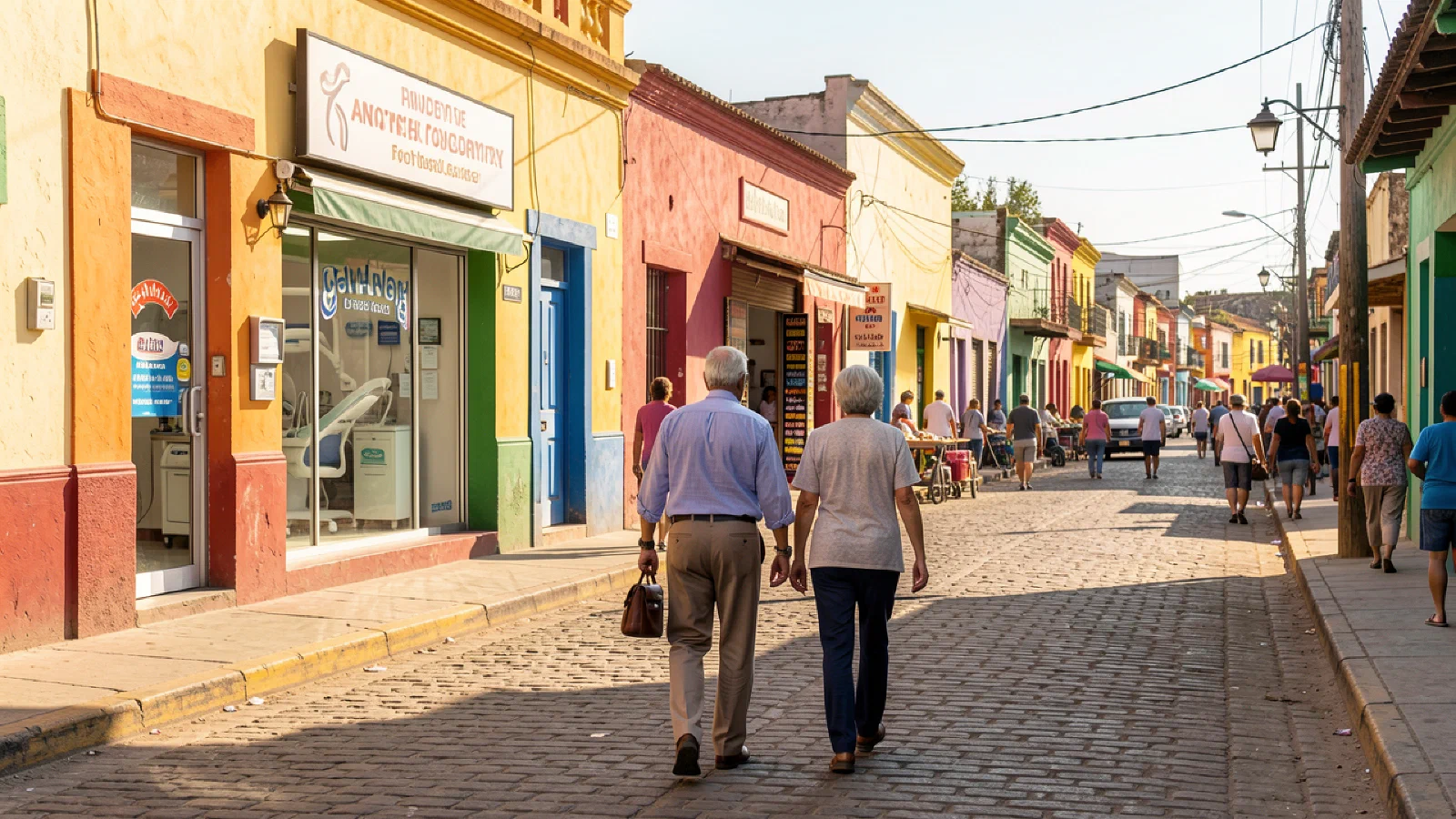
Los Algodones sits at the center of this phenomenon. The town, population roughly five thousand, hosts more than 350 dental clinics, virtually all of them serving American and Canadian patients. Locals call it “Molar City.” On a typical winter day, as many as 13,000 visitors cross the border on foot, parking their cars on the American side and walking into a three-block strip of dental offices, optical shops, and pharmacies. The infrastructure of the town exists to serve people like Linda: retirees on fixed incomes, working adults without dental insurance, anyone facing a dental bill that exceeds what they can reasonably pay.
Other destinations draw American dental tourists as well. Tijuana and Cancun in Mexico, San José in Costa Rica, Medellín in Colombia, Bangkok and Chiang Mai in Thailand. But Los Algodones remains the most accessible, requiring no flights, no hotels for most visitors, and minimal planning for those who can drive to the Arizona or California border.
The Arithmetic of Desperation#
The cost differential explains everything. A dental cleaning that costs $150 to $300 in the United States costs $25 to $50 in Los Algodones. A crown that runs $1,000 to $1,500 at home runs $200 to $400 across the border. A root canal drops from $1,000-$1,500 to $250-$400. A single dental implant, quoted at $3,000 to $5,000 in American cities, costs $800 to $1,500 in Mexican border towns.
For major work, the savings become enormous. Full-mouth restoration, the kind of comprehensive implant work that can transform a patient’s quality of life, costs $30,000 to $50,000 in the United States. The same procedure in Los Algodones costs $8,000 to $15,000. Even accounting for travel expenses, most patients save 40 to 60 percent on major dental work.
Why such a dramatic difference? The reasons are structural. Mexican dental clinics operate with lower overhead: rent, utilities, and staff wages priced in pesos rather than dollars. No insurance middlemen add their cut to every transaction. Border-town clinics place thousands of implants annually, securing wholesale prices on materials that individual American practices cannot match. And American dental pricing, disconnected from the competitive pressures that restrain costs in other markets, has simply risen beyond what the services actually require.
The Quality Question#
The high-end clinics in Los Algodones employ dentists trained at American dental schools, some of whom hold memberships in the American Dental Association. They use FDA-approved materials, the same titanium implants and ceramic crowns manufactured for American practices. They maintain ISO-certified sterilization protocols with documented tracking for every instrument. They offer written warranties on crowns, bridges, and implants.
The low-end clinics do not. Some operate with undertrained staff, poor sterilization practices, and inferior materials that fail earlier than quality alternatives. There is no universal accreditation requirement for dental clinics in Mexico. Regulatory frameworks exist in some states; enforcement varies.
The spectrum matters. A patient who researches carefully, communicates directly with a clinic, verifies credentials, and asks specific questions about materials and warranties may receive care equivalent to what they would receive at home. A patient who walks across the border and follows a street solicitor into the first clinic they encounter faces genuine risk.
The evaluation process requires work that many patients are not equipped to do. Online reviews help but can be manipulated. Dental tourism agencies exist but may steer patients toward clinics that pay referral fees rather than those offering the best care. Before-and-after photos, direct communication with the clinic, and credential verification all take time and knowledge that not everyone possesses.
What Can Go Wrong#
The risks of dental tourism are real, and they deserve honest acknowledgment.
Clinical complications exist with any dental work: infection, nerve damage, implant failure, poor fit, allergic reactions to materials. These risks do not disappear when you cross a border. What changes is your recourse when something goes wrong.
If a crown fails or an implant rejects after you return home, American dentists may be reluctant to perform corrective work on procedures they did not originate. They may charge premium prices for complications they did not cause. They may not be able to determine exactly what was done or what materials were used. Your records from Mexico, if you obtained them, may be incomplete.
Malpractice claims against Mexican dentists are practically impossible to pursue from the United States. You accept this reality when you book your appointment. No legal system will make you whole if something goes seriously wrong.
Some low-cost clinics use inferior materials that fail earlier than quality alternatives. Verifying what materials are actually used in your mouth is difficult for patients who lack technical knowledge. Scams exist; some clinics recommend unnecessary work to extract maximum revenue from one-time visitors who will not return for follow-up.
If You Decide to Go#
For those who have done the math and concluded that dental tourism is their best option, several principles improve outcomes.
Research extensively before committing. Contact multiple clinics, request quotes, verify that quoted prices include everything (X-rays, anesthesia, follow-up visits). Read reviews with skepticism; look for patterns rather than individual complaints or praise. If possible, communicate directly with the dentist who will perform your work, not just an intake coordinator.
Get a treatment plan from an American dentist first. Know what you need before you cross the border. Having an independent diagnosis lets you compare recommendations and catch clinics that recommend unnecessary work.
Start small if possible. If you can manage it logistically, get a cleaning or minor procedure at your chosen clinic before committing to major work. This lets you evaluate the facility, the staff, and the communication before you are dependent on them for something you cannot easily reverse.
Plan for complications before you travel. Identify an American dentist willing to do follow-up care if needed. Understand exactly what warranty the clinic offers and what it covers. Document everything: records, X-rays, materials used, contact information. You will need this if problems arise.
What This Tells Us#
Dental tourism exists because the American healthcare system created it.
When Medicare covers physician visits but not dental care, when a single crown costs a month’s Social Security check, when millions of Americans live with untreated dental disease because they cannot afford treatment, people find alternatives. Those alternatives carry risks. So does going without care. The choice Linda Martinez faced in that Phoenix dental office was not between a perfect option and a flawed one. It was between flawed options, chosen under pressure created by policy failure.
The legislative proposals to add dental coverage to Medicare have not passed. The system that leaves people like Linda calculating whether she can afford to keep her teeth remains intact. And so the parking lots on the American side of the border fill with cars bearing license plates from every western state, their owners walking across an international line to access what their own country has priced beyond reach.
Linda’s implants will probably work. The clinic she chose has good reviews, trained staff, a warranty she can actually use. She did her research. She made a rational decision under irrational circumstances. But she should not have had to make it at all.
How this article connects to others in Blue Gray Matters.
Sources cited in this article.
- "Cost of Dental Work in Mexico 2025: Los Algodones Price Guide." Dental del Rio, 10 Dec. 2025, dentaldelrioalgodones.com/blog/dental-tourism/cost-of-dental-work-in-mexico/.
- "Is Los Algodones Safe for Dental Tourism in 2026?" Globalcare, www.getglobalcare.com/blog/is-los-algodones-safe. Accessed 3 Mar. 2026.
- Johnston, Valerie. "This Small Mexican Town Becomes a Dental Destination as US Healthcare Costs Soar." 12News, 2026, www.12news.com/article/news/health/los-algodones-becomes-dental-destination-as-us-healthcare-costs-soar/.
- "Los Algodones Dentist: Save 70% on Dental Work in Mexico 2025." Globalcare, www.getglobalcare.com/blog/los-algodones-dentist. Accessed 3 Mar. 2026.
- Patients Beyond Borders. "Medical Tourism Statistics and Data." Patients Beyond Borders, www.patientsbeyondborders.com/media. Accessed 3 Mar. 2026.
- Snyder, Jeremy, et al. "A Critical Examination of Empowerment Discourse in Medical Tourism: The Case of the Dental Tourism Industry in Los Algodones, Mexico." BMC Medical Ethics, vol. 19, no. 1, 2018, pmc.ncbi.nlm.nih.gov/articles/PMC6054732/.