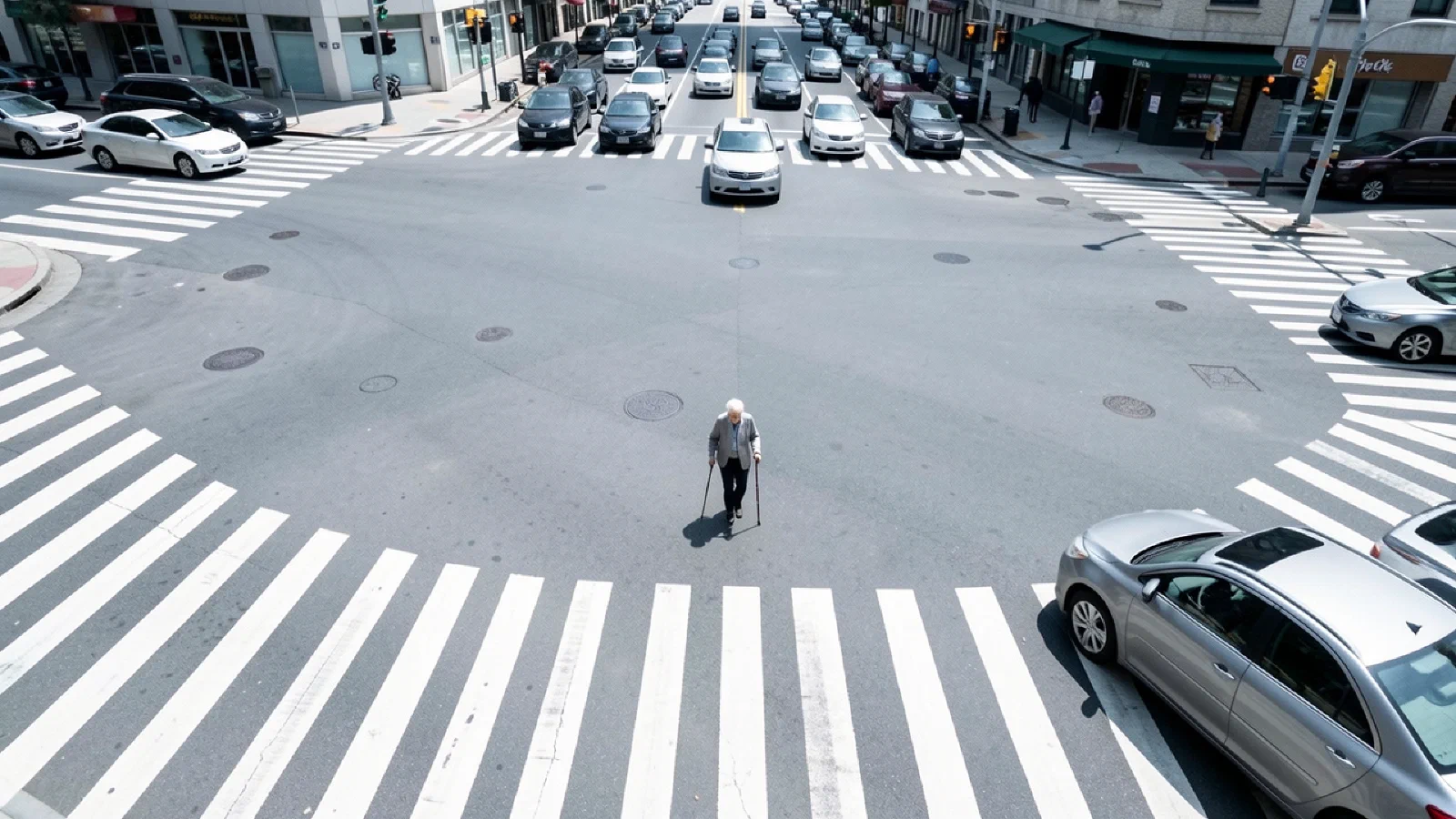
Invisible by Design
How Ageism Operates in Media, Medicine, and Daily Life
Margaret Okonkwo was seventy-four years old when she walked into the emergency room with chest pain.
The physician spent four minutes with her. He noted her age, asked a few questions, attributed the discomfort to anxiety, and sent her home with a brochure about stress management. Three days later, she collapsed in her kitchen. The heart attack that killed her had been building for weeks, throwing off warning signs that her doctor dismissed as expected at her age.
Her neighbor, Susan Chen, had presented to the same emergency room two months earlier with similar symptoms. Susan was fifty-four. She was admitted immediately, underwent cardiac catheterization, received two stents, and went home to her family. Same symptoms. Same hospital. Different outcome.
Margaret’s death was not a medical mystery. It was a predictable consequence of a system that sees older patients as less worth investigating, less likely to benefit from intervention, less worthy of the time and attention that saves lives.
What Ageism Is#
The World Health Organization defines ageism as stereotypes (how we think about people based on age), prejudice (how we feel about them), and discrimination (how we act toward them). It operates in two directions: against the young and against the old. This series focuses on ageism directed at older adults, because that is where the health consequences are most severe and least acknowledged.
The key insight is structural. Ageism is not primarily a matter of individual rudeness or personal bias. It is embedded in institutions, policies, and systems. It shapes who gets hired, who receives aggressive medical treatment, who appears in advertisements, whose opinions are sought, whose presence is welcomed. Individual attitudes matter, but they exist within and are shaped by structures that make certain responses to older people seem natural, reasonable, even kind.
A 2023 University of Michigan survey found that 82 percent of adults over fifty reported experiencing ageism in everyday life. The forms ranged from being ignored in conversations to receiving patronizing treatment from healthcare providers to encountering assumptions that they could not learn new technologies or contribute meaningfully at work. For most, these experiences were not dramatic. They were routine, cumulative, and exhausting.
Where It Operates#
In media, older adults are underrepresented and misrepresented. When they appear in advertising, film, and television, they are often frail, confused, or comic relief. Rarely protagonists. Rarely experts. Rarely desirable. Rarely visible at all. The absence is as powerful as the stereotype: older people learn that they have disappeared from the cultural conversation, that stories are no longer told by or about or for them.
In medicine, ageism shapes both under-treatment and over-treatment. Older patients receive less aggressive cancer care, fewer cardiac interventions, and less attention to mental health symptoms than younger patients with identical presentations. Physicians spend less time with older patients, use patronizing speech that researchers call “elderspeak,” and attribute treatable symptoms to “just getting old.” The technical term is diagnostic overshadowing: the tendency to stop investigating once age provides a convenient explanation.
At the same time, older patients sometimes receive too much treatment: unnecessary medications, paternalistic decisions made without their input, and assumptions of fragility that lead to over-protection. The pattern is not simply neglect. It is a failure to see the older person as an individual whose circumstances, preferences, and capacities require actual assessment rather than age-based assumption.
In the workplace, covered extensively in Series 6, ageism manifests as hiring discrimination, assumptions about declining capacity, exclusion from training and advancement, and the quiet pressure to retire before one is ready. Algorithms now scale these biases, screening out older applicants before human recruiters ever see their names.
In daily life, ageism operates through small erosions: the stranger who speaks slowly and loudly as if to a child, the family member who stops asking for opinions, the group conversation that continues as if the older person were not present. The exclusion from decision-making in families and communities. The assumption of incompetence that must be constantly disproven.
What It Does to Bodies#
Here is where the research becomes most striking. Ageism does not merely offend. It shortens lives.
Becca Levy, a psychologist at Yale who has studied ageism for three decades, has documented what happens when people absorb negative beliefs about their own aging. In one foundational study, she found that older individuals with positive self-perceptions of aging lived an average of 7.5 years longer than those with negative self-perceptions. The effect held after controlling for age, gender, socioeconomic status, loneliness, and functional health. Believing that aging means decline appears to make decline more likely.
The mechanisms are both physiological and behavioral. Chronic exposure to discrimination triggers stress responses: elevated cortisol, increased inflammation, impaired immune function. People who internalize negative age stereotypes exercise less, seek healthcare less often, and engage socially less frequently. They perform worse on cognitive and physical tests when stereotypes are made salient, a phenomenon called stereotype threat. The belief that they cannot do something becomes self-fulfilling.
A 2020 study by Levy and colleagues calculated the healthcare costs of ageism at $63 billion annually in the United States. The figure accounts for the excess prevalence of major health conditions attributable to age discrimination, negative age stereotypes, and negative self-perceptions of aging among Americans over sixty. That is more than the country spends on health costs related to obesity. Ageism is not a social nicety. It is a public health crisis with a measurable price tag.
The Internalized Dimension#
The most insidious form of ageism operates within older people themselves.
Negative age stereotypes are absorbed throughout life, beginning in childhood, reinforced by media, humor, casual conversation, and commercial messaging. By the time people reach old age, they have decades of accumulated beliefs about what aging means: decline, irrelevance, burden, loss. These beliefs do not evaporate upon reaching sixty-five. They become self-applied.
Internalized ageism sounds like this: “I’m too old to learn that.” “What do you expect at my age?” “I don’t want to be a burden.” It looks like reluctance to advocate for oneself, acceptance of poor treatment, withdrawal from activities that could bring meaning. It feels like resignation, which is often mistaken for wisdom or acceptance.
The double bind is painful. Challenging ageism can be dismissed as denial or vanity: the older person who does not accept their diminishment gracefully. Accepting it validates the stereotype and accelerates the decline. There is no comfortable position, only strategic choices about when to push back and when to conserve energy for other battles.
Cultural reinforcement is constant. Birthday cards mock aging. Jokes about memory and incontinence and irrelevance are considered acceptable humor. The phrase “OK, boomer” encapsulates a dismissal so complete that it does not require engagement with what the older person actually said. The message is clear: your opinions no longer matter, and your awareness that they no longer matter is itself funny.
Why This Is a Civil Rights Issue#
Ageism affects health and life expectancy as significantly as racism and sexism. It receives a fraction of the attention.
Legal protections against age discrimination are narrower than protections based on race, sex, or disability. The Age Discrimination in Employment Act covers workers forty and older, but court interpretations have weakened it over time. No comprehensive civil rights framework prohibits ageism in healthcare, housing, or public accommodations. An employer cannot refuse to hire someone because of their race; a hospital cannot decline to treat someone because of their gender. But a physician can decide that aggressive treatment is not worth pursuing because of a patient’s age, and no law clearly prohibits that judgment.
The invisibility of the issue is part of its power. Ageism is so normalized that many people do not recognize it as discrimination. They experience the slights, the exclusions, the diminished expectations, and they attribute them to personal failing or inevitable decline rather than to a system that treats older people as worth less.
The WHO has called for treating ageism as a public health crisis requiring policy intervention, educational programs, and increased intergenerational contact. The United States has not taken that call seriously. The gap between the evidence and the response suggests that ageism remains, in Robert Butler’s original formulation from 1969, the most tolerated form of social prejudice.
At Your Kitchen Table#
If you recognized yourself in Margaret Okonkwo’s story, or in the accumulation of small erasures that older people experience daily, that recognition is where this series begins.
The installments that follow examine how AI systems encode and scale age bias, stripping older workers of opportunities they never know they lost. They confront the tension between autonomy and protection, the question of who gets to decide when an older person needs saving from themselves. They profile those who refuse the narrative of decline and are rewriting what aging can mean. And they ask what we lose as a society when we warehouse and ignore our oldest members.
Ageism is not a minor inconvenience. It is a system that shortens lives, worsens health, and erases dignity. It operates through institutions and within minds. It is structural and personal simultaneously. The first step toward fighting it is seeing it clearly: in the emergency room, in the job listing, in the mirror, and in the casual cruelties that no one calls out because everyone considers them normal.
Margaret Okonkwo deserved four minutes of attention that took her symptoms seriously. She deserved the same diagnostic curiosity that Susan Chen received. She deserved to be seen. The system that failed her is the same system that makes invisible millions of older Americans every day. Naming it is the beginning of changing it.
How this article connects to others in Blue Gray Matters.
Sources cited in this article.
- Chang, E-Shien, et al. "Global Reach of Ageism on Older Persons' Health: A Systematic Review." PLoS ONE, vol. 15, no. 1, 2020, e0220857. doi.org/10.1371/journal.pone.0220857.
- Levy, Becca R. Breaking the Age Code: How Your Beliefs About Aging Determine How Long and Well You Live. William Morrow, 2022.
- Levy, Becca R., et al. "Ageism Amplifies Cost and Prevalence of Health Conditions." The Gerontologist, vol. 60, no. 1, 2020, pp. 174-181. doi.org/10.1093/geront/gny131.
- Levy, Becca R., et al. "Longevity Increased by Positive Self-Perceptions of Aging." Journal of Personality and Social Psychology, vol. 83, no. 2, 2002, pp. 261-270.
- University of Michigan. "Everyday Ageism." National Poll on Healthy Aging, 2023, healthyagingpoll.org/reports-more/report/everyday-ageism.
- World Health Organization. Global Report on Ageism. WHO, 2021, who.int/publications/i/item/9789240016866.