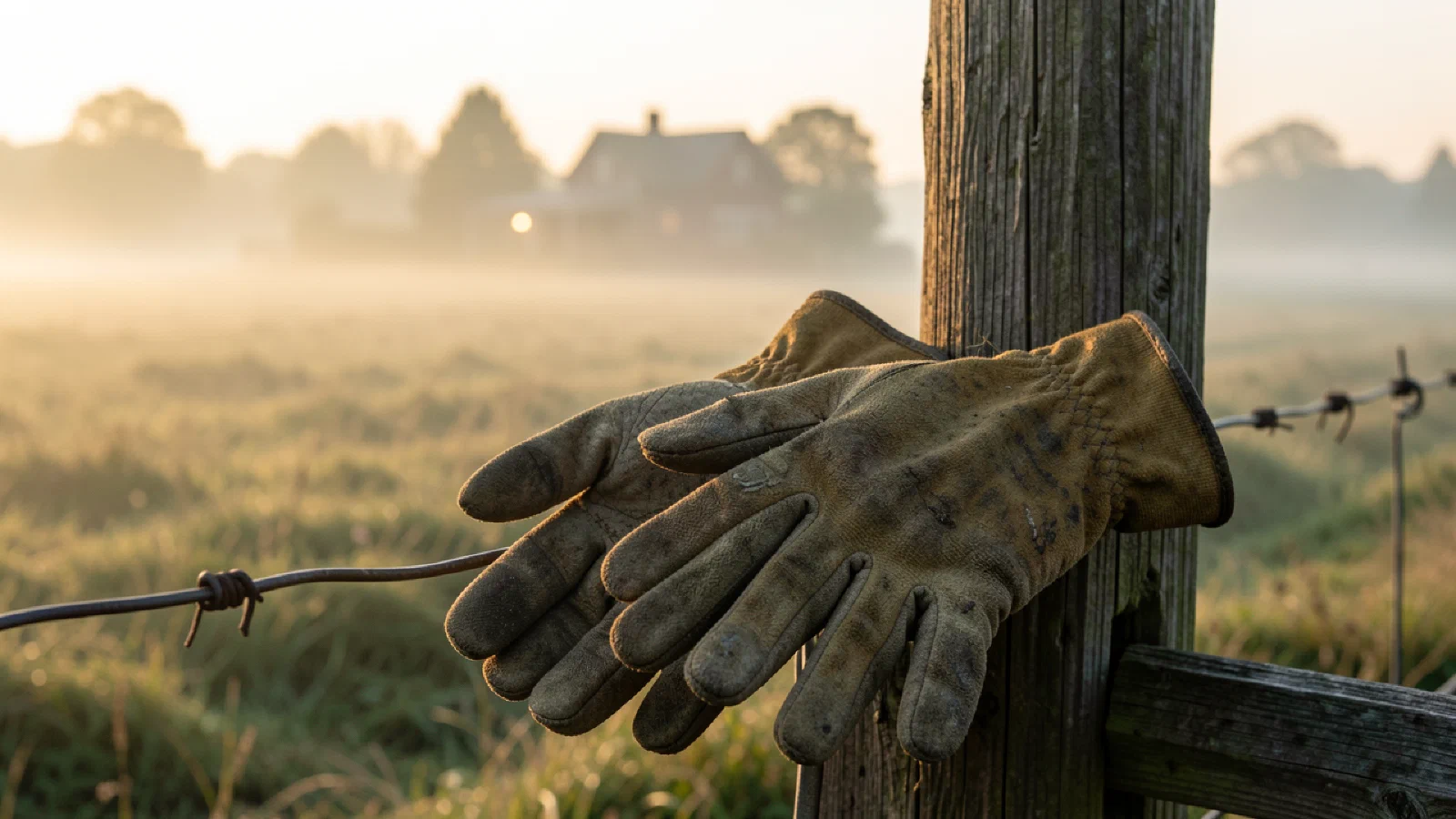
Aging on the Farm
Land, Labor, and the Weight of Legacy
Glen Hargis rises at 4:30, same as he has for fifty years. The cattle will not feed themselves. His knees are bone-on-bone, his lower back a constant argument, and his hands ache in the cold in ways they did not ten years ago. He is 74. His son moved to Denver in 2016 and works in software. His daughter teaches in Kansas City. Neither one is coming back to run this place.
The ranch is 640 acres in southeastern Montana. The land has been in the family since Glen’s grandfather homesteaded it. It is worth, on paper, something north of two million dollars. Glen’s checking account holds enough to cover this month’s feed bill and next month’s property taxes. If he sells, he erases four generations. If he does not sell, he works until his body quits, and then he does not know what happens.
He has not been to a doctor in three years. The nearest one is in Miles City, 80 miles away. He does not talk about his knees, his loneliness, or the fear that wakes him at 3 AM. Talking about those things is not something men in his world do.
The Oldest Workforce in America#
The average age of all U.S. farm producers is now 58.1 years, according to the 2022 Census of Agriculture, the most recent available. That figure has risen with every census for decades. Producers 65 and older make up more than 40 percent of all farmers and ranchers in the country, and their share increased 12 percent between 2017 and 2022 while the number of producers aged 35 to 64 declined by 9 percent.
These are not abstract trends. They describe a workforce aging in place because no one is coming to replace it. Approximately 70 percent of American farmland will change hands in the next 20 years. Many operators have no succession plan, no identified buyer, and no clear path to retirement, because retirement on a working farm is not a concept the occupation was built around. You do not retire from feeding cattle. You do it until you cannot, and then you figure something out.
There are bright spots in the data. Young producers under 35 increased by nearly 4 percent, and beginning farmers (those with ten or fewer years of experience) grew by 11 percent. But these new entrants tend to operate smaller farms with lower sales. They are not, in most cases, taking over the large livestock and grain operations that anchor rural economies. The generational pipeline that once moved a farm from father to son (and it was almost always father to son) has thinned to a trickle.
Asset Rich, Cash Poor#
The financial paradox of farming confounds people who have not lived it. Glen’s land is worth two million dollars. By the net worth calculation a financial planner would use, he is wealthy. By the cash flow calculation that determines whether he can see a doctor or fix his truck, he is not.
Commodity prices are volatile. Input costs (fuel, feed, seed, fertilizer, equipment) rise steadily. Margins are thin in good years and nonexistent in bad ones. The 2022 Census reported average farm income of $79,790, but that figure masks enormous variation. Forty-three percent of farms had positive net cash income; the rest broke even or lost money. The 74 percent of farms with sales under $50,000 accounted for just 2 percent of total agricultural sales. Most American farms are small operations where the family’s income depends heavily on off-farm employment.
Healthcare is a particular vulnerability. Farm operators rarely have employer-sponsored insurance. Many purchase coverage through the ACA marketplace, where premiums are significant and deductibles are high. A major illness or injury can force the sale of land that a family has held for generations. The farm is simultaneously their greatest asset and their greatest risk, because it cannot be liquidated in parts without destroying what it is.
The Labor That Does Not Stop#
There is no mechanism in agriculture for the body to negotiate with the work. The cattle need feeding whether your knees function or not. Fences need mending regardless of your back. Harvest does not wait for recovery from surgery.
Agriculture is among the most dangerous industries in the United States. Older farmers have higher fatality rates from equipment accidents, falls, and animal-related injuries. A lifetime of manual labor accumulates: arthritis, joint damage, hearing loss from decades of machinery noise, respiratory problems from dust and chemical exposure. The physical toll is not a surprise to anyone who has lived it. What may surprise outsiders is that there is no substitute for the farmer. When the person who runs the operation is injured or sick, the work does not stop. It waits, partially done, generating consequences.
The CDC data on farmer suicide are stark. The suicide rate among farmers is 3.5 times higher than the general population, according to the National Rural Health Association. A 2020 CDC study of occupational suicide rates found the rate for farmers, ranchers, and agricultural managers was 43.7 per 100,000, placing agriculture among the highest-risk occupations. The most common circumstance among those who died was physical health problems, and that factor was highest among farmers over 65.
Financial pressure, weather volatility, market uncertainty, isolation, and physical pain converge in a population that has been culturally trained to solve its own problems and never admit weakness. An American Farm Bureau survey found that while 91 percent of rural adults say mental health matters, 61 percent still consider stigma a barrier to seeking help. In small communities where everyone knows everyone, walking into a counselor’s office feels like a public announcement.
The Women Who Hold It Together#
The outline of farm life is typically drawn around the man on the tractor. The fuller picture includes the woman in the kitchen who also does the books, manages the household, drives the children (or grandchildren) to school, and provides care when a spouse or parent develops a chronic condition or cognitive decline.
Farm wives have always performed a double shift of agricultural and domestic labor. When a husband’s health fails, the caregiving shift becomes a third. The formal support systems that might ease this burden in other settings barely exist in many rural areas. Home health agencies are scarce. Adult day programs may be a county away. Respite care waitlists stretch for months or years. The farm wife who is managing her husband’s diabetes, handling the ranch’s finances, and helping with calving season is not a hypothetical. She is a common figure in agricultural communities, and she is often invisible to the systems that are supposed to help.
Research consistently shows that women farmers report depressive symptoms at rates up to four times higher than men. Their mental health burden is compounded by caregiving expectations that are both cultural and structural: cultural because farm communities assign women the caring role, structural because there is no one else available to fill it.
What Would Help#
The people who feed this country are aging without a safety net built for their circumstances. What would help is not mysterious, even if it remains politically unfinished.
USDA programs designed with aging operators in mind could include dedicated transition planning assistance, because the succession crisis is as much a failure of support as it is a failure of planning. Many farmers would engage with the process if someone met them where they are (the kitchen table, the extension office, the co-op meeting) rather than expecting them to seek out services designed for urban professionals.
Rural caregiver support needs to be scaled to the actual geography. Respite care that requires a 90-minute drive each way is not respite. Home health services need to reach dispersed populations, which means rethinking staffing models and reimbursement structures built for denser settings.
Farm-specific mental health programs exist and some of them work well. Farm Aid’s hotline, New York FarmNet’s kitchen-table counseling model (where counselors and business advisors visit the farm together), and state extension programs that train agricultural professionals to recognize signs of crisis all represent approaches that respect the culture while refusing to leave people alone in it. These programs need funding and expansion, not invention.
And the culture itself is shifting, if slowly. Younger farmers are somewhat more willing to discuss mental health. Organizations like the American Farm Bureau have made farm stress a visible priority. The change will not be fast enough for Glen’s generation, but the silence is beginning to break.
What the Land Cannot Say#
The farm is identity, legacy, and weight, all at once. It is the place where Glen’s grandfather broke sod, where his father taught him to ride, where he scattered his wife’s ashes along the creek. It is also the place that will not let him rest, that demands his body long after his body has asked to stop, that ties his financial survival to decisions made by commodity markets and weather systems he cannot control.
Seventy percent of American farmland will change hands in the next two decades. That transition will reshape rural America in ways that are difficult to predict. What is predictable is this: the people managing that transition are doing it largely alone, largely in pain, and largely without the support that the scale of the problem demands.
The land will outlast them. It always does. The question is what we owe the people who spent their lives on it.
How this article connects to others in Blue Gray Matters.
Sources cited in this article.
- United States Department of Agriculture, National Agricultural Statistics Service. "2022 Census of Agriculture." USDA NASS, 13 Feb. 2024, www.nass.usda.gov/AgCensus/.
- National Rural Health Association. "Addressing Higher Risk of Suicide Among Farmers in Rural America." NRHA Policy Brief, 2024.
- Peterson, Cora, et al. "Suicide Rates by Industry and Occupation: National Violent Death Reporting System, 32 States, 2016." MMWR Morbidity and Mortality Weekly Report, vol. 69, no. 3, 2020, pp. 46-52.
- American Farm Bureau Federation. "Farm State of Mind: Farmer and Rural Perceptions of Mental Health." AFBF, 2024, www.fb.org/initiative/farm-state-of-mind.
- National Sustainable Agriculture Coalition. "Examining the Latest Agricultural Census Data." NSAC, 8 Mar. 2024, sustainableagriculture.net/blog/examining-the-latest-agricultural-census-data/.
- Rural Health Information Hub. "Rural Response to Farmer Mental Health and Suicide Prevention." RHIhub, 2024, www.ruralhealthinfo.org/topics/farmer-mental-health.