Broadband as a Lifeline
The Infrastructure That Decides Who Gets Care and Who Gets Left Behind
Phyllis Jackson is 78 and lives outside Pittsburgh. Before the Affordable Connectivity Program, she had no computer and no internet at home. The $30 monthly subsidy changed that. She learned to video call her grandchildren. She scheduled medical appointments online. She checked her bank statements without driving to the branch. She felt, for the first time in years, like the world had not moved on without her.
The Affordable Connectivity Program ran out of money on June 1, 2024. Congress did not renew it. Phyllis is one of an estimated 5 million households that have cut internet service entirely since the program ended. In an Albuquerque senior housing development, 42 residents had home internet through the ACP. Fewer than half have managed to keep it. The services coordinator there describes the change in simple terms: residents who could video call their grandkids no longer can. Residents who managed their health through patient portals no longer do.
The internet is not a luxury. For millions of older Americans, it is the infrastructure on which healthcare, social connection, financial management, and safety now depend. And when it disappears, everything that ran on it disappears too.
The Divide That Never Closed#
The digital divide among older adults is not a single gap. It is three gaps stacked on top of each other: access, affordability, and ability.
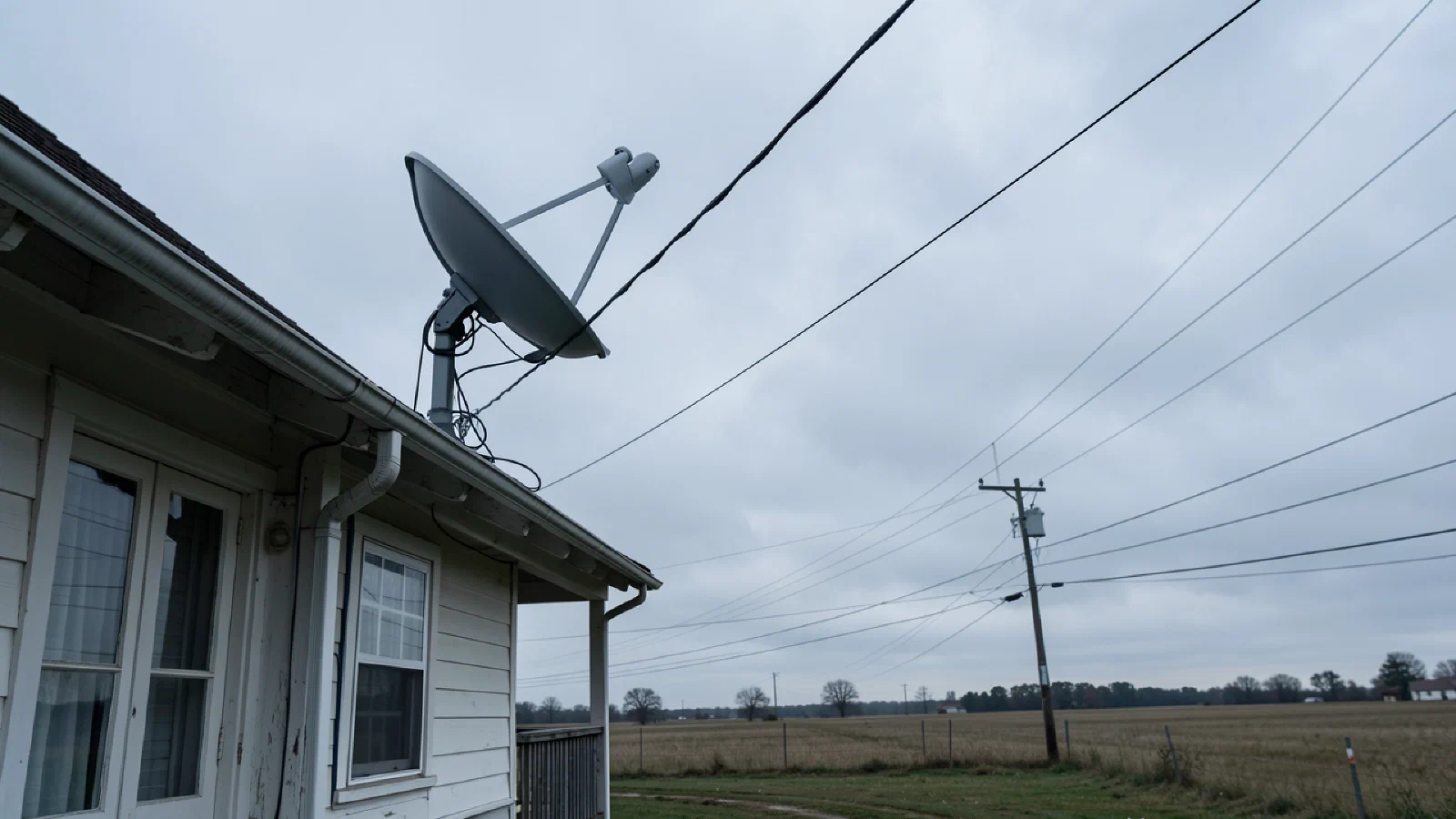
Access is the physical question. Does broadband infrastructure reach your address? Approximately 21 percent of rural Americans still lack access to broadband at the FCC’s threshold speeds. The real number is likely higher, because the FCC’s broadband maps have historically overstated coverage by counting an entire census block as served if a single address in that block has service. In the most remote areas, no provider has laid cable or installed wireless equipment because the economics do not work. The cost of connecting a household at the end of a gravel road in eastern Montana dwarfs the revenue that household will ever generate.
Affordability is the question that killed the ACP. Even where broadband is available, the cost is a barrier. More than 23 million households relied on the ACP’s $30 monthly subsidy, and 10.6 million of those subscribers were aged 50 or older. One in five ACP households included someone 65 or older. When the program expired, 77 percent of enrolled households said losing the benefit would disrupt their service. More than 30 percent of Americans 65 and older lack high-speed home internet, according to AARP’s Older Adults Technology Services. The gap is not about preference. It is about price.
Ability is the third layer, and possibly the most stubborn. Even where broadband is available and affordable, many older adults lack the devices, skills, or confidence to use it. Digital literacy programs exist but are underfunded and unevenly distributed. A 79-year-old who has never used a computer cannot become a fluent telehealth patient with a pamphlet and a login. The learning curve is real, and it requires patient, sustained, in-person support that most communities do not provide at scale.
When Healthcare Assumes You Are Connected#
The shift to telehealth during COVID was framed as a permanent advance. Medicare expanded telehealth coverage. Providers invested in platforms. Patients who could connect from home avoided travel, wait times, and exposure risk. For many, it was genuinely better.
But the system that embraced telehealth did not pause to ask who it was leaving behind. When a health system moves its appointment scheduling online, the patient without internet cannot schedule. When a specialist offers video consultations, the patient without a device or the bandwidth to support video cannot participate. When a pharmacy sends medication reminders through an app, the patient without a smartphone does not receive them.
The assumption of connectivity is now baked into the healthcare system. Patient portals, electronic prescription management, remote monitoring devices, care coordination platforms: each assumes a broadband connection and a device capable of running the software. The people most likely to lack both are older, poorer, rural, and disproportionately Black and Hispanic. The same populations that already face the steepest barriers to care.
This is not a technology problem. It is an equity problem wearing a technology costume.
What $42.45 Billion Has Not Yet Built#
The Broadband Equity, Access, and Deployment Program (BEAD), funded by the 2021 Infrastructure Investment and Jobs Act, allocated $42.45 billion to connect every American to high-speed internet. It was the largest broadband investment in American history, and the ambition was proportionate to the problem.
As of mid-2025, no BEAD funding has been distributed for any eligible broadband deployment projects. All 56 states and territories have submitted their final proposals, and 52 have received approval from the National Telecommunications and Information Administration. But the program has been mired in bureaucratic and political disputes over technology requirements (fiber versus satellite versus fixed wireless), labor standards, and the definition of what constitutes an adequate low-cost service option. A June 2025 restructuring by NTIA changed key program rules, requiring states to conduct additional rounds of competitive bidding and reopening questions that many had considered settled.
Meanwhile, the number of locations eligible for BEAD funding has dropped by more than half since allocations were set in 2023, as private investment and other federal programs have extended coverage. This is arguably good news: the digital divide is narrowing. But the locations that remain unserved are the hardest and most expensive to reach, and the people living there have been waiting longest.
The timeline matters. Even under optimistic scenarios, BEAD-funded construction will take years to complete. For a 78-year-old who needs telehealth now, a fiber line arriving in 2028 is not a solution. It is a promise for someone else.
The Affordability Crisis After the ACP#
The ACP’s expiration created an immediate crisis that infrastructure investment cannot solve. Building broadband to an address means nothing if the person at that address cannot afford the monthly bill.
One year after the ACP ended, the consequences are documented. An estimated 5 million households have disconnected entirely. Pew Research Center data from 2024 shows broadband adoption at 92 percent for households earning over $100,000 but just 57 percent for those earning under $30,000. The divide is not narrowing at the bottom of the income scale; it is holding steady or widening.
New York became the first state to require internet providers to offer a $15 monthly plan to qualifying low-income residents. California, Massachusetts, Vermont, Connecticut, Maryland, and Minnesota have proposed similar mandates. The broadband industry has pushed back, with trade groups urging federal preemption of state affordability laws. The political fight over who pays for affordable internet is unresolved, and every month it remains unresolved, more older adults fall off the connected side of the divide.
The remaining federal option is the Lifeline program, which provides a $9.25 monthly discount on phone or internet service. It is modest, underused, and insufficient. It was designed for a world where a phone line was the essential connection. It has not been updated for a world where the essential connection is broadband.
What This Means at the Kitchen Table#
For the reader managing a parent’s medications from across the country, the broadband gap means the remote monitoring system that would provide peace of mind requires infrastructure that may not exist at the parent’s address.
For the reader who relies on telehealth for specialist visits, losing internet means losing access to the doctor, not because the doctor is far away but because the connection is.
For the caregiver coordinating between multiple providers, the patient portal that was supposed to simplify everything becomes another barrier when the person receiving care cannot access it.
For the person living alone whose primary social connection is a weekly video call with grandchildren, the end of the ACP means the end of that call.
These are not hypothetical scenarios. They are the daily reality for millions of older Americans, and they are invisible to anyone whose internet works without thought or worry.
What Would Help#
The policy agenda is not complicated. It is unfunded.
Congress needs to replace the ACP with a permanent broadband affordability program, not a one-time appropriation that expires when the money runs out. Internet access for low-income older adults is a healthcare issue, a social isolation issue, and an equity issue. It should be funded accordingly.
BEAD deployment needs to move faster, and the remaining unserved locations (the hardest, most expensive ones) need to be prioritized, not deferred. The people who have waited longest for connectivity should not wait longest for the funding designed to serve them.
Digital literacy support needs to be embedded in healthcare, senior services, and community organizations, not treated as a separate program that older adults must seek out. When a health system rolls out a patient portal, it should fund the training and support that its oldest, least-connected patients need to use it.
And the assumption of connectivity needs to be recognized for what it is: a policy choice that excludes the people most in need of the services that connectivity provides. Every system that moves online without maintaining an offline alternative is making a decision about who matters. That decision should be made consciously, not by default.
The Line That Connects Everything#
Broadband is infrastructure in the same sense that roads, water systems, and electrical grids are infrastructure. It is the foundation on which other systems run. When it is absent, those systems fail for the people who lack it, no matter how well the systems work for everyone else.
Phyllis Jackson did not lose a convenience when the ACP ended. She lost a connection to her grandchildren, her doctor, her bank, and her sense that the world still included her. The line that carried all of those things was never a luxury. It was a lifeline, and it was cut.
How this article connects to others in Blue Gray Matters.
Sources cited in this article.
- AARP. "Broadband's Cost Burdens Many Older Adults." AARP, Feb. 2025, www.aarp.org/advocacy/states-address-internet-costs/.
- Broadband Breakfast. "One Year Without the Affordable Connectivity Program." Broadband Breakfast, 31 May 2025, broadbandbreakfast.com/one-year-without-the-affordable-connectivity-program/.
- Congressional Research Service. "The End of the Affordable Connectivity Program." CRS In Focus IF12637, 18 Apr. 2024.
- Congressional Research Service. "The Broadband Equity, Access, and Deployment (BEAD) Program: Issues for the 119th Congress." CRS Report R48666, Aug. 2025.
- National Telecommunications and Information Administration. "BEAD Progress Dashboard." NTIA, 2025, www.ntia.gov/funding-programs/internet-all/broadband-equity-access-and-deployment-bead-program/progress-dashboard.
- Federal Communications Commission. "Affordable Connectivity Program." FCC, 2024, www.fcc.gov/acp.
- The Markup. "The Affordable Connectivity Program Was a Connectivity Lifeline for Millions. Congress Is Letting It Die." The Markup, 4 May 2024.