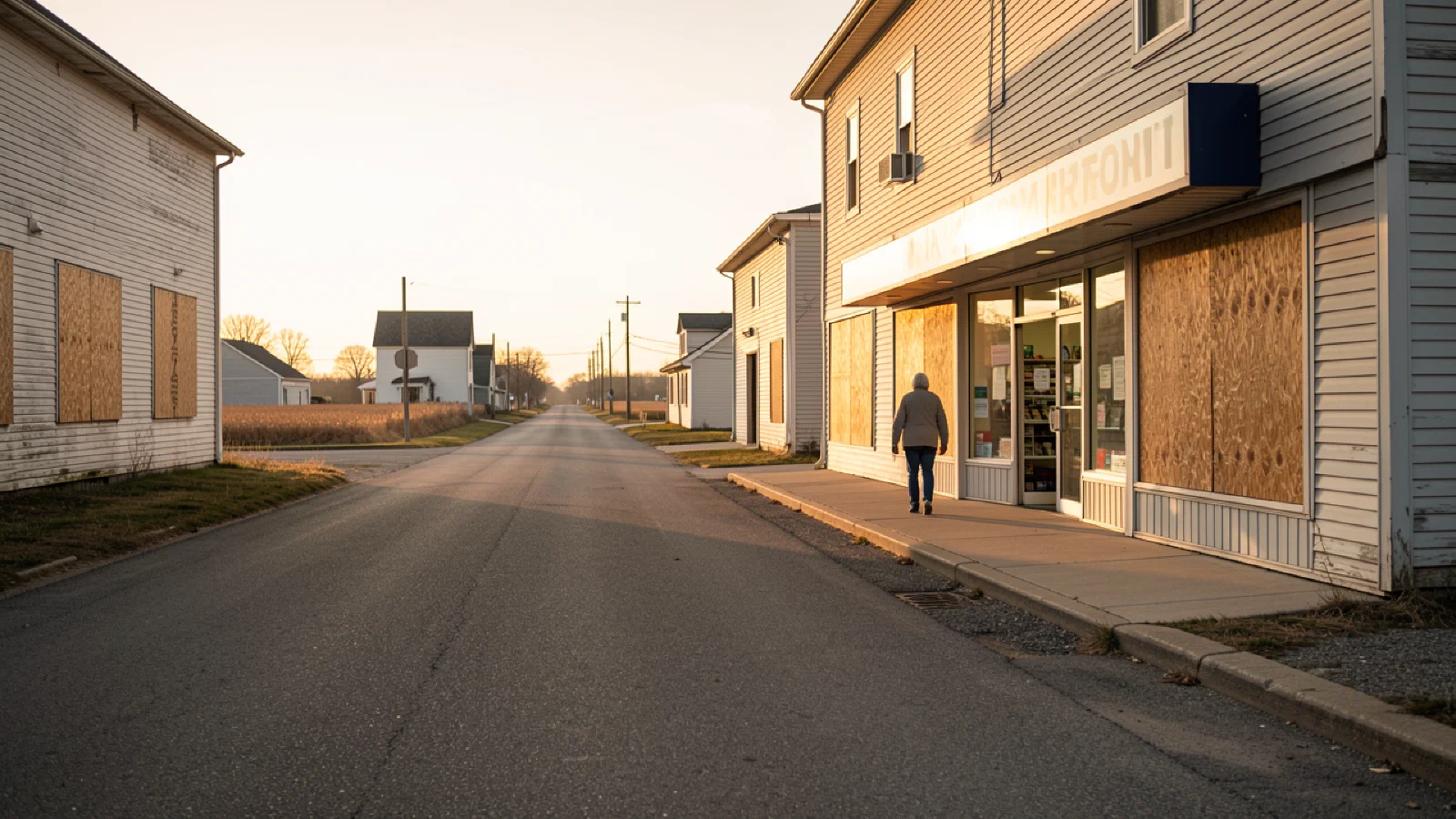
The Rural Cliff
Hospital Closures, Physician Deserts, and the Collapse of Rural Healthcare
Doris Whitaker wakes to chest pain at 2:14 on a Tuesday morning in Owsley County, Kentucky. She is 72, lives alone since Roy passed, and knows this feeling is wrong. Not heartburn. Not anxiety. Something deeper, something pressing against her ribs like a fist closing from inside.
She calls 911. The dispatcher tells her the ambulance is on its way from the station in Booneville, fourteen miles of winding mountain road. Doris sits on the edge of her bed and waits. The nearest hospital closed three years ago. The next nearest is in Jackson, 47 miles away. If the ambulance takes her there, the whole trip, from her bedroom to an emergency physician, will take well over an hour.
In Lexington, 90 miles north, a woman with the same symptoms would be in a cardiac catheterization lab within 40 minutes of calling for help. In Owsley County, that timeline does not exist. The infrastructure that would make it possible is gone.
Doris will survive this night. Her neighbor, same symptoms eight months earlier, did not make it to Jackson in time.
The Scale of What Has Disappeared#
Since 2010, 182 rural hospitals across the United States have closed or converted to models that no longer provide inpatient care. That number comes from the Chartis Center for Rural Health, which has tracked the collapse in real time for more than a decade. The University of North Carolina’s Sheps Center, using a broader definition of “rural,” puts the count at 193 closures from 2005 through 2024. In 2024 alone, 18 rural hospitals either shut down entirely or stopped admitting patients overnight.
These are not numbers that have stabilized. According to Chartis, 46 percent of all rural hospitals now operate at a negative margin. Four hundred and thirty-two are considered vulnerable to closure. In nine states, the majority of rural hospitals could shut down within the next several years.
The geography of collapse is not random. Nearly 70 percent of rural hospital closures between 2014 and 2024 occurred in states that had not expanded Medicaid at the time of closing. Texas has lost 26 rural hospitals since 2010, the most of any state. Tennessee has lost 16. Georgia, Kansas, Mississippi, Missouri, and Oklahoma have each lost 11. The pattern follows a map of political choices about who deserves healthcare coverage, and the people living with the consequences of those choices are overwhelmingly older, sicker, and poorer than the national average.
When a hospital closes, the damage is not limited to the building. Physicians leave because there is no facility to support their practice. When physicians leave, the pharmacy loses customers and closes. The clinic becomes unviable. Lab work and imaging require a trip to the next county. The local economy loses one of its largest employers. A healthcare ecosystem that took decades to build can unravel in months.
The Physician Desert#
The term sounds dramatic until you try to find a doctor.
Approximately 65 percent of the areas designated by the federal government as primary care Health Professional Shortage Areas are rural. Millions of Americans live in communities where a family physician is either unavailable or booked months out. For specialists, the distances become punishing. A cardiologist might be two hours away. An oncologist, three. A neurologist who could evaluate early cognitive changes, the kind that might lead to a timely Alzheimer’s diagnosis, may require a full day of travel, a hotel room, and a family member willing to drive.
Rural physicians are older, on average, than their urban counterparts, and when they retire, they are not replaced. Young medical school graduates overwhelmingly prefer urban and suburban practice. The reasons are rational: better pay, better facilities, proximity to colleagues, lifestyle preferences, a spouse’s career. Loan repayment programs and visa sponsorship for international medical graduates help at the margins but have not closed the gap. The math is simple and unforgiving: more doctors are leaving rural practice than entering it, and the trend has held for decades.
The downstream effects touch everything. Chronic disease management requires regular monitoring. When the nearest doctor is a long drive away, appointments get skipped. Diabetes drifts out of control. Blood pressure goes unmonitored. Heart failure worsens between visits. Cancer gets caught later in rural America because screening is less accessible; by the time symptoms force action, the disease has often progressed to a stage where outcomes are far worse.
Mental health care is even scarcer. Psychiatrists are among the rarest specialists in rural areas. Rural suicide rates consistently exceed urban rates, a pattern driven by access barriers, cultural stigma around seeking help, and the isolation that comes with geographic distance. Older men in rural communities are at especially high risk, and the systems that might reach them are stretched beyond capacity or absent altogether.
When Minutes Determine Everything#
A 2025 study presented at the American College of Surgeons Clinical Congress analyzed more than 69 million EMS calls from January 2023 through January 2025. The findings confirmed what rural Americans already knew from experience: the average total EMS call time in rural communities was 92.8 minutes, compared with 74.1 minutes nationally. For patients with high-acuity conditions (life-threatening injuries, heart attacks, strokes) the rural average climbed to 97.1 minutes.
Those numbers represent total call time, including response, on-scene care, and transport. But even the response phase alone stretches dangerously in many rural areas. While urban EMS systems target arrival within eight minutes, the AMA’s Journal of Ethics reported in 2025 that rural response times of 60 minutes are not uncommon in some parts of the country.
The clinical implications are measured in tissue. For a heart attack, every minute of delay increases the amount of cardiac muscle that dies. For a stroke, the window for effective intervention narrows rapidly; the clot-dissolving medication that can prevent permanent brain damage must be administered within hours of symptom onset, and every minute of delay reduces its effectiveness. For trauma, the concept of the “golden hour,” the period during which emergency treatment most dramatically affects survival, is not a metaphor. It is a physiological reality that geography either respects or violates.
Many rural areas depend on volunteer EMS crews. These are community members with day jobs who respond to calls when they can. Across the country, volunteer EMS systems are in crisis. Volunteers are aging. Recruitment is failing. The certification requirements are demanding, the emotional toll is considerable, and the compensation is often nothing at all. A 2024 survey of rural EMS directors found that 30 percent of all directors and chiefs were unpaid volunteers, and more than a third held full-time jobs outside of EMS. When the call comes in at 2 AM and the nearest volunteer is twenty minutes from the station, the clock starts long before anyone reaches the patient.
Air ambulance transport can close the gap for the most critical cases, but helicopter medical flights cost between $30,000 and $50,000, often with surprise billing that insurance does not fully cover. Access depends on weather, distance, and whether a landing zone exists. It is a lifeline available to some, under some conditions, at a price that can financially devastate a family.
What Telehealth Can and Cannot Reach#
Telehealth was supposed to shrink the distance. After COVID-19 forced rapid adoption of virtual visits, Medicare expanded coverage for telehealth services, and for many rural patients, the ability to see a specialist on a screen rather than drive three hours was a genuine improvement. Chronic disease check-ins, medication management, mental health counseling: these work reasonably well through a video connection when the connection works.
The connection often does not work. Approximately 21 percent of rural Americans lack access to broadband at the speeds necessary for a reliable video visit. The actual usable access is worse than the official numbers suggest, because FCC coverage maps have historically overstated availability, and because “access” in federal reporting does not account for affordability or adoption. A telehealth appointment is useless if the internet drops every few minutes, if the patient cannot afford the monthly bill, or if the patient does not own a device capable of running the software.
Even where connectivity exists, telehealth has hard limits. It cannot perform a physical examination. It cannot draw blood, run an EKG, take an X-ray, or set a broken bone. It cannot deliver emergency care. For many of the conditions that disproportionately affect older rural Americans (falls, acute cardiac events, strokes, surgical emergencies) telehealth is not a substitute for a hospital. It is a supplement. A useful one, but not the solution it is sometimes presented as.
The Medicare telehealth flexibilities introduced during the pandemic helped. But they assumed a level of connectivity and digital literacy that many rural older adults do not have. The 77-year-old in rural New Mexico who drives 45 minutes to the public library to use their WiFi for a 15-minute telehealth appointment is not a hypothetical. She is a representative case. “Telehealth access” on paper and telehealth access in practice are two different things.
The Conditions That Go Undiagnosed#
Every access barrier is also a diagnostic barrier. When a community loses its hospital, its physicians, and its clinical infrastructure, the conditions that require early detection to treat effectively are the conditions that get missed.
Cognitive decline is one of them. Dementia in rural America goes undiagnosed longer than in urban areas, because the primary care physicians who might catch early signs are unavailable, and the neurologists and geriatricians who would confirm a diagnosis are hours away. As BGM-2A establishes, the window between first symptoms and formal diagnosis is a period when interventions (both pharmacological and behavioral) have their greatest potential impact. When that window is extended by months or years because of geography, the person and the family lose time they cannot recover.
Cancer screening tells a similar story. Rural Americans are more likely to receive a cancer diagnosis at a later stage, not because their cancers grow faster but because the screening that catches disease early is harder to reach. Mammography, colonoscopy, and other routine screening procedures require facilities, equipment, and trained personnel that may no longer exist in the community.
Diabetes, hypertension, heart failure, chronic kidney disease: these conditions do not announce themselves with a single dramatic event. They accumulate quietly, and their management depends on regular monitoring that becomes impossible when the nearest clinic is a half-day commitment. The result is that rural Americans carry a heavier burden of uncontrolled chronic disease, not because they are less responsible about their health, but because the system responsible for supporting their health has withdrawn.
Policy Failure, Not Fate#
The rural healthcare cliff is not a natural disaster. It did not happen because rural communities are too small to sustain medical infrastructure. It happened because of specific, traceable policy decisions.
States that refused to expand Medicaid left their hospitals with higher rates of uncompensated care and smaller patient pools. Medicare payment structures reimburse rural hospitals at lower rates while those hospitals face higher per-patient costs due to smaller volumes and greater distances. Federal infrastructure spending has historically prioritized urban areas, leaving rural communities to fight for basic road maintenance and broadband connectivity that urban Americans take for granted.
The Rural Emergency Hospital designation, created in 2023, allows struggling rural hospitals to convert to 24/7 emergency departments without inpatient beds, receiving enhanced reimbursement in exchange. Thirty-two hospitals had converted by early 2025. The program preserves emergency access but eliminates the inpatient care that communities also need. It is a triage solution, not a repair.
What would actually change the trajectory is not mysterious. Medicaid expansion in the remaining holdout states would reduce uncompensated care and stabilize hospital finances. Enhanced Medicare reimbursement for rural providers would reflect the actual cost of delivering care in low-volume settings. Sustained broadband investment would make telehealth viable where it currently is not. Loan forgiveness programs scaled to the actual shortage would bring physicians to communities that have been without them for years. Community health worker programs would extend the reach of the providers who remain.
None of these solutions is novel. None requires a technological breakthrough. They require political will and public investment, the same ingredients that built the interstate highway system, the rural electrification program, and the postal service. The question is whether rural healthcare is considered infrastructure worth maintaining or a cost center worth abandoning.
What the Distance Means#
The woman in Owsley County did not choose to live far from a hospital. She chose to live in the community where she was raised, where her family is buried, where her church meets on Sunday mornings. The hospital came to her county decades ago because someone decided that people who live in the mountains deserve medical care. It left because someone decided they do not generate enough revenue to justify the investment.
That calculation did not account for Doris, awake at 2 AM with a fist closing in her chest. It did not account for the 46 million Americans who live in rural communities and depend on healthcare systems that are collapsing around them. It did not account for the fact that these are the people who grow the food, maintain the land, and anchor the small towns that stitch this country together.
The rural healthcare cliff is real. People are falling off it. Not because they were careless, not because they failed to plan, but because the system that was supposed to catch them pulled back and left open air where the ground used to be.
How this article connects to others in Blue Gray Matters.
Sources cited in this article.
- Chartis Center for Rural Health. "2025 Rural Health: State of the State." Chartis, 10 Feb. 2025, www.chartis.com/insights/2025-rural-health-state-state.
- Kaiser Family Foundation. "10 Things to Know About Rural Hospitals." KFF, 3 Sept. 2025, www.kff.org/health-costs/10-things-to-know-about-rural-hospitals/.
- Khan, L., et al. "Disparities in Timely Access to Prehospital Care in Rural America." Scientific Forum, American College of Surgeons Clinical Congress 2025, Chicago, Oct. 2025.
- "How Should We Fund and Reimagine EMS to Support Sustainable Rural Health Infrastructure?" AMA Journal of Ethics, vol. 27, no. 7, July 2025, pp. E503-509, doi:10.1001/amajethics.2025.503.
- Cecil G. Sheps Center for Health Services Research. "Rural Hospital Closures." University of North Carolina at Chapel Hill, www.shepscenter.unc.edu/programs-projects/rural-health/rural-hospital-closures/.
- Center for Healthcare Quality and Payment Reform. "Rural Hospital Closures and the Loss of Obstetric Services." CHQPR, Nov. 2025.
- Health Resources and Services Administration. "Health Professional Shortage Areas." HRSA Data Warehouse, data.hrsa.gov/topics/health-workforce/shortage-areas.
- Federal Communications Commission. "Broadband Deployment Report." FCC, 2024.
- Utah Department of Public Safety. "Addressing Critical Issues Affecting Rural EMS Agencies." Feb. 2025, ems.utah.gov.