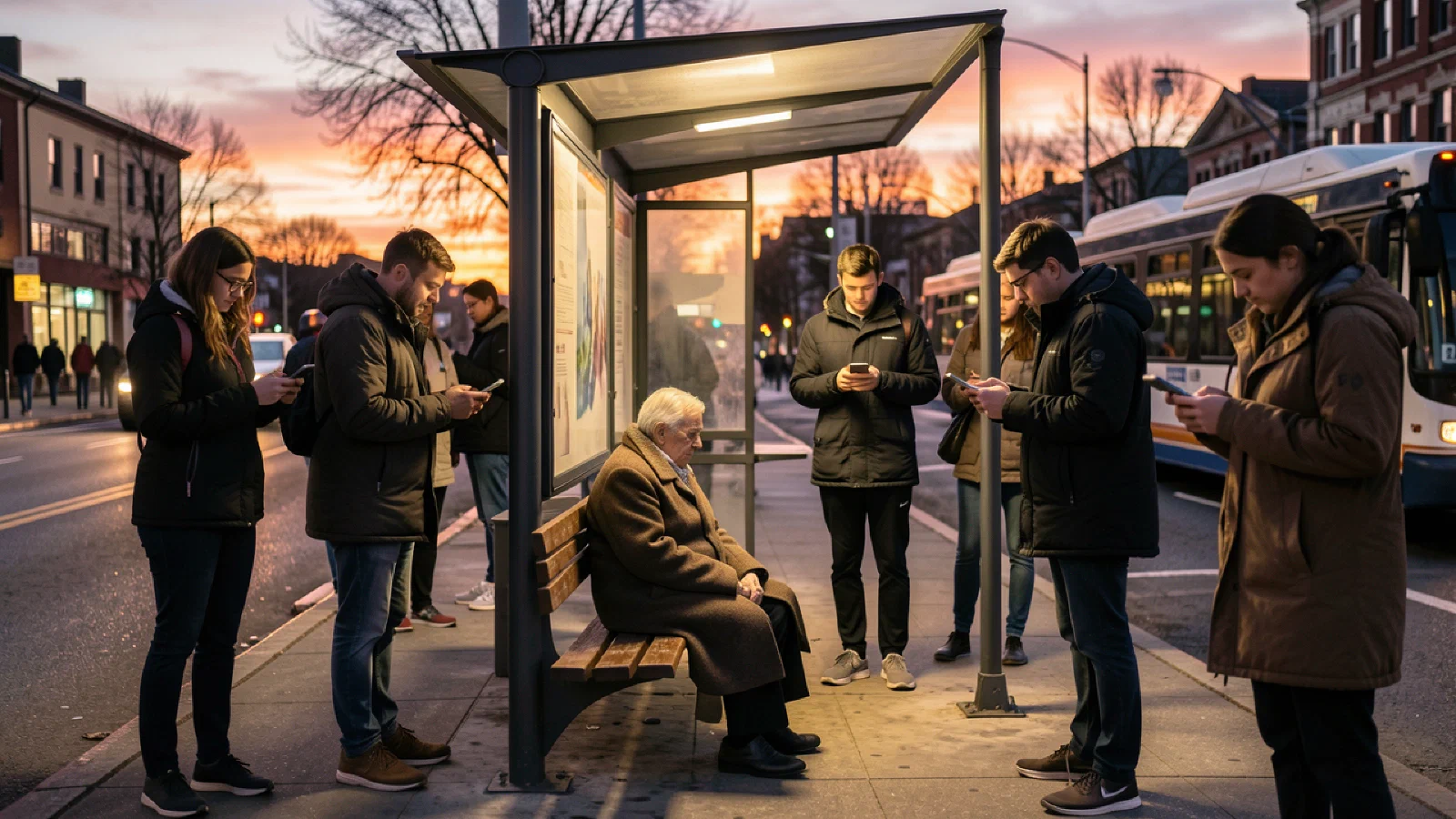
Urban Aging: Invisible in the Crowd
Density, Displacement, and the Paradox of Growing Old in a City
Clarence Webb has lived in the same Harlem apartment since 1971. He moved in the year his daughter was born, back when the building was rent-stabilized and the block had a barber, a bodega, a church that knew his name, and a bakery where the regulars lingered over coffee until noon. He is 81 now. The barber is a juice bar. The bodega is a wine shop. The church closed and became condominiums. The bakery held on until 2019, then surrendered to a lease increase it could not absorb.
Clarence still has his apartment, technically. The rent stabilization protects him. But the building changed hands twice in ten years, and each new owner found ways to make staying uncomfortable: delayed repairs, construction noise, a lobby renovation that removed the bench where he used to rest after climbing the stairs. His neighbors are younger, wealthier, and transient. They nod in the hallway. They do not stop.
He lives in one of the most densely populated places on earth, surrounded by eight million people. He is profoundly alone.
The Urban Paradox#
Cities have everything older adults are supposed to need. Hospitals within miles, not hours. Pharmacies on every block. Public transit. Senior centers. Meals on Wheels. Area Agencies on Aging with budgets and staff. Walk out the front door and the world is there.
And yet urban seniors report rates of loneliness and social isolation comparable to their rural counterparts. The reasons are different, but the outcomes converge. In cities, the barriers are not distance but cost, accessibility, displacement, and the particular cruelty of isolation in a crowd, where there are people everywhere and connection nowhere.
The Urban Institute reported in 2025 that the number of senior households considered severely cost burdened (spending more than half their income on housing) has nearly doubled over two decades, rising from 5.2 million to nearly 11.7 million. Renters are hit hardest at every age, and seniors 75 and older are more likely to be cost burdened than younger seniors. Between 2019 and 2022, the share of older adults experiencing homelessness increased 37 percent. These are not rural statistics. They are overwhelmingly urban ones.
When the Neighborhood Leaves You Behind#
Gentrification research has only recently begun to focus on older adults, and the emerging picture is troubling. A 2025 study in The Gerontologist examined what the authors call “gentrification acceleration press,” the way neighborhood transformation pushes older adults toward displacement or housing insecurity even when they technically remain in place. The pressure is not always an eviction notice. It is a property tax increase that a fixed income cannot absorb. It is the pharmacy that becomes a boutique. It is the senior center that loses its lease. It is the slow erasure of every place and face that made the neighborhood yours.
A five-year ethnographic study of older adults in a gentrified Manhattan neighborhood documented how commercial changes destroyed “third places,” the informal gathering spots (a bakery, a diner, a deli) where older residents built and maintained social connections. When those places closed or were replaced by establishments oriented toward younger, wealthier clientele, the older residents lost not just a coffee shop but a social infrastructure. Proximity, low cost, physical design that welcomed lingering, and a sense of ownership all mattered. The replacement businesses offered none of these.
A 2025 study in the Journal of Racial and Ethnic Health Disparities, using data from the REGARDS cohort, found that gentrification disproportionately affects Black older adults, who report higher fear of displacement and experience more pronounced disruptions to their social and community networks. An NCRC report documented that 523 majority-Black neighborhoods experienced gentrification between 1980 and 2020, with approximately 261,000 fewer Black residents in those neighborhoods, indicating considerable displacement over four decades. The cities most affected include Washington, D.C., New York, Philadelphia, New Orleans, and Atlanta.
The pattern is consistent: gentrification improves the physical infrastructure of a neighborhood while hollowing out the social infrastructure that older, lower-income residents depend on. New streetlights and bike lanes do not compensate for the loss of a congregation, a lunch counter, or a neighbor who checks in.
The Building Itself#
Urban housing stock presents its own challenges. In cities like New York, Boston, Chicago, and Philadelphia, much of the affordable housing where older adults live was built before accessibility standards existed. Walk-up apartments without elevators. Narrow doorways that will not accommodate a wheelchair. Bathtubs without grab bars. Steps at every entrance.
The Urban Institute found that nearly half of large homes rented and owned by seniors were built before 1980 and may require serious renovation. Thirty-four percent of households headed by someone over 50 lack the financial resources to cover median out-of-pocket expenses for home modifications. For renters, that figure rises to 58 percent.
A fall in a fifth-floor walk-up is not just a health event. It is a housing crisis. The person who breaks a hip in a building without an elevator faces a choice: recover elsewhere (if “elsewhere” exists and is affordable) or return to a home they can no longer safely access. Many older urban residents live in a quiet negotiation with buildings that were not designed for the bodies they now have.
Heat, Concrete, and Vulnerability#
Cities are hotter than the surrounding countryside. The urban heat island effect, created by the absorption and re-radiation of heat by asphalt, concrete, and buildings, can raise temperatures 5 to 10 degrees Fahrenheit above nearby rural areas. For older adults, this is not discomfort. It is danger.
Thermoregulation declines with age. Common medications, including diuretics and beta-blockers, further impair the body’s ability to manage heat. Chronic conditions like heart failure and diabetes compound the risk. The UN Environment Programme’s Frontiers 2025 report found that annual heat-related deaths among older adults have risen an estimated 85 percent since the 1990s. A Nature Communications study projected that by 2050, more than 23 percent of the global population aged 69 and older will live in climates where acute heat exposure exceeds the critical threshold, up from 14 percent today.
In New York City alone, an estimated 580 residents die prematurely each summer because of hot weather, most from heat-exacerbated chronic conditions rather than direct heat stroke. Black New Yorkers have an age-adjusted heat-stress death rate twice that of white New Yorkers. Among those who died from direct heat stress, 58 percent were exposed at home, and none of those with available data had a working air conditioner.
The pattern repeats across cities. Maricopa County (Phoenix) confirmed 602 heat-related deaths in 2024. In every jurisdiction that tracks these deaths, the victims are disproportionately older, poorer, and more isolated.
Services That Exist but Cannot Be Reached#
Cities concentrate social services in ways that rural areas cannot match. But concentration does not equal access. An older adult in the Bronx may live three miles from a geriatric specialist, but if the trip requires two bus transfers, a six-block walk from the stop, and climbing subway stairs with a bad knee, three miles might as well be thirty.
Transit systems designed for commuters serve working-age adults moving between residential neighborhoods and employment centers during peak hours. Older adults traveling to medical appointments, senior centers, or grocery stores during off-peak hours, often to locations not on direct routes, find the system less accommodating. Paratransit services exist but are oversubscribed, with wait times and scheduling rigidity that make spontaneous activity impossible.
The result is a paradox: the services are there, the person is there, but the connection between them fails. And when the connection fails often enough, people stop trying. They order delivery instead of going to the store. They skip the appointment instead of fighting the transit system. They stay home instead of going to the senior center. Each small surrender compounds into a larger withdrawal.
What Cities Could Do Differently#
Some cities are trying. New York’s Age-Friendly NYC initiative, launched in 2007, has worked to integrate aging considerations into city planning, transit, and services. Portland, Oregon has age-friendly zoning initiatives. WHO’s Global Network for Age-Friendly Cities now includes dozens of American cities committed to age-inclusive design.
Rent stabilization and tenant protection laws remain the most direct tools for preventing displacement of older residents. Property tax freezes or deferrals for seniors on fixed incomes exist in many jurisdictions but are underused, partly because the people who would benefit most often do not know the programs exist.
Accessibility retrofitting needs public investment. Medicare does not cover home modifications. The gap between what aging bodies need and what aging buildings provide will only widen as the population grows older.
And the commercial displacement problem requires creative policy: community land trusts, commercial rent stabilization, dedicated spaces for senior-serving businesses and organizations. When the bakery closes, it is not just commerce that disappears. It is a place where someone was known.
Surrounded and Alone#
The city promises proximity. It delivers proximity to everything except the things that matter most when you are old: familiarity, continuity, recognition, and a built environment that accommodates the body you have rather than the body you used to have.
Clarence Webb can see a hospital from his window. He can walk to a pharmacy if his knees cooperate. He has a bus stop at the corner and a senior center eight blocks away. On paper, he has access to everything. In practice, his world has contracted to his apartment, a bench in the park when the weather permits, and a phone call from his daughter on Wednesday evenings.
The city did not abandon him. It rearranged itself around him until he no longer fit.
How this article connects to others in Blue Gray Matters.
Sources cited in this article.
- Urban Institute. "America's Housing Market Is Failing Older Adults." Urban Wire, 2 Apr. 2025, www.urban.org/urban-wire/americas-housing-market-failing-older-adults.
- Van Vleet, Samuel, and Kate de Medeiros. "The Gentrification Acceleration Press Schema: A Critical Examination of Gentrification-Induced Displacement in Later Life." The Gerontologist, vol. 65, no. 6, 2025, gnaf107, doi:10.1093/geront/gnaf107.
- Qualitative Sociology. "For a Younger Crowd: Place, Belonging, and Exclusion among Older Adults Facing Neighborhood Change." Qualitative Sociology, 2020, doi:10.1007/s11133-019-09441-z.
- Journal of Racial and Ethnic Health Disparities. "Gentrification and Fear of Displacement: A Quantitative Study of Older Black and White US Adults." 2025, doi:10.1007/s40615-025-02735-9.
- National Community Reinvestment Coalition. "Displaced by Design: Fifty Years of Gentrification and Black Cultural Displacement in US Cities." NCRC, Oct. 2025.
- United Nations Environment Programme. Frontiers 2025. UNEP, 2025.
- Nature Communications. "Global Projections of Heat Exposure of Older Adults." Nature Communications, vol. 15, 2024, doi:10.1038/s41467-024-47197-5.
- New York City Department of Health and Mental Hygiene. "2025 Heat Mortality Report." NYC Environment and Health Data Portal, 2025.