Aging in Poverty
What It Means to Grow Old Without Enough
On the first of every month, Gloria counts her pills.
She is 71 years old. She has prescriptions for five medications: blood pressure, diabetes, cholesterol, an antidepressant, and something for the arthritis in her hands. Her Social Security check is $1,147. Her rent is $785 for a one-bedroom apartment in a building where the elevator breaks twice a month. Her utilities run about $120. That leaves $242 for food, medications, transportation, and everything else.
She can afford to fill three prescriptions. She chooses the blood pressure and the diabetes. The cholesterol she skips every other month. The antidepressant she stopped filling two years ago. The arthritis medication she never fills at all. Her hands ache constantly now. She has learned to open jars by wedging them against the counter and pressing with her forearm.
Gloria worked for thirty-four years: cleaning houses, then working the register at a grocery store, then cleaning houses again when the store closed. She paid into Social Security with every paycheck. This is what she receives in return.
She is not an outlier. She is a statistic, and the statistics are vast.
Who Is Poor#
Approximately 10.3 percent of Americans aged 65 and older live below the federal poverty line, which for a single person stands at roughly $15,000 per year. That translates to about 5.8 million older Americans in poverty. But the federal poverty measure, developed in the 1960s based on food costs, dramatically understates what it costs to live. The Elder Index, developed by researchers at the University of Massachusetts Boston, calculates that a single older adult renting a one-bedroom apartment needs roughly $25,000 to $30,000 annually for basic needs, depending on location. By that measure, approximately 40 percent of older Americans lack economic security.
The demographics of poverty in old age are predictable, because poverty in old age is usually the continuation of a lifetime of disadvantage. Women are poorer than men, particularly women who raised children, interrupted careers for caregiving, or outlived husbands. Black and Hispanic Americans are poorer than white Americans, carrying forward the compounded effects of discrimination in employment, housing, and wealth-building. People who worked in low-wage jobs without pensions or employer retirement plans arrive at 65 with little besides Social Security.
Some people become poor in old age after lives of relative stability. Widowhood can cut household income dramatically while fixed costs remain. A medical crisis can consume savings. Years of caring for a spouse with dementia can drain assets and foreclose any possibility of paid work. The fall into poverty can happen in months.
But for millions, there was never a fall. There was never enough.
What Poverty Looks Like#
Gloria’s Social Security benefit is close to the national average for women, which runs about $400 less per month than the average for men. For workers who spent years in jobs that did not withhold Social Security taxes, or who worked part-time while raising children, benefits can be far lower. Supplemental Security Income, the federal program for aged, blind, and disabled people with minimal income and assets, provides a maximum federal benefit of $943 per month for an individual, well below the poverty line. Many states add small supplements. None make SSI adequate.
Housing consumes most of what poor older Americans have. Among renters 65 and older with incomes below $15,000, the median rent burden exceeds 50 percent of income. This means that after paying for a place to live, less than half of an already inadequate income remains for everything else. Many live in housing that is substandard: mold in the bathroom, mice in the kitchen, heating that fails in January, stairs that become dangerous when joints stiffen. The housing makes them sicker, and being sicker makes everything harder.
Food insecurity affects roughly 7 percent of households headed by someone 65 or older. The rate is higher for Black and Hispanic seniors, for those living alone, and for those in rural areas where food access is limited. What food insecurity looks like: eating less to make food stretch. Buying the cheapest options, which are often the least nutritious. Skipping meals at the end of the month when the SNAP benefits run out. Choosing between the fresh vegetables that the doctor recommends and the canned goods that fit the budget.
Healthcare gaps persist even for those with both Medicare and Medicaid. Transportation to appointments is its own crisis when you do not own a car and the bus route requires three transfers. Copays that seem small to policymakers are not small when there is nothing left at the end of the month. The dental care that Medicare does not cover, the hearing aids that cost thousands, the glasses that need updating: these become luxuries that poverty does not allow.
Every day is triage. Every month is calculation. The math never comes out right.
The Health Consequences#
Poverty is not just uncomfortable. It is deadly.
Chronic disease follows poverty like a shadow. Diabetes is more prevalent and more poorly controlled among low-income seniors, in part because nutrition matters for management and nutritious food costs more. Hypertension runs higher and is treated less consistently when medication competes with rent. Heart disease, respiratory illness, arthritis, and depression all cluster in populations with fewer resources, worse living conditions, and less access to care.
The life expectancy gap between rich and poor in America is staggering. Research by economists Raj Chetty and colleagues found that men in the top 1 percent of income live about 15 years longer than men in the bottom 1 percent. For women, the gap is approximately 10 years. These are not small differences. They are the difference between meeting grandchildren and not meeting them, between a retirement and none.
Dental health illustrates the cascade. Medicare does not cover routine dental care. Medicaid dental coverage for adults varies by state and is often limited. Among low-income seniors, untreated tooth decay and gum disease are common. What begins as a cavity becomes an abscess. An abscess becomes an extraction. Extractions accumulate until eating becomes difficult. Difficulty eating leads to malnutrition. Malnutrition accelerates every other condition. The mouth, visible when someone smiles, becomes a marker of class. Many stop smiling.
Mental health suffers in poverty. Depression rates among low-income older adults run roughly twice the rate of their affluent peers. The isolation of poverty, the shame of it, the daily grind of not having enough, all contribute. Treatment is often inaccessible. The antidepressant Gloria stopped filling was not making her less depressed. But she could not afford it and food.
Housing Instability#
Gloria’s $785 rent is low by national standards. In many cities, she could not find a one-bedroom apartment for twice that. For poor older Americans, housing is the constant crisis: too expensive, too unstable, too dangerous.
Public housing and Section 8 vouchers offer subsidized options, but the waitlists stretch for years. In major metropolitan areas, a senior applying for Section 202 housing (HUD’s senior-specific program) may wait three to five years or longer. In the meantime, they pay market rent from poverty wages, or they double up with family, or they end up in housing that accelerates their decline.
Homelessness among older adults is rising faster than among any other age group. The fastest-growing demographic in shelters is people over 50. These are not people who have been homeless for decades. Many are newly homeless in their sixties or seventies, pushed out by rent increases, evictions, medical costs, or the death of a spouse. The shelter system was not designed for aging bodies. The cots are hard to get into. The stairs are dangerous. The stress makes everything worse.
For those who have housing, instability haunts every month. A rent increase of $100 is a catastrophe when there is no margin. An eviction notice can come from a late payment during a hospitalization. The fear of losing housing, of ending up in a shelter or on the street, is a constant pressure that shapes every decision.
The Invisibility#
Poor older Americans are largely invisible in American public life. They do not appear in retirement advertisements. They are not the silver-haired couples walking beaches in pharmaceutical commercials. They do not have lobbyists. They do not fund campaigns. They struggle quietly, often ashamed.
The shame compounds the poverty. Gloria does not tell her church friends that she skips medications. She does not tell her daughter how often she eats cereal for dinner. She minimizes, deflects, insists she is fine. Poverty in old age, in a culture that treats wealth as a measure of worth, feels like failure. Never mind that she worked her entire adult life. Never mind that she played by the rules. The rules did not include enough for her.
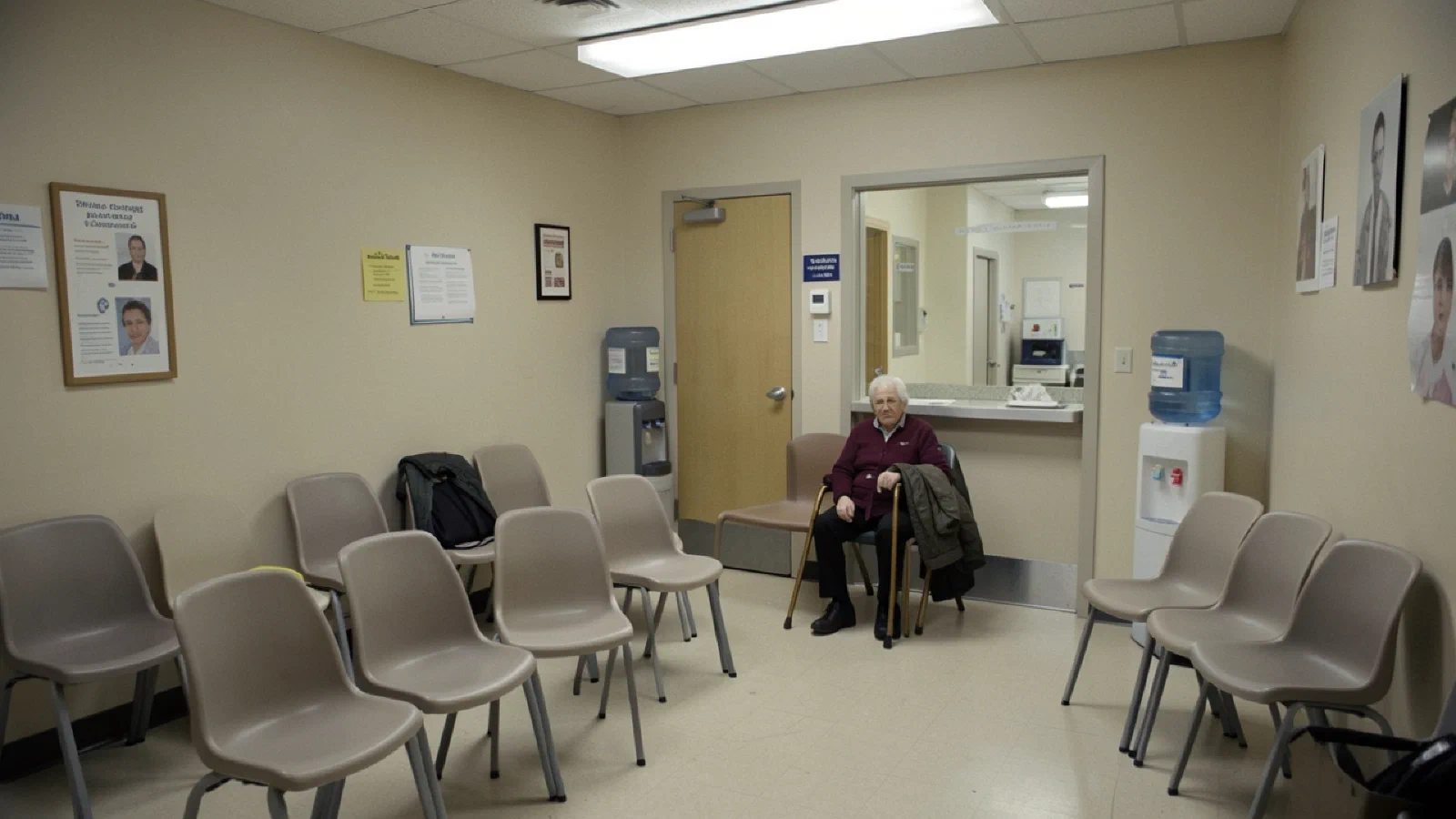
Where are they? Not in the retirement communities or active adult centers that dominate media representations of aging. They are in single-room-occupancy hotels. In the back bedrooms of adult children’s crowded apartments. In neighborhoods that no one with options would choose. They are in the waiting rooms of free clinics, in the lines at food pantries, in the pews of churches that offer meals after services. They are everywhere, and they are nowhere.
What Would Help#
The policy solutions are not mysteries. They are choices we have declined to make.
Social Security could be expanded. The minimum benefit could be raised so that no one who worked a lifetime receives less than a living income. The cost-of-living adjustment could be calculated using an index that reflects what seniors actually buy, including healthcare, instead of the general consumer index that understates their inflation. The earnings cap could be lifted so that high earners contribute proportionally. These changes would cost money. The question is whether we think people who worked their whole lives deserve to grow old in poverty.
Housing investment could be increased. The waitlists for Section 202 and Section 8 are policy choices, not natural phenomena. Building more subsidized senior housing and funding more vouchers would reduce them. Preserving existing affordable housing, rather than allowing conversion to market rate, would prevent displacement. Expanding tenant protections would provide stability.
Medicare could cover dental, vision, and hearing care. The exclusion of these services was a choice made in 1965, when Medicare was enacted. It could be unmade. The cost would be substantial. The cost of not doing it is measured in pain, malnutrition, isolation, and early death.
SNAP benefits could be raised, and enrollment could be simplified. Many eligible seniors do not receive SNAP because the enrollment process is confusing, stigmatizing, or inaccessible. Making benefits adequate and enrollment automatic would reduce food insecurity.
None of these solutions is exotic. All are expensive. All require a decision that poverty in old age is unacceptable, followed by the political will to act on that decision.
What We Owe#
Gloria did not make bad choices. She made the choices available to her. She cleaned other people’s houses so that her children could have opportunities she did not have. She worked until her body could not work anymore. She paid into a system that promised to care for her when she could no longer care for herself.
This is what the system gives her: a one-bedroom apartment with a broken elevator, three of five medications, and canned vegetables. This is what she gets for a lifetime of labor.
Poverty in old age is not a mystery. We know who is poor. We know why. We know what would help. We know the cost of helping and the cost of not helping. The woman counting her pills on the first of the month is not a stranger. She is a neighbor, a member of the congregation, someone’s mother. She exists in large numbers, and she exists specifically, one person at a time, making impossible choices every day.
The question is not whether we can afford to do better. The question is whether we believe she deserves better. The answer to that question is not technical. It is moral.
How this article connects to others in Blue Gray Matters.
Sources cited in this article.
- Chetty, Raj, et al. "The Association Between Income and Life Expectancy in the United States, 2001-2014." *JAMA*, vol. 315, no. 16, 2016, pp. 1750-1766.
- Coleman-Jensen, Alisha, et al. "Household Food Security in the United States in 2022." *USDA Economic Research Service*, 2023.
- Cubanski, Juliette, et al. "How Many Seniors Live in Poverty?" Kaiser Family Foundation, 2024.
- Joint Center for Housing Studies of Harvard University. *Housing America's Older Adults 2023*. Harvard University, 2023.
- Mutchler, Jan E., et al. "The Elder Index: A Standardized Measure of Minimum Income Required to Meet Basic Needs." *Gerontologist*, vol. 55, no. 6, 2015, pp. 1021-1033.
- National Alliance to End Homelessness. "State of Homelessness: 2023 Edition." NAEH, 2023.
- Social Security Administration. "Annual Statistical Supplement to the Social Security Bulletin, 2023." SSA, 2023.
- U.S. Census Bureau. "Income and Poverty in the United States: 2022." Census.gov, 2023.
- U.S. Department of Health and Human Services. "HHS Poverty Guidelines for 2024." ASPE, 2024.
- Wu, Bei, et al. "Oral Health Among Low-Income and Minority Older Adults." *Journal of Dental Research*, vol. 96, no. 5, 2017, pp. 507-514.