Two Hip Fractures
The Same Injury in Two Different Americas
They fell on the same Tuesday morning in February.
Helen, 74, tripped on the oriental rug in the marble foyer of her Scottsdale home. She landed hard, her hip twisting beneath her. The pain was immediate and total. Her husband found her within seconds and called 911. The ambulance arrived in eight minutes.
Delores, 74, caught her foot on the cracked linoleum of her South Phoenix apartment. She had been reaching for a coffee mug on a high shelf. She fell the same way, landed the same way, felt the same white-hot bolt through her hip. She was alone. It took her forty minutes to crawl to her phone. The ambulance arrived in twenty-two minutes after that.
Same county. Same age. Same bone. Same break. A femoral neck fracture, the most common hip fracture among older adults, requiring surgical repair and weeks of recovery. Everything that happens next is different.
The Hospital#
Helen was taken to a top-rated hospital near her home. The emergency department was busy but not overcrowded. She received pain management within thirty minutes of arrival. An orthopedic surgeon who specializes in hip fractures reviewed her imaging that afternoon. By 8 PM, less than twelve hours after she fell, Helen was in surgery.
That timing matters. Research published in JAMA Internal Medicine shows that mortality risk increases measurably for each day surgery is delayed beyond the first 24 hours. Surgical delay beyond 48 hours is associated with roughly a 5% increase in the chance of dying within 30 days. The gold standard is surgery within 24 hours. Helen met it easily.
Delores was taken to the county hospital. The emergency department was packed. She waited three hours for imaging, another two for pain management that brought relief. The orthopedic surgeon on call was handling four other fracture cases. Delores was stable, not emergent. Surgery was scheduled for two days later.
The prosthesis Helen received was the latest model, selected by her surgeon based on her activity level and bone density. The prosthesis Delores received was adequate, standard issue, what the hospital stocked. Both will function. But the one in Helen’s hip was chosen for her. The one in Delores’s hip was chosen for the budget.
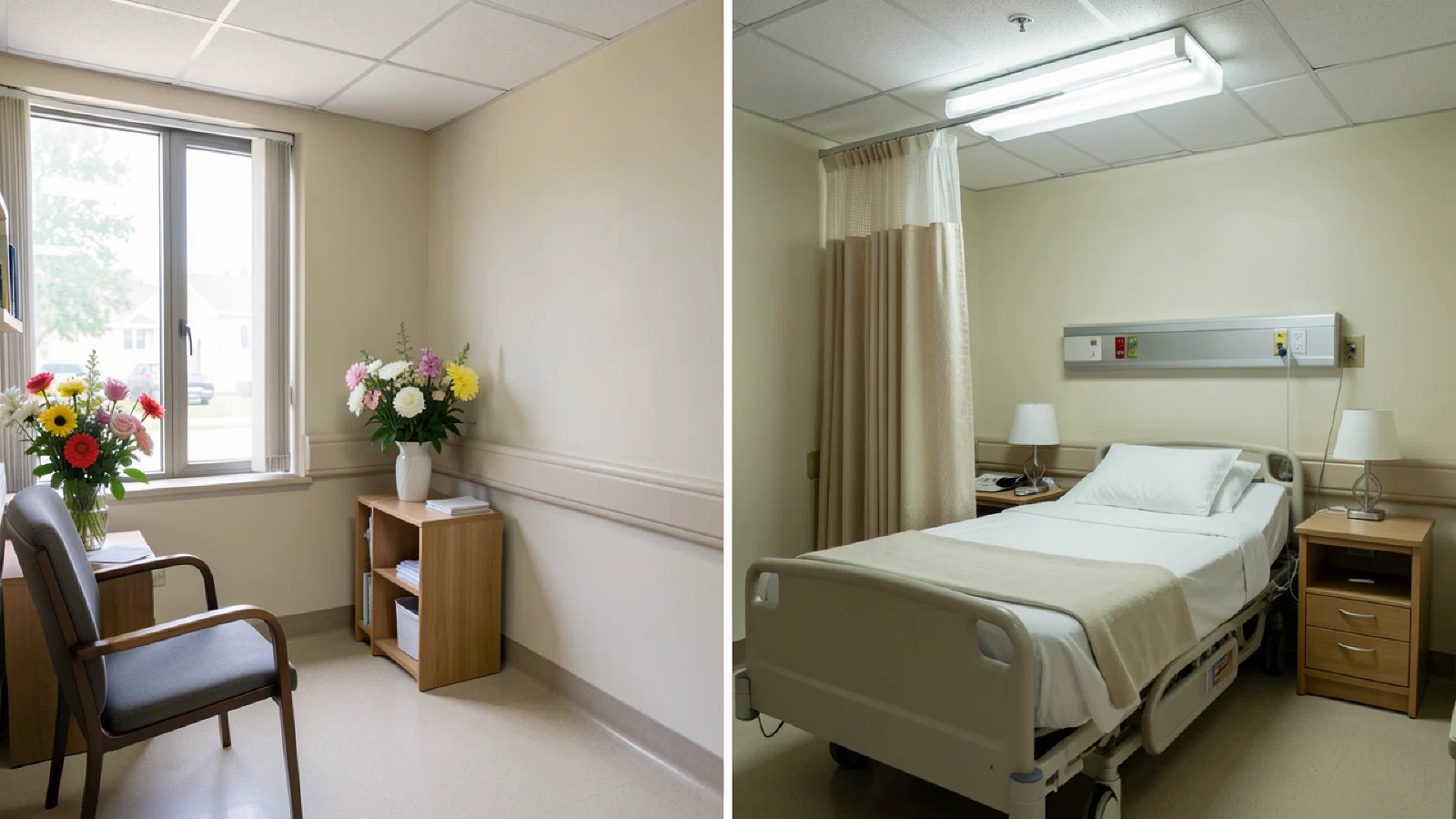
Helen recovered in a private room with a view of the courtyard. Delores shared a room with another patient whose family visited loudly and often. Neither woman slept well. But Helen could close a door.
The Rehabilitation#
Three days after surgery, Helen was transferred to a rehabilitation facility that looks more like a boutique hotel than a medical center. Private room, daily physical therapy, daily occupational therapy, a therapy pool, and meals designed by a nutritionist. Her insurance covered it. Her family supplemented it. After three weeks, she went home.
That transition was careful. Her daughter, who lives twenty minutes away, took a week off work. A home health agency sent a physical therapist three times weekly for a month. For the first two weeks, a private aide stayed overnight, just in case. Helen’s husband learned to help her with transfers, with bathing, with the small indignities of recovery. They hired a service to bring meals.
Delores was transferred to the skilled nursing facility that had a bed. The room was shared. Physical therapy happened three times per week, the Medicare minimum for skilled nursing coverage. The therapists were competent and stretched thin, managing caseloads that didn’t allow for the sustained attention Delores needed. After fourteen days, Medicare’s skilled nursing benefit required that she show continued improvement to stay. Her progress was slow. She was discharged.
Delores returned to her apartment alone. Her son lives in California. He called every few days. A home health aide came twice weekly for two weeks, the maximum her coverage would support. After that, she was on her own. A walker. A shower chair. A refrigerator that needed filling. Stairs to the laundry room she could not safely use.
The First Six Months#
By June, Helen was walking her neighborhood again. Not as far as before, not as fast. But walking. The physical therapist had pushed her hard and she had responded. Her surgeon scheduled a follow-up at three months and pronounced the recovery excellent. She bought new walking shoes. She and her husband took a short trip to San Diego.
By June, Delores could walk to the mailbox if she was careful. The rehabilitation she didn’t receive in those critical early weeks had become the rehabilitation she now couldn’t recover. Her gait was unsteady. She had developed a fear of falling that the research literature calls “post-fall syndrome,” a common and often permanent consequence of inadequate recovery support. She stopped going out alone. She stopped going out much at all.
Her son flew in for a weekend. He was alarmed at what he found. She was thinner. The apartment was messier than he’d ever seen it. She was afraid, and the fear had shrunk her world to the distance between her bed and her chair. He called a few home care agencies, recoiled at the prices, and flew home promising to figure something out.
The Numbers Underneath#
What happened to Helen and Delores was not random, not a matter of luck, not a mystery. It was money.
The median cost of three weeks in a quality rehabilitation facility runs between $15,000 and $25,000 out of pocket for what insurance doesn’t cover. The median cost of two weeks of 24-hour home care runs roughly $6,500. The median cost of a home health aide for a month runs about $5,500. Add the surgeon’s fee differential, the private room, the better prosthesis, the meals, the convenience, and Helen’s hip fracture probably cost $40,000 more than Delores’s. It bought her a different future.
Delores had Medicare. She had the coverage that’s supposed to be the floor, the guarantee, the thing that keeps medical catastrophe from becoming financial catastrophe. And Medicare worked as designed. It paid for the hospital. It paid for the surgery. It paid for the minimum rehabilitation. It paid for two weeks of limited home health. And then it ended, right at the moment when the difference between full recovery and permanent disability was still being decided.
The class gap in hip fracture outcomes is measurable. Research published in the Journal of Bone and Joint Surgery shows that patients with lower socioeconomic status have significantly higher rates of complications, readmissions, and mortality after hip fracture than affluent patients with the same injury. The difference isn’t in the bone or the break. It’s in everything that happens after.
What the Data Cannot Show#
The numbers describe the mechanics. They don’t describe what it feels like to be Delores at 3 AM, awake and afraid, knowing that if she falls again there will be no one to hear her.
They don’t describe the particular cruelty of having done nothing wrong. Delores worked for forty years as a hotel housekeeper. She raised a son alone. She saved what she could, which was never enough. She paid into Medicare her entire working life. And now she sits in an apartment she can barely move around, in a body that might have healed if the system had allowed it, watching the world she built contract to the size of her fear.
Helen also did nothing wrong. She married a man who built a successful business. She raised two children. She saved, planned, bought good insurance, and maintained a body that stayed strong into her seventies. When she fell, the system she had paid into delivered exactly what she needed.
The difference is not virtue. The difference is not effort. The difference is money, which in America operates as a kind of health insurance that works independently of actual health insurance. Money buys time with surgeons. Money buys better prosthetics. Money buys the rehabilitation that determines whether a hip fracture is a temporary setback or the beginning of a decline.
The Same Break#
Two women fell on the same Tuesday. Both broke the same bone in the same way. Both entered a healthcare system that is, on paper, supposed to treat them equally. Both are now living with the results.
Helen will probably forget her hip fracture within a year or two. It will become the story she tells at parties, the time she tripped on that stupid rug, remember that? She will walk and garden and travel. The scar will fade. The prosthesis will hold. Life will continue.
Delores will not forget. She cannot forget, because she lives inside the consequences every hour of every day. The walker by her bed. The shower chair she’s afraid to use. The stairs she no longer attempts. The world that stopped at the edges of her apartment the day she came home from that skilled nursing facility, alone, to recover on her own.
The system didn’t fail. This is what it was designed to do. It provides a floor. It does not provide recovery. For that, you need money. And whether you have it or not when the bone breaks is not a matter of how you fell. It’s a matter of how you lived, which in America is a matter of class.
Two hip fractures. One county. Two different lives from here on out.
How this article connects to others in Blue Gray Matters.
Sources cited in this article.
- Berry, Sara D., et al. "Association of Clinical Outcomes With Surgical Repair of Hip Fracture vs Nonsurgical Management in Nursing Home Residents With Advanced Dementia." *JAMA Internal Medicine*, vol. 178, no. 6, 2018, pp. 774-780.
- Brauer, Carl A., et al. "Incidence and Mortality of Hip Fractures in the United States." *JAMA*, vol. 302, no. 14, 2009, pp. 1573-1579.
- Genworth Financial. *Cost of Care Survey 2023*. Genworth, 2023.
- Groff, Hilary, et al. "Socioeconomic Factors and Outcomes Following Hip Fracture." *Journal of Bone and Joint Surgery*, vol. 102, no. 15, 2020, pp. 1281-1288.
- Kaiser Family Foundation. "Medicare Beneficiaries' Out-of-Pocket Health Care Spending as a Share of Income." KFF, 2024.
- Moran, Christopher G., et al. "Early Mortality After Hip Fracture: Is Delay Before Surgery Important?" *Journal of Bone and Joint Surgery*, vol. 87, no. 3, 2005, pp. 483-489.
- Siu, Albert L., et al. "Early Ambulation After Hip Fracture: Effects on Function and Mortality." *Archives of Internal Medicine*, vol. 166, no. 7, 2006, pp. 766-771.