Familismo and Its Weight
Hispanic Families, Care, and the Expectations We Carry
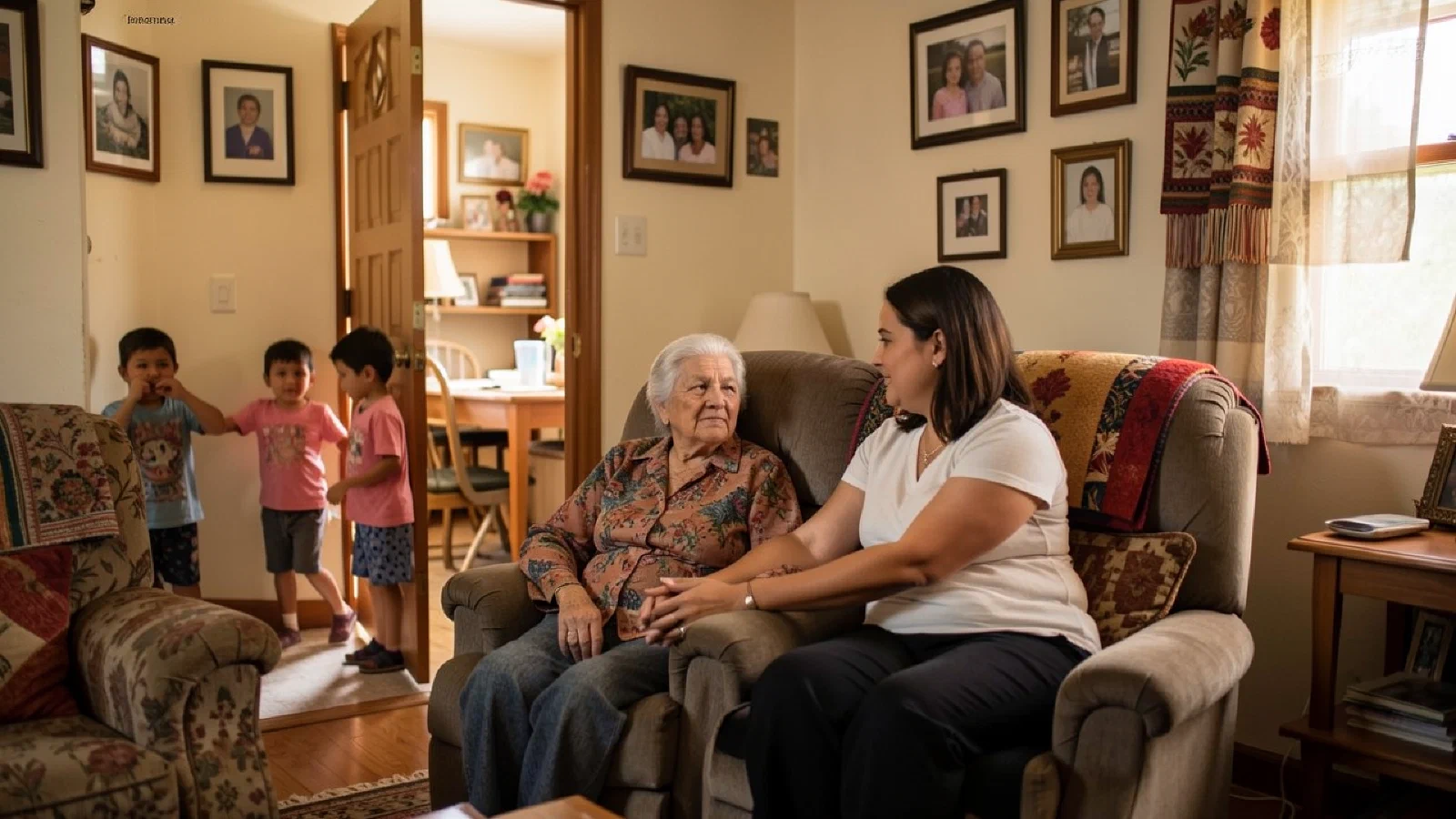
Rosa Delgado has not had a full night’s sleep in four years. She wakes at 5:30 to get her mother ready before her own shift at the hospital laundry starts at seven. She packs her mother’s pills in a weekly organizer, prepares meals that can be reheated, and arranges for her teenage daughter to check in after school. By the time Rosa gets home at four, her mother needs help with the bathroom, with dinner, with the anxiety that swells as evening approaches. By the time her mother is settled for the night, Rosa has perhaps two hours before she needs to sleep so she can do it all again.
Her mother, Carmen, is 79 and has vascular dementia. She came to San Antonio from Mexico forty years ago, worked in restaurants and cleaning houses, never had the papers that would have meant Social Security or Medicare. When Rosa takes her to the community health clinic, she translates every word. When the dementia stole Carmen’s English, Rosa became her mother’s only bridge to the world.
Rosa does not consider placing her mother in a nursing home. The thought does not cross her mind as a real option. Her mother cared for her grandmother until the end. Her grandmother cared for her great-grandmother. This is what family does. This is familismo: the cultural value that places family at the center of everything, that makes obligation and loyalty not just expected but defining.
Familismo is one of the most studied concepts in research on Hispanic and Latino families. The term describes an orientation toward family that privileges collective needs over individual ones, emphasizes reciprocity across generations, and maintains close ties even across geographic distance. It shapes everything from living arrangements to healthcare decisions to how crises are managed. In many Hispanic households, adult children live with or near aging parents. Nursing home placement is often seen as abandonment. Care is provided at home, by family, for as long as humanly possible.
This is both strength and weight. The strength is real: elders embedded in family networks are less isolated, more connected, more likely to have someone who notices when something is wrong. Research consistently shows that social connection protects health. Hispanic elders who live with family often fare better than their peers who live alone. The family provides what formal systems often cannot: continuity, knowledge of who the person was before illness, care delivered with love.
But the weight is also real, and it falls unevenly. In most families, the primary caregiver is a daughter. Sometimes a daughter-in-law. Rarely a son. The women who provide care often reduce their work hours or leave the workforce entirely. They sacrifice their own health, their own retirement security, their own futures. The cultural expectation that they will provide this care is so strong that asking for help can feel like failure, like betraying the values that give life meaning.
And the care itself can be overwhelming. Dementia care, in particular, demands constant vigilance. The person you love becomes unpredictable, sometimes unrecognizable. The work is physically exhausting and emotionally devastating. When Rosa describes her days, she speaks of fatigue so deep it feels like a fog, of grief for the mother who is still alive but somehow already gone, of resentment she feels guilty for feeling.
For families navigating immigration status, the weight multiplies. Rosa’s mother is one of approximately 400,000 undocumented immigrants in the United States over the age of 65. These elders have no Medicare; they are not eligible. Most have no Social Security unless they worked with a valid Social Security number, which many did not. Medicaid covers emergency care only. Routine management of chronic conditions happens through community health centers, charity care, or not at all.
The fear of deportation compounds every other stress. Undocumented elders may avoid medical care because they are afraid that any contact with government systems could result in removal. Mixed-status families, where children are citizens but parents are not, navigate impossible calculations: applying for benefits for the children might draw attention to the parents. The shadows stretch over everything.
For those who arrived legally, barriers remain. Under current law, legal permanent residents cannot access Medicaid or most federal benefits for five years after receiving their green card. Adult children who sponsor their parents sign affidavits of support, promising to provide for them financially. This means that elderly parents who arrive legally may spend years entirely dependent on their children, unable to work, unable to access services, waiting out a clock.
Language adds another layer. Approximately one quarter of Hispanic adults over 65 have limited English proficiency. In medical settings, this means consent forms signed without full understanding, medication instructions that do not make sense, diagnoses delivered through children or inadequate interpreters. When Rosa’s mother sees the doctor, Rosa must translate not just words but context, history, culture. She must convey symptoms her mother cannot articulate and explain treatments her mother cannot comprehend.
Using family members as interpreters is common but problematic. Adult children may lack the medical vocabulary to translate accurately. They may soften bad news to protect a parent or exaggerate symptoms because they are frightened. The emotional burden of delivering a diagnosis of cancer or dementia through your own child is one that medical ethics has barely begun to address. Professional interpreters are required by law in healthcare settings, but they are not always available, not always competent, and not always used.
Within all of this, there is the cultural dimension that researchers have called the “Hispanic health paradox.” Despite significant socioeconomic disadvantage, Hispanic Americans have life expectancy similar to or exceeding that of white Americans. Some researchers attribute this to the “healthy migrant effect” (the people who migrate tend to be healthier than those who stay), others to cultural factors including diet, family support, and lower rates of smoking. But the paradox is not uniform. U.S.-born Hispanic Americans have worse health outcomes than immigrants, suggesting that acculturation may erode whatever protective factors exist. And the paradox does not mean that Hispanic elders do not need support. They do.
What would help? Immigration reform that creates pathways for long-term undocumented residents would allow elders like Carmen to access the benefits their years of work should have earned. Eliminating or shortening the five-year bar for legal permanent residents would reduce the dependency period. Expanding interpreter services and investing in a bilingual healthcare workforce would address the communication gaps that compromise care.
But there is also a subtler need: recognizing that family care is valuable without expecting families to carry everything. Policy that supports family caregivers through respite services, paid leave, and financial assistance honors the cultural value of familismo without exploiting it. Policy that expands home-based services allows elders to remain with family without requiring family members to sacrifice their own lives entirely.
Rosa Delgado does not ask why she does what she does. The answer is so obvious to her that the question makes no sense. Her mother cared for her. Now she cares for her mother. This is what love looks like. This is what family means.
But love should not require destruction. The fact that Rosa has not seen a doctor herself in three years, that her own blood pressure is uncontrolled, that she cries in the shower because there is nowhere else to cry: these are not badges of devotion. They are signs of a system that expects women to absorb what it refuses to provide.
Familismo is a gift. It keeps elders connected, valued, held. It provides something that no institution can manufacture: the care of people who knew you before you were sick. It also extracts a price, mostly from women, mostly in silence. The weight is carried because the alternative feels unthinkable. But it should not have to be this heavy.
How this article connects to others in Blue Gray Matters.
Sources cited in this article.
- Sabogal, Fabio, et al. "Hispanic Familism and Acculturation: What Changes and What Doesn't?" Hispanic Journal of Behavioral Sciences, vol. 9, no. 4, Dec. 1987, pp. 397-412.
- Mayeda, Elizabeth Rose, et al. "Inequalities in Dementia Incidence Between Six Racial and Ethnic Groups Over 14 Years." Alzheimer's & Dementia, vol. 12, no. 3, Mar. 2016, pp. 216-224.
- Migration Policy Institute. "Profile of the Unauthorized Population: United States." MPI Data Hub, 2024.
- Markides, Kyriakos S., and Karl Eschbach. "Aging, Migration, and Mortality: Current Status of Research on the Hispanic Paradox." Journals of Gerontology: Series B, vol. 60, no. spec. issue 2, Oct. 2005, pp. S68-S75.
- Ruiz, John M., et al. "Hispanic Mortality Paradox: A Systematic Review and Meta-Analysis of the Longitudinal Literature." American Journal of Public Health, vol. 103, no. 3, Mar. 2013, e52-e60.
- Karliner, Leah S., et al. "Do Professional Interpreters Improve Clinical Care for Patients with Limited English Proficiency? A Systematic Review of the Literature." Health Services Research, vol. 42, no. 2, Apr. 2007, pp. 727-754.
- Ku, Leighton, and Sheetal Matani. "Left Out: Immigrants' Access to Health Care and Insurance." Health Affairs, vol. 20, no. 1, Jan.-Feb. 2001, pp. 247-256.
- Vega, William A., et al. "The Latino Paradox in Late Life: Selected Topics and Future Directions." Annual Review of Public Health, vol. 30, 2009, pp. 153-167.
- U.S. Citizenship and Immigration Services. "Affidavit of Support Under Section 213A of the INA." USCIS, 2024.