The Model Minority Grows Old
Beyond the Myth of Asian American Success
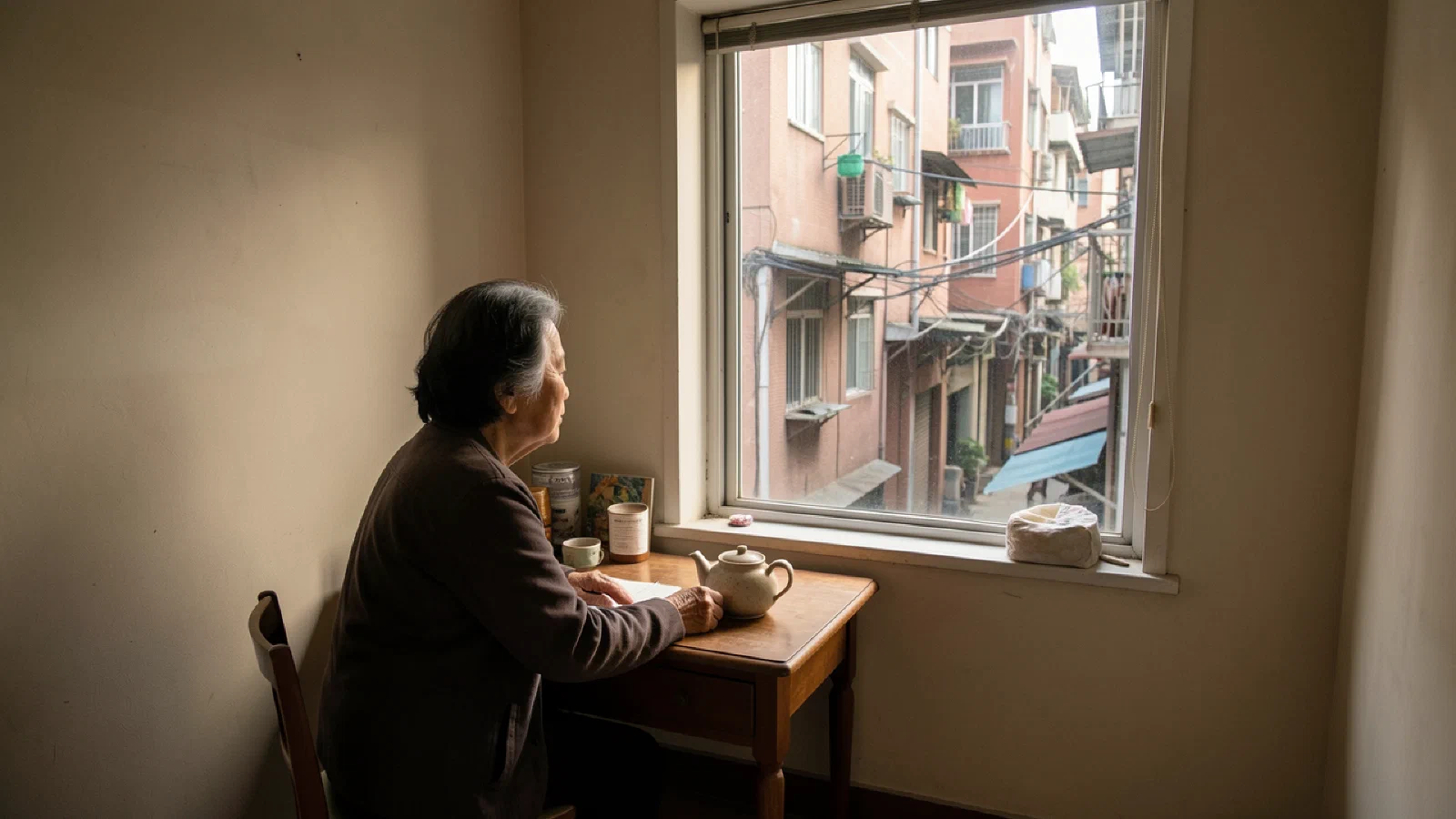
Mrs. Nguyen has not left her apartment in San Jose for three weeks. She is 79 years old, a former seamstress who arrived from Vietnam in 1980 with nothing but her children and whatever she could carry. Her daughter works double shifts as a home health aide for other people’s parents. Her son lives in Texas. Her husband died eight years ago. The television plays Vietnamese programs on a loop, the same voices filling the silence day after day.
Sometimes Mrs. Nguyen has chest pain. She does not mention it. The words would come out in Vietnamese, and she is not sure her daughter could find the time to take her to a doctor who would not understand her anyway. She does not want to be a burden. She has been taking care of herself since before her children were born. She can manage this too. So she waits, alone, for the pain to pass or not pass.
When researchers and policymakers talk about Asian Americans, they often invoke a story of success. High educational attainment. High incomes. Low crime rates. The “model minority” myth suggests that Asian Americans have figured out something that other minority groups have not, that they have succeeded through hard work and cultural values that emphasize achievement. The implication, never stated but always present, is that if other groups are struggling, it must be their own fault.
The myth is a lie, and the lie does particular damage to Asian American elders.
The first problem is aggregation. The category “Asian American and Pacific Islander” contains multitudes: Chinese, Filipino, Indian, Vietnamese, Korean, Japanese, Pakistani, Cambodian, Hmong, Laotian, Native Hawaiian, Samoan, and dozens of other distinct populations. These groups have vastly different histories, immigration pathways, socioeconomic profiles, and health patterns. Averaging them together produces a statistical artifact that describes no one.
When data is disaggregated, the picture changes dramatically. Indian Americans, many of whom arrived through employment-based immigration pathways that selected for education and professional skills, have among the highest household incomes in the country. Southeast Asian refugees who arrived after the Vietnam War with nothing, often from rural backgrounds with little formal education, have some of the highest poverty rates of any population. Pacific Islanders face health disparities that rival or exceed those of other marginalized groups. Hmong elders may have never learned to read in any language. The “model minority” is an average that flattens all of this into invisibility.
For elderly Asian Americans, the consequences are concrete. Those who arrived as refugees in the 1970s and 1980s are now reaching their seventies and eighties. Many never achieved the economic success the stereotype suggests. They worked in garment factories, restaurants, nail salons, and small businesses. Their English is limited. Their savings are sparse. They depend on adult children who are themselves often struggling to make ends meet in expensive metropolitan areas.
The poverty is hidden because the stereotype makes it shameful. If Asian Americans are supposed to succeed, then being poor is a failure not just of circumstances but of character. The elderly Vietnamese woman living in a one-bedroom apartment with her son’s family, sleeping in the living room, too proud to apply for assistance she might not qualify for anyway: she does not fit the narrative. So she is not seen.
Language barriers compound the isolation. Significant proportions of elderly Asian Americans have limited English proficiency. Among Vietnamese, Korean, and Chinese elderly immigrants, the majority may be more comfortable in their native language. This affects everything: navigating the healthcare system, understanding medication instructions, communicating with social service agencies, even calling 911 in an emergency. Professional interpretation is required by law in medical settings, but interpreters for languages like Hmong, Khmer, or Tagalog are scarce. Family members end up translating, with all the complications that entails: lack of medical vocabulary, emotional burden of delivering bad news, children becoming parents to their parents in the most intimate moments of vulnerability.
Mental health stigma adds another layer of silence. In many Asian cultures, mental illness carries profound stigma. Depression and anxiety are sources of shame, not conditions to be treated. Admitting to emotional struggles is seen as bringing dishonor to the family. The result is that rates of mental health treatment among Asian Americans are lower than other groups, not because the need is lower but because the barriers to help-seeking are higher.
For elderly Asian Americans, the stakes are acute. They may have lost status through immigration, becoming dependent on children in a culture that valued their authority. They may be isolated, unable to communicate with the world around them, watching their grandchildren grow up speaking a language they do not share. Depression is common. Treatment is rare. Suicide rates among elderly Asian American women exceed those of their peers in other racial groups.
The cultural expectation of filial piety shapes both the support that elders receive and the silence they maintain. In Confucian tradition, adult children are expected to care for aging parents. This expectation provides real support: many Asian American elders live with family and receive care that isolated elders do not. But it also creates pressure not to burden children, not to complain, not to need more than what is offered. Elders may hide symptoms, minimize pain, and refuse help because accepting it would mean admitting that the family cannot provide.
Placing a parent in a nursing home is often viewed as abandonment. Families provide care beyond their capacity because the alternative feels morally unacceptable. This can be beautiful: elders remaining in homes where they are loved and known. It can also be devastating: caregivers burning out, elders not receiving the skilled care they need, families collapsing under weight they were never meant to carry alone.
What would help? Disaggregating data so that the specific needs of different populations become visible. Targeting services to communities that need them: senior centers in appropriate languages, outreach workers who understand cultural context, mental health services that address stigma. Immigration policy that shortens waiting periods and reduces the dependency that makes elderly immigrants so vulnerable. And something harder to measure: dismantling a stereotype that makes suffering invisible and poverty shameful.
Mrs. Nguyen is still in her apartment. The chest pain comes and goes. Her daughter calls every night after work, exhausted, asking if she needs anything. She says no. She always says no. There is nothing her daughter can do that she is not already doing. There is no help that does not require admitting that help is needed.
The model minority myth does not just obscure poverty. It makes poverty shameful. It does not just ignore elders who struggle. It makes their struggle invisible. The Asian American elder who is isolated, depressed, and silent is not a failure of the model. The model was always a lie. Seeing clearly requires looking behind the stereotype, disaggregating the numbers, and listening to the languages that the statistics do not hear.
How this article connects to others in Blue Gray Matters.
Sources cited in this article.
- Budiman, Abby, and Neil G. Ruiz. "Key Facts About Asian Americans, a Diverse and Growing Population." Pew Research Center, 29 Apr. 2021.
- Asian American Federation. "Asian American Seniors in Need: A Profile." AAF, 2021.
- Yi, Stella S., et al. "Disaggregating Asian American and Native Hawaiian and Other Pacific Islander Health Data: A Conceptual Framework." American Journal of Public Health, vol. 112, no. 5, May 2022, pp. 683-688.
- Centers for Disease Control and Prevention. "Suicide Among Asian American/Pacific Islander Populations." Web-Based Injury Statistics Query and Reporting System, 2023.
- Sue, Stanley, et al. "Asian American Mental Health: A Call to Action." American Psychologist, vol. 67, no. 7, Oct. 2012, pp. 532-544.
- Mui, Ada C., et al. "Linguistic Pluralism and Mental Health Among Older Asian Immigrants in the United States." Journal of Cross-Cultural Gerontology, vol. 22, no. 1, Mar. 2007, pp. 11-26.
- Kim, Bryan S. K., et al. "Cultural Values and Asian Americans' Help-Seeking Attitudes." Counseling Psychologist, vol. 35, no. 4, July 2007, pp. 535-562.
- Lai, Daniel W. L., and Shireen Surood. "Predictors of Depression in Aging South Asian Canadians." Journal of Cross-Cultural Gerontology, vol. 23, no. 1, Mar. 2008, pp. 57-75.
- Wu, Bei, et al. "Asian American Older Adults: Diversity and Inequality." Journals of Gerontology: Series B, vol. 76, no. 7, Aug. 2021, pp. 1466-1475.